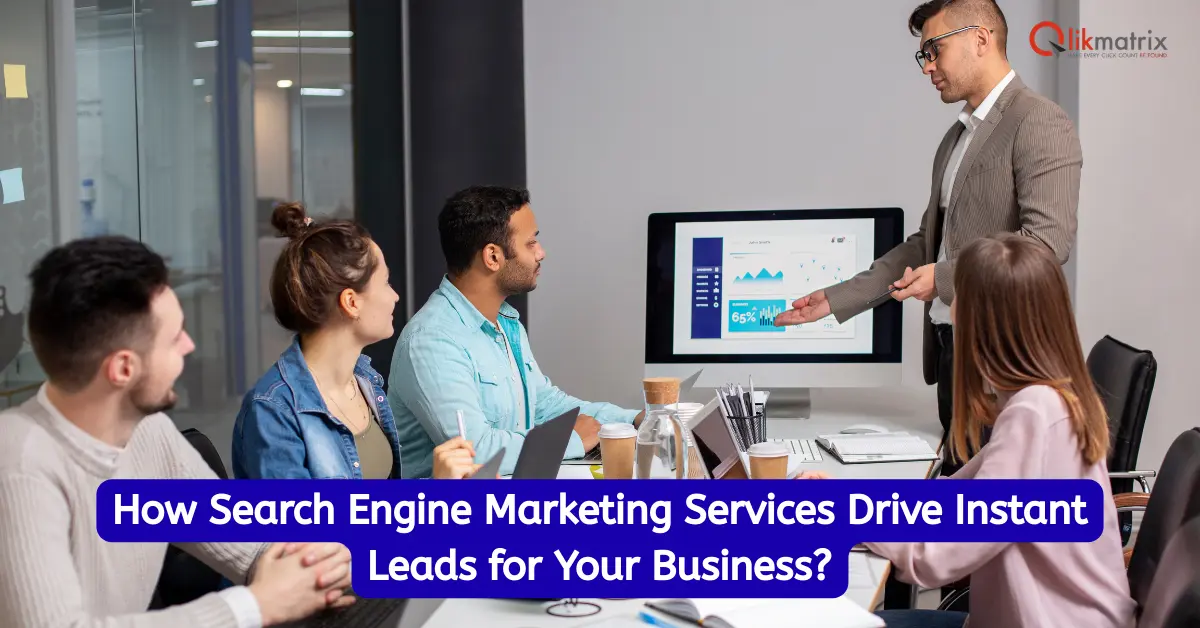
How Search Engine Marketing Services Drive Instant Leads for Your Business

Search Engine Marketing Services Drive Instant Leads

Every business wants fast results. You want leads that come in today, not months later. This is where search engine marketing services make a big impact. They help your brand appear right when people search for something you offer. This means your business reaches users with real buying intent, and that too instantly.

Before we explore how SEM works, let’s understand why it has become such an important part of modern marketing.

Why SEM Generates Leads at a Faster Rate Than Most of the Channels?

The majority of marketing approaches are time consuming. SEO, social media, and content marketing are excellent, but they do not develop fast.

SEM is different. It places your business at the top of the search results through paid ads. So the moment a user searches, your ad appears. This creates an instant connection between demand and solution. And when users already know what they want, conversions happen faster.

Now that we know why SEM is fast, let’s move into how it drives these quick leads in real-time.

1. Targeting Users with High Buying Intent

SEM targets people at the moment they need something. When someone types “buy laptop,” they are already close to making a decision.

Search engine marketing services use this intent. They show your ads exactly when the user wants your product or service. This timing boosts the chances of leads coming in right away.

And when intent is strong, the quality of leads also improves. With intent covered, the next step is precision targeting, which makes campaigns even more powerful.

2. Reaching the Right Audience with Precision

SEM allows you to choose your audience based on multiple factors:

  • Location
  • Keywords
  • Age
  • Interests
  • Devices
  • Behaviour

This ensures your money is spent only on people who match your ideal customer. When your ad reaches the correct user, conversion speed increases. This level of precision is one reason why SEM is trusted for lead generation. Now that audience targeting is clear, the next important factor is keyword strategy.

3. Using Smart Keyword Planning

Keywords are the heart of SEM. They decide when and where your ads appear.

Strong SEM campaigns focus on:

  • Commercial keywords
  • High-intent keywords
  • Local keywords
  • Competitor keywords

When keywords match what the customer is thinking, leads come quickly. Good keyword planning also helps reduce irrelevant clicks. Once keywords are set, the next part that boosts instant leads is ad quality.

4. Creating Ads That Push Users to Act Fast

Good ads are clear, simple, and direct. They highlight your value and give customers a reason to click.

Key elements include:

  • Strong headline
  • Clear offer
  • Simple benefits
  • Urgency triggers
  • Easy call-to-action

When users see an ad that solves their problem, they act immediately. As ad quality increases, landing pages become the final step in driving instant leads.

5. Landing Pages Built for Fast Conversions

A strong landing page turns visitors into leads quickly. It must be clean, fast, and focused.

Good landing pages include:

  • Short forms
  • Real customer proof
  • Clear benefits
  • Trust signals

When users feel confident and comfortable, they convert within seconds. This is why SEM and landing pages work together so well. Before moving to advanced strategies, it’s important to discuss local reach since many businesses rely on geography.

6. Boosting Local Leads with Local Targeting

Local search results bring high-intent users near you. This helps businesses like clinics, restaurants, training centers, real estate, home services, and retail stores. Local search engine marketing services help create ads that appear to customers in specific areas.

Local targeting pushes instant calls, map visits, and store visits. As local leads increase, advanced optimisation becomes the next key driver of faster results.

7. Using Analytics to Improve Lead Quality

SEM campaigns generate a lot of data. This data helps you understand what users click, what they ignore, and what creates conversions.

With this information, marketers adjust:

  • Keywords
  • Ad text
  • Bids
  • Locations
  • Devices

This constant improvement makes each campaign sharper. And sharper campaigns bring faster, better-quality leads. When optimisation gets complex, many businesses take expert support, which leads us to consulting services.

8. Getting Expert Guidance for Better Performance

Sometimes you need professional help. This is where search engine marketing consulting services make a difference.

Experts study your business goals, check your existing campaigns, and guide you on:

  • Keyword selection
  • Budget planning
  • Audience targeting
  • Ad copywriting
  • Landing page fixes

Good consulting ensures your money works smarter. And smart spending leads to instant, meaningful results. Now let’s explore how working with an SEM partner offers even more advantages.

9. Support from a Professional SEM Partner

A trusted SEM services provider​ brings experience, tools, and industry knowledge. They manage campaigns daily, track performance, fix issues, and improve results.

With a partner handling SEM, you save time and avoid mistakes. The campaigns run smoother, and leads come in consistently. Businesses that want a complete end-to-end solution often work with a full SEM firm.

10. The Role of a Search Engine Marketing Company

A full-service search engine marketing company handles everything from planning to optimization.

They manage:

  • Keyword research
  • Market analysis
  • Ad creation
  • Landing page setup
  • Conversion tracking
  • A/B testing

This ensures every part of the campaign works together. When all elements align, lead flow becomes faster and more predictable. Now that we have covered the process, let’s break down what truly makes SEM unique.

Why SEM Brings Instant Leads – Final Breakdown?

Here’s what makes SEM fast:

  • Users already want the product
  • Ads appear at the perfect moment
  • Targeting is precise
  • Landing pages remove friction
  • Optimisation improves results daily

These elements create a strong system that brings high-intent leads quickly and consistently. With all these pieces working together, SEM becomes one of the most dependable ways to get fast business growth.

Conclusion

Immediate leads are attained by satisfying the customer at the appropriate time. It is achievable with the help of search engine marketing services through which your brand is linked to already-willing users. The right strategy, effective targeting, and properly created advertisements can provide your business with a continuous stream of lead on a daily basis with the help of SEM.

In case you need customers who are already on the hunt for what you sell, SEM is one of the quickest and most sure methods of expanding business.
Q1. What is the most expensive online advertising mistake?

Ans. Audience targeting gone wrong, by a distance. A bad keyword wastes only the clicks it generates. Targeting the wrong people means every rupee goes to someone who was never going to buy. It doesn’t stop on its own. It runs until someone actually digs into who’s clicking and finds none of them were real prospects.

Q2. How often should campaigns be reviewed?

Ans. Every week for the first month without exception. After that, every two weeks at a minimum. The search terms report, audience performance breakdown, and creative fatigue all shift faster than a monthly review schedule can catch.

Q3. Does ad copy really change conversion rates that much?

Ans. The difference between two ads targeting the same audience with the same budget but different copy is regularly 200 to 400 percent in conversion rate. Copy is not a secondary consideration. It’s often the primary one.

Q4. How do I know if my conversion tracking is actually working?

Ans. Do a test conversion yourself. Check if it fires in real time inside your platform’s event manager. Then compare the conversion numbers from your ad platform against actual sales in your CRM every week. Consistent gaps between those two numbers mean something is broken in the tracking chain.

Related Blogs

Some of the most expensive online advertising mistakes are sitting inside campaigns that look completely normal on the surface. Impressions coming in. Clicks happening. Budget spending cleanly. And underneath all of it, money going to the wrong people, for the wrong searches, tracked incorrectly, with copy that never had a chance.

Table of Contents

If you work with search engine marketing services or manage paid ads internally, this is where to look first.

1. Poor Audience Targeting

This mistake means paying for every click from people who were never going to buy. It doesn’t stay small. It scales with the budget.

A fitness brand running ads to everyone aged 18 to 65 interested in health is not targeting an audience. That’s broadcasting. Pull actual customer data. Who bought before? What age, location, device? Which pages did they visit before converting? Build lookalikes from real buyers on Meta, not from guesses about who might be interested. For B2B, LinkedIn’s job title and company size filters exist for a reason. Use them with behavioral data layered on top, not instead of it.

On Google, match types matter more in 2026 than most advertisers realise. Broad match without a solid negative keyword list shows ads for searches that have nothing to do with what you sell. Audience settings are not a one-time setup job. Review them every 30 days.

2. Wrong Keyword Selection

This is why campaigns look good in the dashboard and produce nothing in the bank account. Impressions up. Clicks up. Conversions flat.

Someone typing “how does retargeting work” is doing research. Someone typing “retargeting agency for ecommerce” is ready to talk to someone. Both live inside the same industry. Only one has buying intent. Bidding on both with the same budget treats research traffic like purchase traffic, and that’s where money disappears.

Good online advertising mistakes analysis starts with knowing which six areas drain the most money and in what order to fix them. Keyword intent is the first filter. Get it wrong here and everything downstream, the bids, the budget, the reporting, runs on bad inputs.

Negative keywords need to be built before the campaign launches, not discovered in the first week’s search terms report. “Free,” “DIY,” “how to,” and competitor names where you don’t want comparison traffic are the starting point, not the full list. Check the search terms report every week for the first month. What you think you’re targeting and what you’re actually showing for are different lists more often than not.

3. Lack of Conversion Tracking

No tracking means no real data. Every budget decision after that is a guess dressed up as a strategy.

The problem isn’t that advertisers skip tracking. It’s that they set it up wrong and never check whether it’s working. Page view is tracked instead of form submission. Most accounts have the tag firing on page load, not on actual form submission. Every false fire sits in your data as a real conversion, and you optimise against it without knowing. iOS 14 broke attribution in 2021 and most ad accounts still haven’t fixed it, which means Google Ads, Meta pixel, and GA4 are all showing different numbers, and none of them are complete.

Cross-reference them weekly against actual CRM data or backend sales numbers. If the numbers don’t match consistently, something in the tracking chain broke somewhere and you’re optimising campaigns based on wrong information.

4. Low Quality Ad Copy

This is what turns a perfectly targeted campaign into a money pit.

The pattern is almost always the same. The headline leads with the brand name. The body copy lists features. The language is vague. “High quality.” “Trusted.” “Industry-leading.” None of it means anything to someone who doesn’t already know you. And the person seeing your ad doesn’t know you yet.

In search, the headline has to match the intent behind the keyword. Someone searching for accounting software for a small business wants to see that reflected back, specifically, not a tagline that could apply to any software company on earth.

On social, the first two seconds are everything. A hook naming a specific problem the audience actually has, or a claim that catches them off guard, gets the read. A logo and a brand slogan does not. Run three different creative angles per ad set at a minimum. Pull the one that works and scale it. Replace the ones that don’t before they drain the budget.

FAQs

Q1. What is the most expensive online advertising mistake?

Ans. Audience targeting gone wrong, by a distance. A bad keyword wastes only the clicks it generates. Targeting the wrong people means every rupee goes to someone who was never going to buy. It doesn’t stop on its own. It runs until someone actually digs into who’s clicking and finds none of them were real prospects.

Q2. How often should campaigns be reviewed?

Ans. Every week for the first month without exception. After that, every two weeks at a minimum. The search terms report, audience performance breakdown, and creative fatigue all shift faster than a monthly review schedule can catch.

Q3. Does ad copy really change conversion rates that much?

Ans. The difference between two ads targeting the same audience with the same budget but different copy is regularly 200 to 400 percent in conversion rate. Copy is not a secondary consideration. It’s often the primary one.

Q4. How do I know if my conversion tracking is actually working?

Ans. Do a test conversion yourself. Check if it fires in real time inside your platform’s event manager. Then compare the conversion numbers from your ad platform against actual sales in your CRM every week. Consistent gaps between those two numbers mean something is broken in the tracking chain.

Request A Proposal

Our team will connect back with you within 24 hours.

Get In Touch