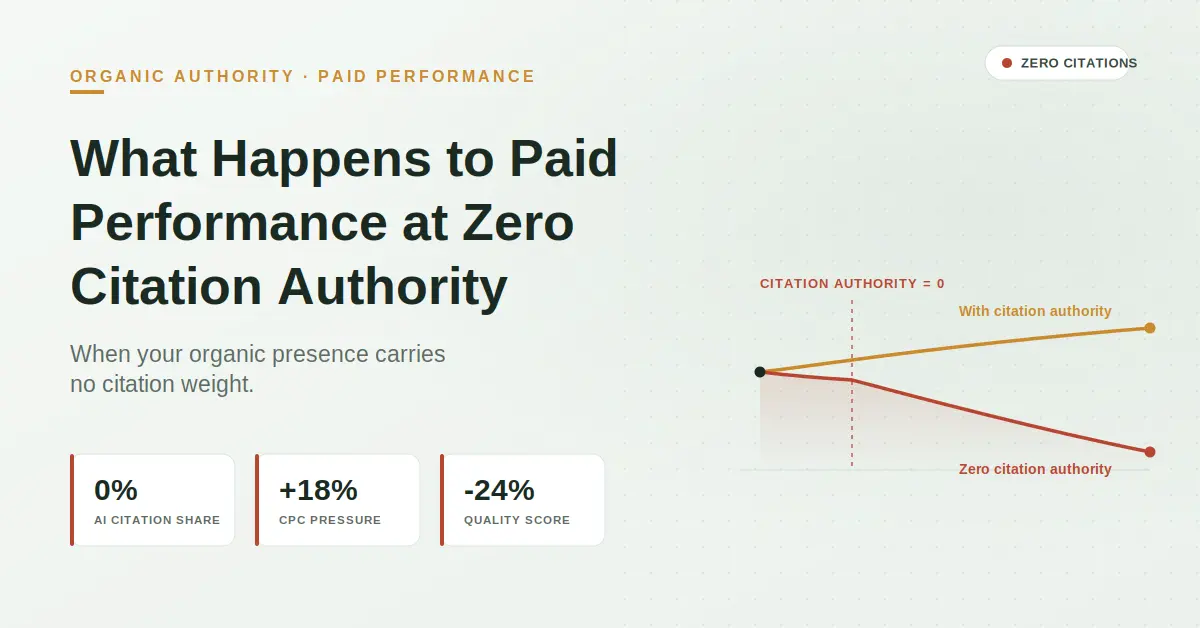
Organic click share used to be the king, holding anywhere from 60 to 95 percent of all clicks at the start of 2025. By January 2026, that grip loosened, dropping to 50 to 84 percent. The traffic didn’t disappear. Brands just started paying for it instead. It found a new home in paid, and yes, brands are the ones picking up the cost. Then another number started showing up. Brands getting cited in AI Overviews are seeing 91 percent more paid clicks than those left out in the cold on the same searches. So, when we talk about organic citation authority and paid search performance in 2026, it’s not just some SEO metric to tick off. It’s a real, tangible cost issue for paid media.
We first noticed it in accounts where paid efficiency was slipping for reasons with no clear culprit. CPCs were creeping up, conversions were steady, but somehow, the cost to acquire each customer kept inching higher. It wasn’t the targeting. The creative was doing its job. The bidding strategy hadn’t gone rogue. Everything inside the campaigns looked fine on paper.
What had changed was the search environment around those accounts. AI Overviews now reach 1.5 billion users monthly across more than 200 countries, and on queries where they appear, organic CTR fell 61 percent while paid CTR dropped 68 percent. The brands being cited weren’t seeing the same level of decline. Everyone else was paying more for fewer clicks in a shrinking pool of available traffic.
The paid problem had an organic root. And nobody was looking at it from that angle.
Are You Paying to Buy Back Traffic That Used to Come for Free
Classic organic results captured 60 to 95 percent of clicks in January 2025, depending on vertical. By January 2026, that range had compressed to 50 to 84 percent, with paid results capturing 19 to 36 percent depending on category.
That shift did not happen because paid campaigns suddenly got better. It happened because the organic click pool shrank and paid absorbed the displaced volume. Text ads gained 7 to 13 percentage points across every major vertical in twelve months, not through improved performance but through structural redistribution.
Average Google Ads CPC rose to $5.26 in 2025, up 12.9 percent year over year, with 87 percent of industries seeing increases. Software and technology CPCs jumped 41 percent. Fewer clicks at higher prices, with the deficit coming directly out of what used to be free organic traffic. If a brand has zero organic citation authority, every query it shows up on in paid is a query it is paying for that a cited competitor may be getting more efficiently on both channels at the same time.
What Being Cited Actually Does to Your Paid Costs and Why It Is Not Just an SEO Win
When a brand is cited in an AI Overview, it earns 35 percent more organic clicks and 91 percent more paid clicks compared to when it is not cited at all. On the exact same SERP, for the exact same query, with the exact same ad running.
The 91 percent paid lift is the number that reframes the conversation. Organic citation is not producing a paid benefit because the ad changed. It is producing it because a user who sees a brand mentioned inside the AI response and then sees that brand’s ad is clicking at nearly double the rate of a user who only sees the ad. The citation is doing trust work before the ad ever appears. A brand without citation authority is entering the same auction without that advantage. The CPC might be the same, but the trust isn’t.
What Happens to Non-Cited Brands in the Same Auction
Organic searches that surfaced an AI Overview where the brand was not cited saw CTR declines of 67 percent across 2025. Not a rounding error. Not temporary volatility. A sustained, consistent compression across an entire year of data.
Only 12 percent of URLs cited by AI platforms rank in Google’s traditional top ten for the same queries. Which means ranking well is not a reliable substitute for citation authority, and the brands spending heavily on paid to compensate for organic performance are doing so in an environment where their uncited status is actively depressing the return on that spend.
“For performance marketing agencies, this creates a dependency that most clients don’t see coming — your paid campaigns now perform better when your organic content is being cited in AI Overviews on the same queries. A brand with zero citation authority is paying a premium CPC to appear next to a competitor that Google’s AI has already editorially validated. That’s not a paid media problem. It’s a content infrastructure problem that bleeds directly into your ad costs.”
— Vishal Singh, Performance Marketing Specialist
Where AI Overviews Are Appearing Most and Why Paid Teams Should Care
Seer Interactive’s data shows AI Overviews have the highest presence on comparison, question, and price-oriented searches. These are the searches where most paid teams already spend serious money. These are the mid-funnel queries where paid teams spend the most budget, the ones with commercial intent, the ones closest to a conversion decision.
A brand with zero organic citation authority on comparison and price-oriented queries is running paid ads on the searches most likely to surface an AI Overview, competing against brands that are already editorially present inside the AI response, and paying a CPC premium that reflects a trust gap the auction cannot close on its own. The AI Overviews impact on paid CPC and brand visibility is highest precisely where the paid budget is most concentrated.
Content That Earns Citations vs Content That Just Ranks
After looking through enough pages that consistently earn AI Overview citations, the pattern becomes fairly obvious. They answer the question immediately, structure information so Google can lift it easily, back up claims with real numbers, and most importantly, sound like they were written by someone who’s actually done the work instead of researched it.
Content that ranks but does not get cited is usually topically relevant and technically sound. The information is there. The structure does not make it easy to extract, the claims are generic enough to apply to anyone, and there is nothing specific enough to quote. It performs in traditional search. It disappears in AI-driven search, and it takes paid performance with it on every query where an AI Overview appears.
Schema markup has been shown to produce 89 percent more featured snippet appearances and three times more AI Overview mentions in controlled tests. Content optimised for answer engines earns 3.5 times more citations and ranks for two to three times more traditional keywords than generic content on the same topics. At this point, I don’t think citation optimisation sits outside SEO anymore. It’s quickly becoming part of what good SEO actually looks like.
Why the Quality of AI-Referred Traffic Changes the Economics Completely
AI-referred visitors convert at 4.4 times the rate of traditional organic visitors. That number changes the cost-per-acquisition math significantly for any brand that earns citations. A smaller volume of AI-referred traffic generating 4.4 times the conversion rate against a much lower effective acquisition cost than paid creates a compounding advantage that non-cited brands are paying to compete against without knowing it.
This is why I don’t think AI Overviews are just changing SEO. They’re changing how efficiently paid search works as well. The brands building citation authority are giving their paid campaigns a head start before the auction even begins.
What We Hear When This Comes Up With Clients
Q1. Why would organic citation authority affect paid performance if they are separate channels?
Ans. Because people don’t separate paid and organic the way marketers do. If someone sees your brand inside an AI Overview and notices your ad two seconds later, those two experiences blend together. The citation functions as editorial validation that changes how the ad is received. The paid result looks more credible because the organic presence already established trust on the same page.
Q2. Does this mean increasing organic content spend instead of paid?
Ans. Not instead of. The data shows the combination is what produces the compounding advantage. A brand cited in AI Overviews earns 91 percent more paid clicks than an uncited brand running ads on the same queries. Organic citation authority multiplies paid performance. The two channels are more interdependent than most paid-first strategies account for.
Q3. Which industries are most affected by AI Overview presence?
Ans. AI Overview coverage in healthcare runs at 88 percent, B2B technology at 82 percent, and education at 83 percent, all up dramatically year over year. Any industry where informational and comparison searches are common is experiencing high AI Overview rates. This is true for most industries in 2026.
Q4. What is the fastest way to start building citation authority?
Ans. Audit which queries your paid campaigns are spending the most budget on. Check AI Overview presence on those queries. For any query where an Overview appears, and your brand is not cited, that is where the content investment needs to go first, starting with structured, answer-first content that addresses the specific question behind the query with verifiable, first-person specificity.
Written by Vishal Singh, Performance Marketing Specialist
I work across paid and organic search strategy for agencies and direct clients. The relationship between organic citation authority and paid performance is something we track in live accounts, not something we read about in isolation from the channels it affects.
For more on how we build content and SEO strategies that improve visibility and paid performance together, visit our search engine optimization services.