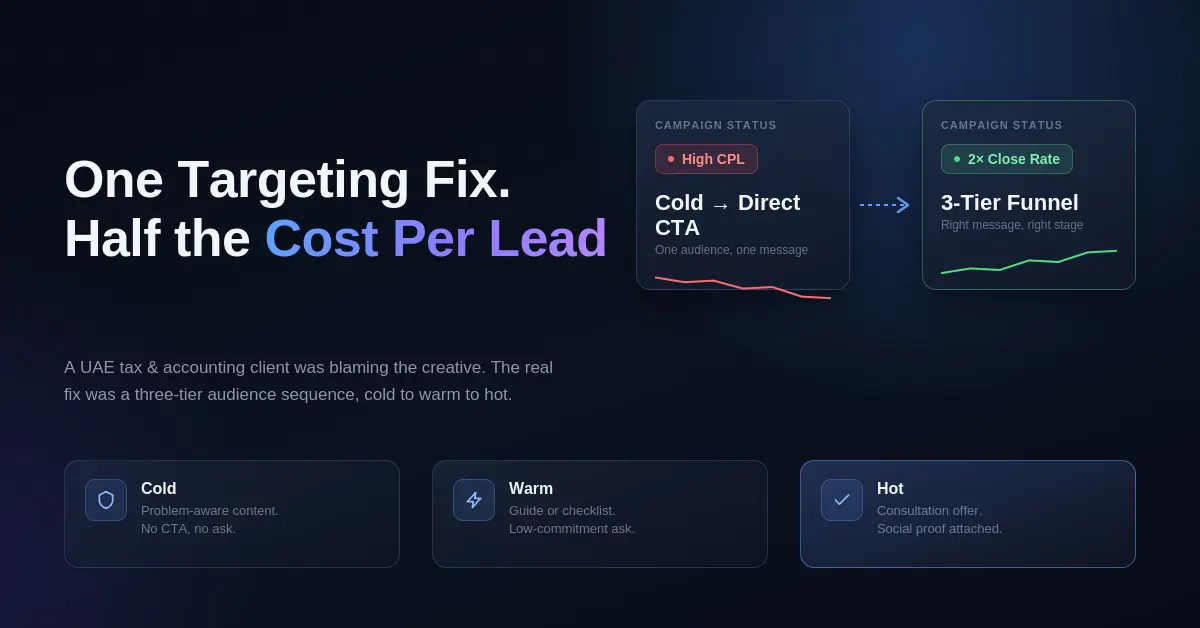
Whenever cost-per-lead starts creeping up on a Meta campaign, everyone blames the creative. But what if, just for once, we looked at the targeting instead? That’s exactly what we did for a UAE tax and accounting client who was basically hemorrhaging money on leads. One simple fix in how we sequenced the audiences (yes, just that) slashed the CPL and doubled the close rate. No fancy new ads. No extra budget. Just a better way of moving people through the funnel.
The client came to us convinced the creative was the problem. The leads were expensive, the ones that did come in were not converting, and every conversation internally had circled back to the same diagnosis, the ads were not compelling enough.
We have seen this before. When CPL climbs on a professional services account, and the instinct is to fix the creative, it is almost always because the creative is the most visible thing in the room. It is easier to talk about copy and visuals than it is to have the conversation about whether the campaign is asking the right people the right question at the right moment.
Once we looked past the creative, the real issue became obvious.
What Was the Targeting Actually Doing Wrong
The campaigns were running bottom-funnel CTAs, things like “Get a Free Tax Consultation” and “Speak to an Accountant Today,” directly to cold audiences who had never heard of the brand and had no particular reason to trust it.
Think about it from the buyer’s perspective, think about how a UAE business owner making a financial services decision actually behaves. They do not see a Meta ad on a Tuesday afternoon and immediately hand over their company’s tax situation to a firm they have never encountered. That is not how high-trust B2B decisions work, especially in a market where professional services relationships are built on reputation and referral. Asking a cold audience to make that jump on first contact is not a targeting mistake exactly. It is a sequencing mistake. And sequencing mistakes look like poor creative performance because the metric that suffers is the conversion, not the click.
To reduce CPL in UAE accounting services specifically, this distinction matters more than in most categories, because the consideration cycle is longer and the trust requirement is higher.
What Advantage+ Was Quietly Doing to the Audience
Audience sequencing wasn’t the only issue. Once we dug into the delivery data, another pattern started showing up.
Advantage+ had been running on the campaigns and doing what Advantage+ does when it is optimising for lead volume without tight constraints: expanding. The intended audience was finance decision-makers, CFOs, and senior accountants in SMEs across the UAE. What the delivery data showed was that a significant portion of impressions had drifted toward general business owners, entrepreneurs, and early-stage founders, people who might theoretically need accounting services someday but were nowhere near the ICP the client was actually trying to reach.
Nobody had flagged it because the volume looked fine on paper. The quality of what was coming through told a different story.
How the Three-Tier Fix Actually Worked
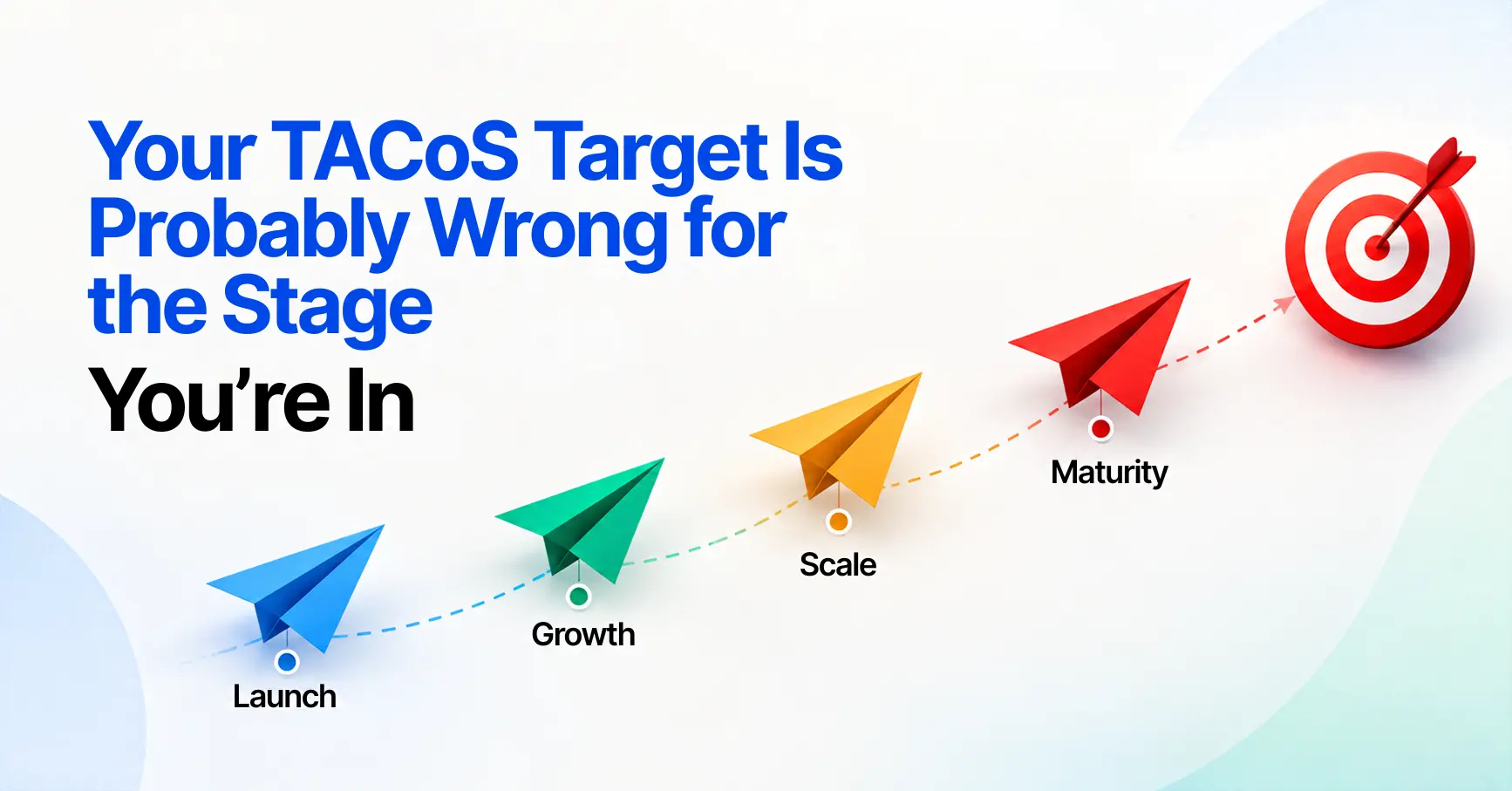
We restructured the targeting into three audience tiers and built different messaging for each one.
Cold audiences, people with no prior brand contact, got problem-aware content. Not a CTA, not a consultation offer, just content that spoke to the specific tax and compliance pressures a UAE business owner faces. Corporate tax registration deadlines. VAT audit preparation. Payroll compliance timelines. Content that gave people a reason to pay attention before asking them to book a consultation.
Warm audiences, people who had engaged with the page, watched videos, or visited the website, got educational content with a softer CTA. A guide download, a checklist, something with low commitment that moved the relationship forward without asking them to book a call yet.
Hot audiences, retargeting pools, and lookalikes from actual converted leads got the direct consultation offer with social proof attached. Testimonials, client results, trust signals. The bottom-funnel CTA that had been running to cold audiences from the start.
“We’ve seen this pattern across every UAE professional services account we’ve run — the client blames the creative, the agency blames the market, and nobody looks at the fact that the campaign is asking cold audiences to make a high-trust financial decision on first contact. The targeting wasn’t wrong. The sequencing was.”
— Vishal Singh, Performance Marketing Specialist
What the Lead Form Change Did to Volume and Why That Was Fine
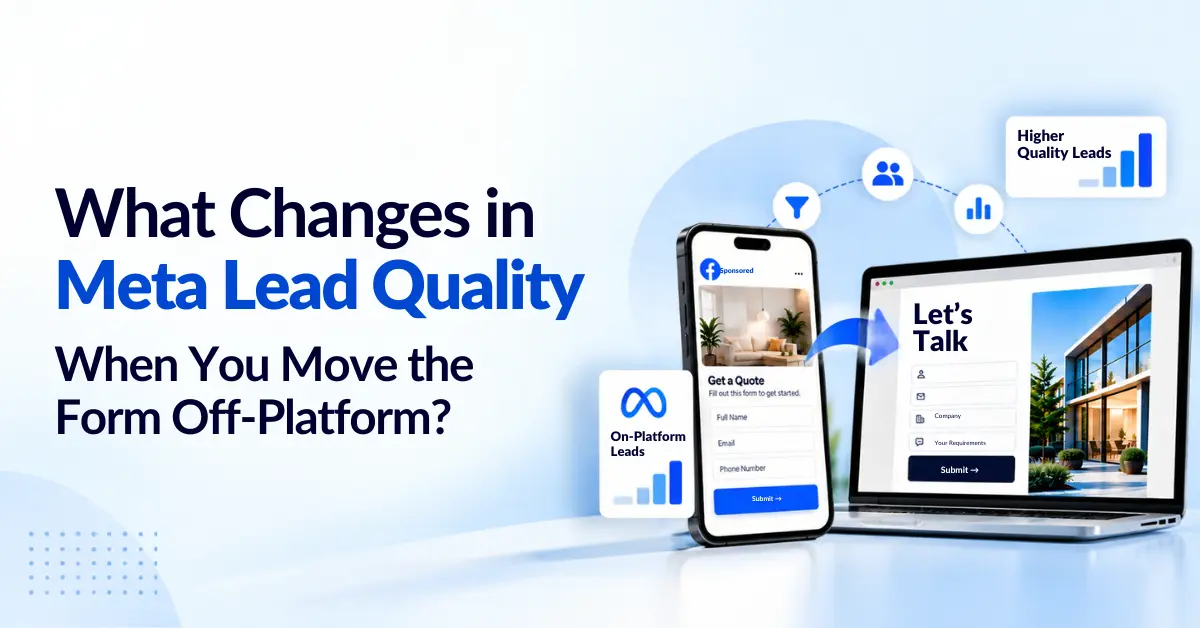
One of the harder conversations with the client was about the lead form. The original form was two fields- name and phone number. Simple, low friction, high volume. Also completely useless for qualification.
We added three questions. What type of service are you looking for? How many employees does your business have? Are you currently registered for corporate tax?
Lead volume dropped 40%. The sales team’s close rate on the remaining leads doubled.
The client’s first reaction to the volume drop was concern, which is understandable. But the leads that disappeared were the ones that were never going to close anyway, people who filled in a form out of mild curiosity and had no actual need or budget for the service. What remained was a pipeline the sales team could actually work with. Cost per acquired client, not cost per lead, is the number that matters for a professional services business, and that number moved in the right direction.
Why Service-Line Segmentation Was the Last Piece
Running Corporate Tax, VAT, and Bookkeeping under the same ad set was sending mixed conversion signals to Meta’s algorithm. The platform was trying to optimise for leads across three services with different buyer profiles, different consideration timelines, and different CPLs, all at once, which meant it was not optimising well for any of them.
Separating them into distinct ad sets gave each service its own conversion data, its own audience signal, and its own creative direction. The bookkeeping buyer and the corporate tax buyer are not the same person. Treating them as one audience in the name of campaign simplicity was costing the account the targeting precision it needed to make Meta Ads lead generation for UAE B2B actually work at scale.
What People Usually Ask When They Hear This
Q1. Does this approach work for other professional services or just accounting?
Ans. The sequencing principle applies across any high-trust B2B category. Legal, consulting, financial advisory. Any service where the buyer needs to believe in you before they contact you. The specific tier structure and content types change by category, but the logic stays the same.
Q2. Should Advantage+ be turned off entirely on B2B accounts?
Ans. Not always, but it needs constraints. Audience controls, geographic restrictions, and regular delivery insight checks are non-negotiable when using Advantage+ on accounts where ICP precision matters. Left unchecked, it will optimize for volume and drift from the audience that actually converts.
Q3. What if the client pushes back on lower lead volume?
Ans. Show them the close rate data and work backwards from revenue. A pipeline of 30 qualified leads closing at 40% is a better business outcome than 120 unqualified leads closing at 8%. The conversation about Meta Ads lead generation UAE B2B needs to happen at the revenue level, not the lead volume level.
Written by Vishal Singh, Performance Marketing Specialist
This account is one of several UAE professional services clients we have run Meta lead generation for. The pattern in this article repeats more often than it should, which is exactly why we wrote it down.
For more on how we approach paid media strategy and lead generation, visit our search engine marketing services.