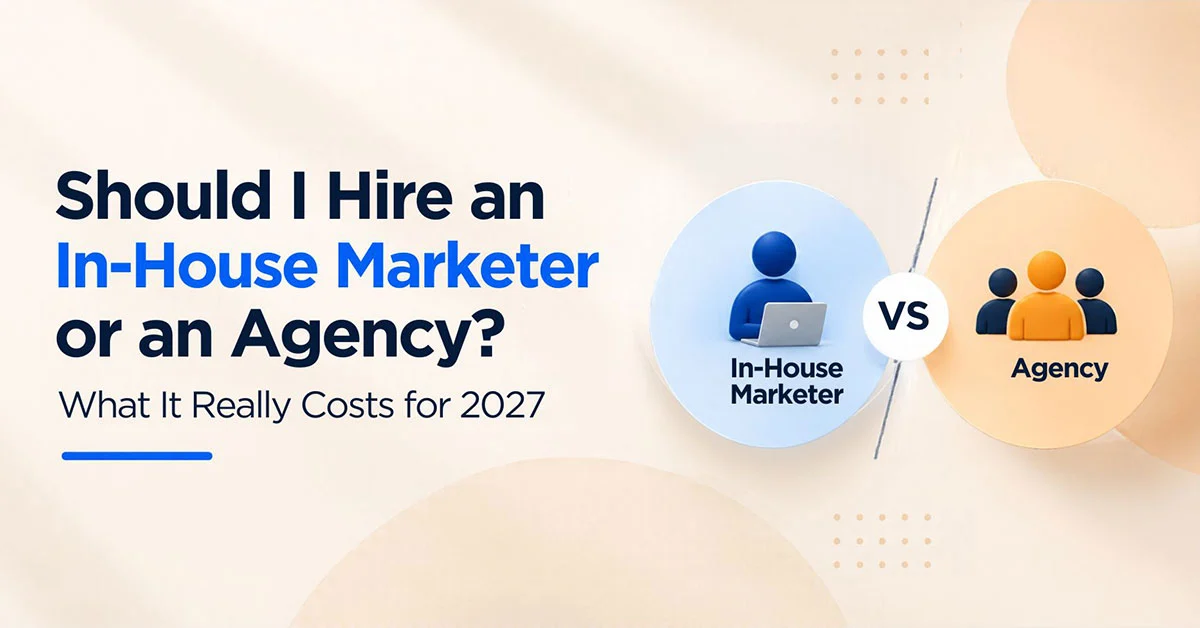
Typing “should I hire an in-house marketer or an agency” into Google at midnight? You’re probably weighing a salary against a retainer. Fair enough, but that’s maybe half the real bill. Tools, training, your own evenings spent managing them, one poor soul juggling five channels, and the headache when they leave with your ad logins. Count all of that, then decide.
It usually comes up around budget season. “We’re spending decent money on Google and Meta. Wouldn’t it be cheaper to just hire someone?”
Fair question. Sometimes the answer’s yes.
But the comparison people do in their heads goes something like this. Agency retainer on one side, a marketing executive’s salary on the other. Salary’s lower. Done, hire someone.
Then six months in, the new hire is running Google Ads, Meta, LinkedIn, the website, SEO, the newsletter and somehow also the trade show stand. Performance has flattened. Nobody’s quite sure why. And the founder is spending two hours a week reviewing campaigns they don’t fully understand.
So let’s do the maths properly.
Is an Agency Cheaper than Hiring In-house?
Honestly? Kind of a “how long is a piece of string” one. On a spreadsheet the salary line always looks smaller. What the spreadsheet forgets is the software subscriptions, the courses, the hiring process, the hours you spend checking their work, and the very real chance they quit in month seven. Once you pencil those in, an agency for one or two channels often works out roughly level, sometimes cheaper.
Here’s the in-house vs agency cost picture most people skip. The salary is just the start. Then there’s the tool stack, which for a decent setup means a keyword tool, a reporting dashboard, design software and maybe a social scheduler, each with its own monthly bill. Courses to keep them current, because Google changes something every other Tuesday. And hiring itself. Either a recruiter’s fee, or you sitting through fourteen interviews where everyone claims they “scaled ROAS 5x”. A laptop, a seat, benefits.
And the hidden one. If that person resigns in August, you’re back to square one with Q4 coming, and possibly without the passwords.
An agency carries most of that overhead itself. You’re paying for it in the retainer, sure, but you’re not managing it.
Can One Person Handle Google, Meta, Linkedin and SEO?
Handle, technically, yes. Do all four well, rarely. Each platform changes constantly and needs real hours every week. One generalist spread across all of them usually ends up keeping things running rather than improving anything. They’ll keep the lights on. Pushing numbers up is another matter.
Google Ads alone wants search term reviews, bid strategy checks and landing page tests. Meta wants fresh creative every couple of weeks or performance drops. LinkedIn wants careful audience work. SEO wants content, technical fixes and patience. That’s four jobs.
What usually happens is the person gets good at one or two and the others quietly coast. Not their fault. There just aren’t enough hours.
What Happens to My Ad Accounts If the Agency or Employee Leaves?
If the accounts are owned by you, nothing much, you just remove their access. If they were set up under the agency’s or the employee’s own login, you might lose the account, its history and its learning, and have to start from scratch. So make sure your business owns every account, from day one.
This is the bit that genuinely hurts. Google Ads accounts created inside an agency’s manager account. A Meta ad account sitting in a freelancer’s personal Business Manager. GA4 property under someone’s Gmail. When the relationship ends, getting that back can take weeks of emails, or not happen at all.
Google’s manager account guide is clear that linking your account to an agency’s manager account leaves your account and its history intact, and that the agency doesn’t get admin ownership unless you turn it on. That’s the setup you want. You own it. They get access. Same idea for Meta. Your business portfolio owns the ad account and pixel, and the agency is added as a partner.
We have taken over many accounts where the brand did not own its own ad account or analytics property. Whatever model you choose for 2027, ownership of accounts and data should never be part of the negotiation. That one decision protects you more than any choice between in-house and agency. The usual story is a brand switching agencies and discovering its Google Ads account, with years of conversion data, was sitting under the old agency’s login all along.
— Vishal Singh, Performance Marketing Specialist
What is a Hybrid In-house Plus Agency Model?
Your person steers, the agency rows. That’s roughly it. The in-house hire sets direction, protects how the brand sounds, and makes sure the logins and data stay with you. The agency gets its hands dirty on the channels, runs the tests, and handles the fiddly specialist bits. You get insider knowledge plus people who’ve seen fifty other accounts this quarter.
In practice it often looks like one in-house marketing manager working with an agency on paid media and SEO. That person’s job is mostly deciding what matters this quarter, signing off spend, and being the one who actually talks to customers and sales. The agency runs the campaigns, reports back and brings ideas from other accounts.
It works well because each side does what it’s good at. In-house people know the product, the sales team and the politics. Agencies see what’s working across twenty accounts this month, have direct contacts at Google and Meta, and can launch quickly. Neither is better. They’re just different.
This is honestly where most growing brands end up for 2027 planning.
Right, but should I hire an in-house marketer or an agency for a budget like ours?
No hard rule here, just what we’ve seen work. If you’re only on a channel or two and the budget’s modest, a full-time salary probably won’t pay for itself yet. An agency or a really good freelancer gets you further. Once you’re running four or more channels with serious budgets, an in-house lead plus agency support tends to work best. Very large, steady programmes can justify a fuller in-house team.
Channel count matters as much as spend. A brand spending a lot only on Google Ads might do fine with one in-house specialist. A brand spending less but across Google, Meta, LinkedIn and SEO needs more varied skills than one hire can bring.
And timing. Decide the model before 2027 budgets are locked, not after Q1 results disappoint and everyone’s scrambling. The in-house vs agency cost comparison looks very different when you’re making it calmly in November versus panicking in March.
How Do I Switch Agencies without Losing Performance?
Step one, before anything else, check the accounts are in your name. Then don’t do a clean cut. Let the old and new agency both have access for a bit, give the new lot a decent handover document, and ask them nicely not to tear things apart in month one. They should learn what’s working before they “fix” it.
The overlap matters more than people think. Two to four weeks where both have access means the new team can ask questions and see the history, rather than guessing.
And tell the new agency to hold off on rebuilding everything immediately. New teams love a fresh restructure. Sometimes it’s needed. Often it just resets learning periods and costs you a month. A good digital marketing services partner will audit first and change things gradually. If you’re comparing agencies offering the best digital marketing services, ask what they’d change in the first 30 days. “Everything” is the wrong answer.
Questions We Get Asked About In-House vs Agency Cost
Q1. Is a freelancer cheaper than an agency?
Ans. Often, yes. But you’re relying on one person, so make sure you own the accounts and have a backup plan if they get busy or disappear.
Q2. Does in-house vs agency cost change if I’m in India versus the UAE?
Ans. Salaries and retainers differ by market, but the hidden costs work the same way everywhere. Tools, management time and turnover still add up.
Q3. Can I start with an agency and bring it in-house later?
Ans. Yes, and it’s a common path. Just make sure you own every account from the start, so the handover’s smooth when you do.
Written by Vishal Singh, Performance Marketing Specialist
I work with brands across India and the UAE on paid media and SEO, and “should we hire someone or use an agency?” comes up at almost every planning meeting. The right answer depends on your channels and budget, but the account ownership answer never changes.
If you’d like help working out the right setup for 2027, take a look at our digital marketing services.