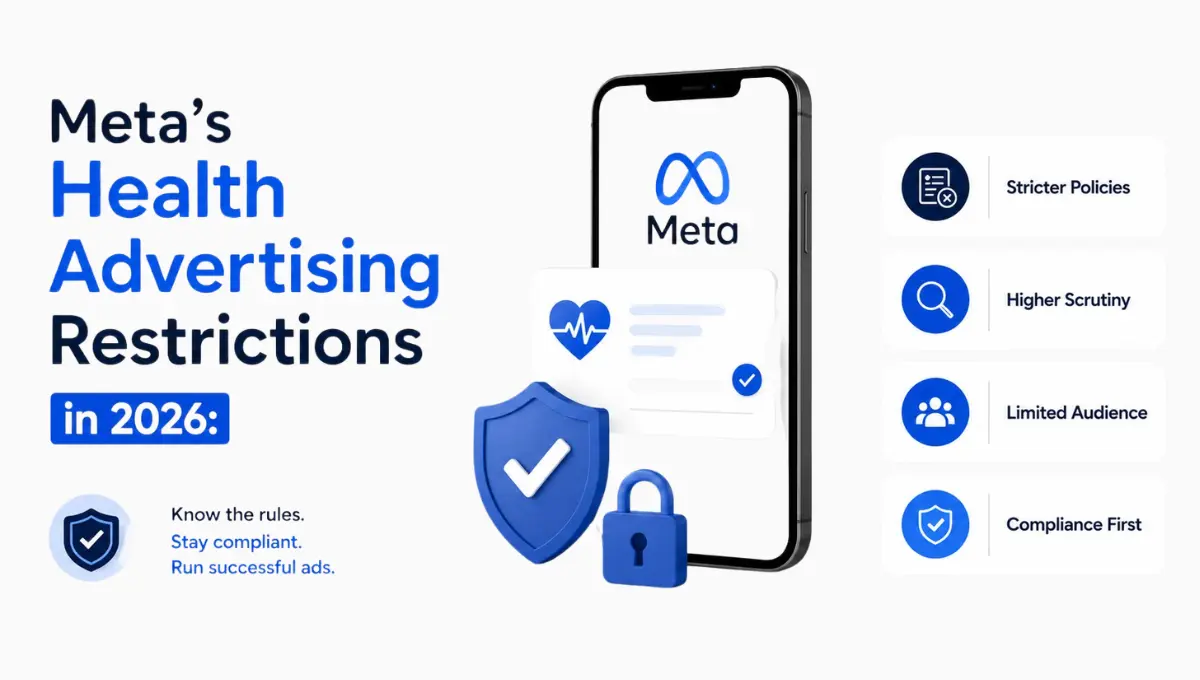
Meta health advertising restrictions 2026 are not a fresh set of rules. They are the second wave of enforcement from a policy framework that started in 2025, and this wave is hitting clinical practices and medical lead generation directly. Campaigns that were running without issues six months ago are getting flagged. Here is what is actually happening and what to do about it.
There is a particular kind of frustration that comes with getting flagged by Meta when you are running what feels like a completely normal healthcare campaign. Not a pharmaceutical ad. Not anything remotely controversial. Just a clinic trying to book patient consultations, the same way they have been for the past two years. And then one morning, the campaign is restricted and nobody can clearly explain why.
What happened throughout 2026 is that Meta’s healthcare enforcement expanded to include physician practices and behavioral health clinics running lead-generation campaigns. The first wave in 2025 went after wellness and product brands, supplements, fitness, consumer health. Most clinical practices watched that happen and figured they were in the clear. They were not. They were just next.
The distinction Meta is drawing is no longer about what you are selling. It is about whether your campaign infrastructure touches anything that could qualify as health-related data at any point in the funnel. That is a wider net than most practices realised.
What Is Actually Getting Flagged and Why It Is Not Always the Ad Copy
This is the part that trips people up. The assumption is that if the ad copy is clean, the campaign is fine. Meta’s enforcement in 2026 does not work that way.
PHI-related form fields are blocking Leads and Schedule events. Direct patient portal links are restricted. Flagging is triggered by language around PHI, symptoms, and specific conditions in audience names, custom conversion rules, or metadata, not just the ad copy itself.
So a campaign can have perfectly compliant ad copy and still get flagged because an audience is named “knee pain retargeting” or a custom conversion event is called “arthritis consultation booked.” Meta’s automated systems read those strings and treat them as sensitive health signals regardless of what the ad actually says.
Custom and lookalike audiences whose names, rules, or metadata included or implied sensitive traits were flagged and disabled. If you built those audiences over the past year and they are sitting in your account right now, they may be running but they are also at risk. And when they get disabled, they go without warning and without an obvious explanation in the account notification.
The Partial vs Full Restriction and What Each One Actually Means
Not every healthcare account gets treated the same way, and understanding the difference matters for how you respond.
Partial restrictions apply to most health and wellness brands and limit optimisation on lower-funnel conversion events like appointment bookings. Full restriction applies primarily to entities linking to patient portals. The difference between the two is significant. Partial restriction means you can still run campaigns, but you lose access to the most efficient optimisation signals. Full restriction means the account’s ability to run certain campaign types is severely limited.
The thing that determines which category you fall into is not always obvious. A URL path that includes a word like “cardiology” or “schedule” can tell Meta’s crawler everything it needs to know without any event needing to fire. The flagging is often happening at the infrastructure level rather than the content level, which is why campaigns that look clean on the surface are still getting caught.
“Healthcare brands that built their patient acquisition on Meta’s detailed health targeting over the last 3 years are now discovering that the audience data they built belongs to Meta’s old policy framework, not the current one. The audiences still exist — but the ability to use them for appointment-booking optimization is restricted. The practices navigating this best are the ones who built owned first-party lists in parallel rather than relying entirely on platform targeting.”
— Vishal Singh, Performance Marketing Specialist
What the Compliant Setup Actually Looks Like
The good news is that compliant healthcare campaigns on Meta are still possible. The bad news is that the setup requires more thought than most campaigns have historically received, and retrofitting compliance onto an existing account is harder than building it in from the start.
No PHI in form fields is the starting point. Lead forms should collect name, phone, and email only. No condition questions, no symptom fields, nothing that could classify as health information in the form itself. Lead form ads can still work for patient acquisition when the forms are configured to collect only necessary contact information and avoid health condition questions that might create PHI concerns.
Audience naming matters more than anyone expects. Removing any reference to conditions, treatments, or symptoms from audience names, custom conversion labels, and any metadata that flows through the Conversions API is not optional. Meta reads all of it.
Server-side tracking through the Conversions API, with PHI stripping in place before data is transmitted to Meta, is the setup that prevents pixel-level health data leakage. Standard browser-based pixel implementation is a liability in this environment because it sends data through the client without any filtering, and if health-related information ends up in that data stream, the account is exposed both to Meta’s enforcement and to HIPAA compliance risk.
Educational content campaigns, ads that drive traffic to informational articles rather than directly to booking pages, remain less restricted because they are not tied to a conversion event at the health-action stage. This is the format that gives healthcare practices continued reach while the more direct appointment-booking campaigns are being restructured.
Why Microsoft Ads Deserves More Attention From Healthcare Practices Right Now
Microsoft Ads healthcare policy is meaningfully less restrictive than Meta’s in 2026, and this is being missed by most practices that have defaulted to Meta as their primary social channel.
The 45-plus demographic, which represents a high concentration of active health researchers and one of the most valuable patient segments for most clinical specialties, is accessible on Bing in ways that Meta is progressively restricting. CPC on Microsoft Ads for healthcare terms runs below Google equivalents for the same keywords. Reach is smaller but the compliance environment is cleaner, and for practices that have been burned by Meta enforcement, the lower restriction level is worth the trade-off in audience size.
What Changed vs What Stayed the Same in Meta Ads Healthcare Compliance 2026
What changed is that optimisation events for lower-funnel appointment actions are restricted for most health and wellness accounts. Custom audiences that reference conditions or treatment types are being disabled. Patient portal links trigger full restriction. PHI in any part of the tracking stack is a liability.
What stayed the same is that educational content campaigns remain less restricted. Awareness objectives are still available. Top-of-funnel campaigns driving to informational articles are not under the same enforcement pressure as direct appointment-booking campaigns. Reach and engagement objectives for building brand awareness in a geographic area are still a workable strategy.
Choose the compliant setup if the goal is sustainable patient acquisition on Meta that does not get interrupted by enforcement action. Choose the old setup if you enjoy rebuilding campaigns from scratch every few months. The practices keeping their Meta campaigns running reliably right now are the ones that treated Meta Ads healthcare compliance 2026 as a structural requirement from the start rather than a policy review at the end.
What Clinics Usually Ask When This Comes Up
Q1. Can healthcare clinics still use retargeting on Meta?
Ans. Yes, but not from every source. Website visitors retargeted through a pixel that has PHI filtering in place, and engagement audiences from video views or page interactions, are workable. Patient lists uploaded directly to Meta are high risk. Lookalike audiences seeded from condition-specific conversion events are the ones most likely to get flagged and disabled.
Q2. Does the compliance issue affect the ad copy or the backend setup?
Ans. Both, but the backend setup is causing more enforcement action than the ad copy in 2026. Clean ad copy does not protect an account if the audience names, custom conversion labels, or form fields contain health-related language that Meta’s systems flag automatically.
Q3. What should a clinic audit first to check their Meta compliance status?
Ans. Start with the audience names in the account. Anything that references a condition, treatment, or symptom should be renamed or rebuilt. Then check the custom conversion event names and any parameters being passed through CAPI. Then review the lead form fields. Those three audits will surface the most common enforcement triggers before Meta finds them first.
Written by Vishal Singh, Performance Marketing Specialist
I manage paid media for healthcare and regulated-categoryregulated category clients across agency and direct-client structures. The enforcement patterns in this article reflect what we are seeing in live accounts in 2026, not policy documentation reviewed in isolation.
For more on how we approach performance marketing in regulated verticals, visit our digital marketing services.