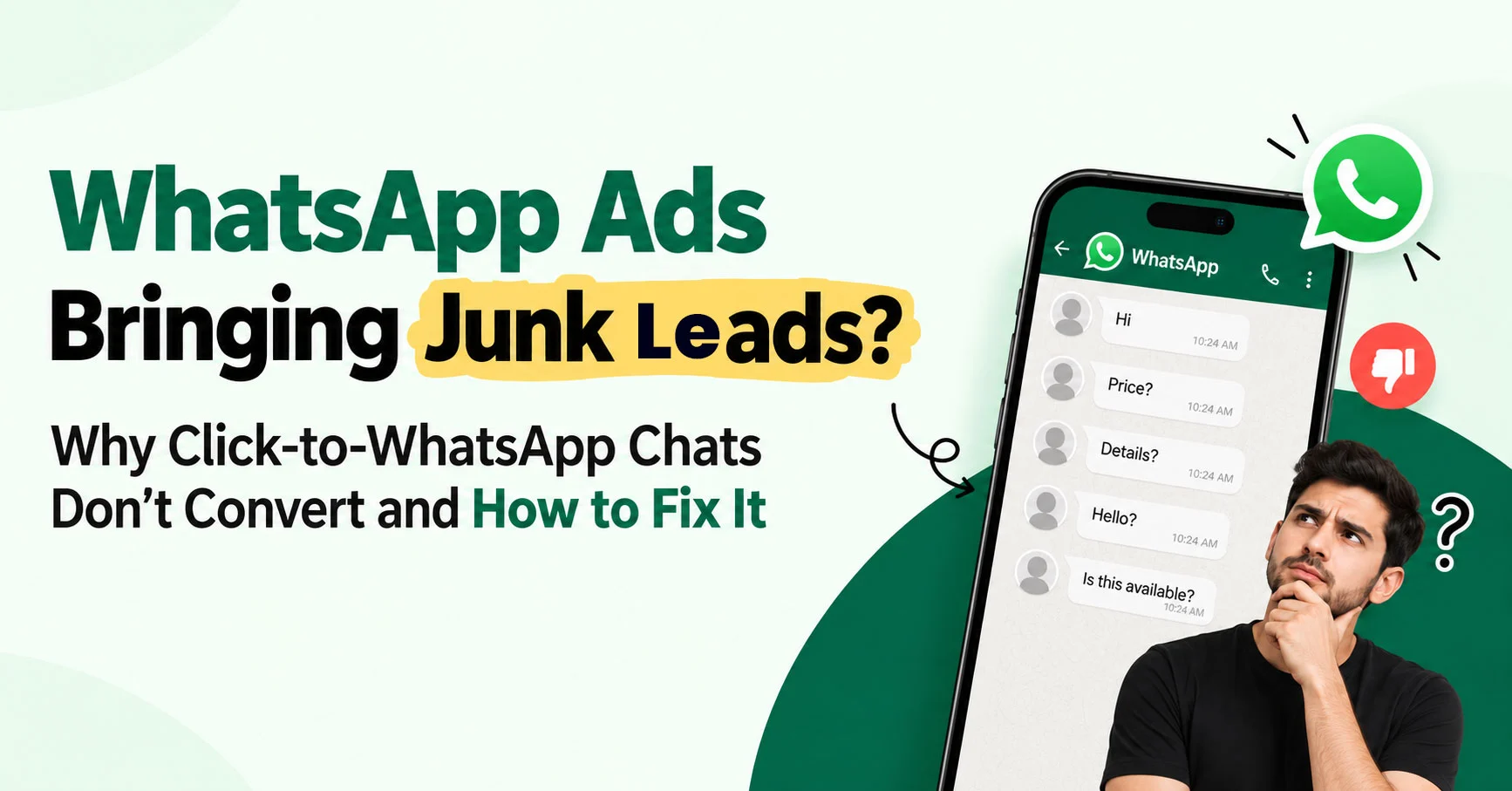
Click to WhatsApp ads, bad leads, a phone full of “Hi” and nobody buying. Sound familiar? Weirdly, the ad’s hardly ever to blame. What kills it is the reply coming hours late, a first message that tells you nothing about the person, and Meta being trained to find chatty people instead of paying ones. All fixable.
Every agency in India and the UAE has had this call. “The WhatsApp ads are working brilliantly, cost per conversation is down to almost nothing.” Then, a fortnight later, from the same client. “The leads are rubbish. Nobody replies. Can we switch it off?”
Both statements are true. That’s the annoying part.
A click-to-WhatsApp ad is ridiculously easy to respond to. Tap, WhatsApp opens, “Hi” is already typed, send. Done. Which is lovely for volume and terrible for intent, because tapping once costs the person nothing. So the inbox fills with people who were mildly curious for about four seconds.
The good news? Most of what goes wrong happens after the tap. And that bit you control.
Why Do People Message ‘Hi’ and Then Disappear?
Honestly? Usually because the reply took ages, or it felt like a chore. Somebody taps your ad in the queue at the chai stall, fires off “Hi”, pockets the phone. Your answer turns up two hours later as a wall of text about amenities. By then they’ve no memory of messaging you at all.
Think about how it feels from their side. They sent one word. You send back eight lines, a brochure PDF and “please share your requirements”. That’s homework. Nobody wants homework from an ad.
There’s also the accidental crowd. Some taps are curiosity, some are thumbs slipping. You can’t stop that completely. What you can do is make the first exchange so quick and easy that the curious ones either qualify themselves or politely drop off, without your sales team chasing ghosts for a week.
Click to Whatsapp Ads, Bad Leads or Just a Bad Setup?
Nine times out of ten, the setup. And you can usually guess in advance whether it’ll work for a business or not.
It does brilliantly for big, local, talk-it-through purchases. Property launches in Pune or Dubai, a dermatology clinic, admissions for a coaching centre, someone hunting for a wedding venue. Nobody books a ₹1.2 crore flat through a form. They want to ask about parking, possession date and whether the builder will negotiate, and they want to do it on WhatsApp because that’s where they already live.
And when does it flop? When chats sit unanswered, when nobody’s worked out what the first couple of messages should say, and when sales rings every single “Hi” like it’s a hot lead. Somewhere around the 40th call that goes to voicemail, someone declares WhatsApp ads junk. Not quite fair.
Are Whatsapp Ads Better than Meta Lead Forms?
Depends, annoyingly. If people want to chat before buying and you’ve got someone glued to the inbox, WhatsApp. If it’s a simple offer and a callback tomorrow is fine, a form. Can’t staff WhatsApp properly? Then a decent lead form with two qualifying questions will probably serve you better, and that’s okay.
The WhatsApp ads vs Meta lead form debate mostly comes down to who’s on the other end. A form collects details and waits. Someone calls back later, maybe. WhatsApp starts a live conversation, which is brilliant when a human (or a decent bot) responds straight away, and pretty useless when nobody does.
The way we tend to call it? Buyer needs a proper back-and-forth, go WhatsApp. Buyer just wants a price list, a form’s fine and usually less hassle.
WhatsApp ads look brilliant in the first week because cost per conversation drops. Then the sales team says the leads are useless. In almost every case the ad is fine. Nobody defined what a qualified chat is, and nobody replied fast enough to find out. A typical pattern on a property launch looks like this. Three hundred chats in the first week, most of them answered the next morning, and only a handful of site visits booked, even though the ads themselves were doing exactly what they were told.
— Vishal Singh, Performance Marketing Specialist
How Fast Do I Need to Reply to Whatsapp Leads?
Fast. Like, minutes. They had the phone in their hand when they tapped, and that’s your window, while it’s still in their hand. If your team’s swamped at peak times, let an automated opener go first with one useful question, and get a real person in right after.
This is where most CTWA campaigns quietly die. The ad runs till midnight. Sales logs off at seven. All those evening chats sit there till morning, by which point the person’s moved on, or messaged your competitor, who replied.
Easiest fix of all? Only run the ads when someone’s around to answer. If that’s not realistic, stick a WhatsApp Business API tool in front so nobody’s left hanging. Messages sent within 72 hours of someone clicking a WhatsApp ad are free to send, so there’s no excuse for not following up.
How Do I Qualify Leads Inside Whatsapp without Losing Them?
Let the first message do the sorting for you, and keep it to a tap or two. Pre-fill something that actually says what they’re after, then reply with a couple of buttons. People will happily tap “next 3 months”. They will not type a paragraph about their budget to someone they’ve never met.
So instead of “Hi” being pre-filled, try something like “Hi, I’d like details on 2BHK options”. That alone tells you more than a blank “Hi” ever will. Then the first reply comes back with buttons. “Looking to buy in the next 3 months”, “Just exploring”, “Need a home loan too”. One tap and you know who’s who.
Two or three questions, tops. Go to seven and congratulations, you’ve built a lead form inside WhatsApp, except worse.
How Do I Tell Meta Which Chats Became Real Customers?
Hook the WhatsApp Business API up to your CRM, tag the chats that turned into proper leads or sales, and pass those back to Meta using the Conversions API for business messaging. Otherwise Meta only ever knows that a chat started. It has no clue which ones paid.
Here’s the core problem. If your campaign is optimised for “conversations started”, Meta’s algorithm hunts for people who tap and type. It’s very good at that. Doesn’t mean they buy.
Meta’s developer docs list lead and purchase events for business messaging. Full optimisation support for WhatsApp ads has lagged behind Messenger, so check what’s switched on in your own account. But even purely for measurement, it’s worth setting up, because now you can report cost per qualified chat and cost per site visit, rather than cost per “Hi”. Any good social media marketing services setup should be reporting on that, not on conversations alone.
And if you’re comparing agencies offering the best social media marketing services, ask them one question. “What’s your cost per qualified WhatsApp chat?” If they only know cost per conversation, you’ve learned something.
Questions We Get Asked About WhatsApp Ads vs Meta Lead Form Campaigns
Q1. Can I run WhatsApp ads and lead forms at the same time?
Ans. Yes, and plenty of brands do. Lead forms for colder audiences who aren’t ready to chat, WhatsApp for warmer ones and retargeting. Just track them separately so you know which is actually bringing buyers.
Q2. Is WhatsApp ads vs Meta lead form cheaper per lead?
Ans. WhatsApp usually looks cheaper per conversation. Compare cost per qualified lead or per sale instead, because that’s where the real answer lives.
Q3. Do I need the WhatsApp Business API, or is the app enough?
Ans. The free app works for very small volumes. Once you’re getting dozens of chats a day, you’ll want the API for automated replies, multiple agents and CRM tracking.
Written by Vishal Singh, Performance Marketing Specialist
I run Meta campaigns for real estate, healthcare and education brands across India and the UAE, and “the WhatsApp leads are junk” is one of the first things I hear on a new account. It’s almost never the ad.
If you’d like help turning WhatsApp chats into actual customers, take a look at our social media marketing services.