Meta generates cheap B2B leads. It does not automatically generate B2B pipeline. The gap between the two is not a platform problem, it is a funnel structure problem. B2B SaaS lead generation Meta Ads funnel 2026 works when the offer, the sequence, and the conversion signal are set up to find buyers, not just form fillers.
There is a very specific kind of frustration that comes with running Meta for B2B SaaS. The leads come in. Sometimes a lot of them. The CPL looks great in the dashboard. And then the sales team opens the CRM and starts making calls, and nothing is there. Personal Gmail addresses, phone numbers that do not pick up, people who vaguely remember clicking something but have no interest in a demo, let alone a paid subscription.
The agency says the creative is not resonating. The sales team says the leads are garbage. And the marketing team is stuck in the middle, wondering why a channel that works so well for e-commerce is producing a pipeline that looks like a ghost town.
The problem is almost never Meta. It is what Meta is being asked to do with an offer and a funnel that was not designed for how cold B2B audiences actually make decisions.
Why Meta’s CPM Advantage for B2B Is Real But Easy to Waste
Meta’s CPM for B2B audiences runs at roughly $4 compared to LinkedIn’s $25 to $60. That is a significant cost advantage, and it is why Meta deserves a place in the B2B lead generation mix even though LinkedIn gets all the professional targeting credibility. Cheap impressions delivered to a partially relevant audience can outperform expensive impressions to a precisely relevant audience, but only if the offer and funnel are structured to convert at the quality level the business actually needs.
The mistake that turns the CPM advantage into a budget drain is running a bottom-funnel CTA, something like “Book a Demo” or “Get a Quote,” to cold audiences who have never encountered the brand before. On LinkedIn, the professional context of the platform gives that CTA some level of credibility by association. On Meta, a cold SaaS audience scrolling between personal content has zero reason to trust a brand they have never seen enough to hand over their time for a sales call. The form fill happens anyway because the friction is low. The qualified lead does not happen because the trust was not there.
Why Advantage+ Is Not the Right Fix for Most B2B SaaS Accounts
Most B2B SaaS companies generate 20 to 30 qualified leads per week from Meta, which sits below the 50 conversions per week threshold for reliable Advantage+ optimisation. Below that threshold, the algorithm explores rather than optimises, finding the cheapest audiences rather than the highest-value ones.
This is worth sitting with for a moment. Advantage+ is genuinely impressive for high-volume accounts where the algorithm has enough signal to learn what a good conversion looks like. For a B2B SaaS company with a narrow ICP and a 30-lead week, the algorithm does not have that signal. It finds whoever is most likely to fill a form, which in B2B often means it finds people who are enthusiastic clickers but not buyers. The CPL stays low. The pipeline stays empty.
The better approach for most B2B SaaS accounts is Advantage+ with a CRM-seeded lookalike as the audience suggestion and a downstream conversion event as the optimisation target, rather than raw form submissions. Give the algorithm a better starting point and a better goal, and the results change.
What Actually Generates Qualified Leads at Lower CPL Than a Direct Sales Offer
Value-first lead magnets consistently generate leads at 40 to 80 percent lower CPL than campaigns leading with a direct sales offer on cold Meta audiences. Gated benchmark reports, ROI calculators, and industry playbooks outperform “Book a Demo” on cold traffic because they ask for something proportionate to the trust level at that moment.
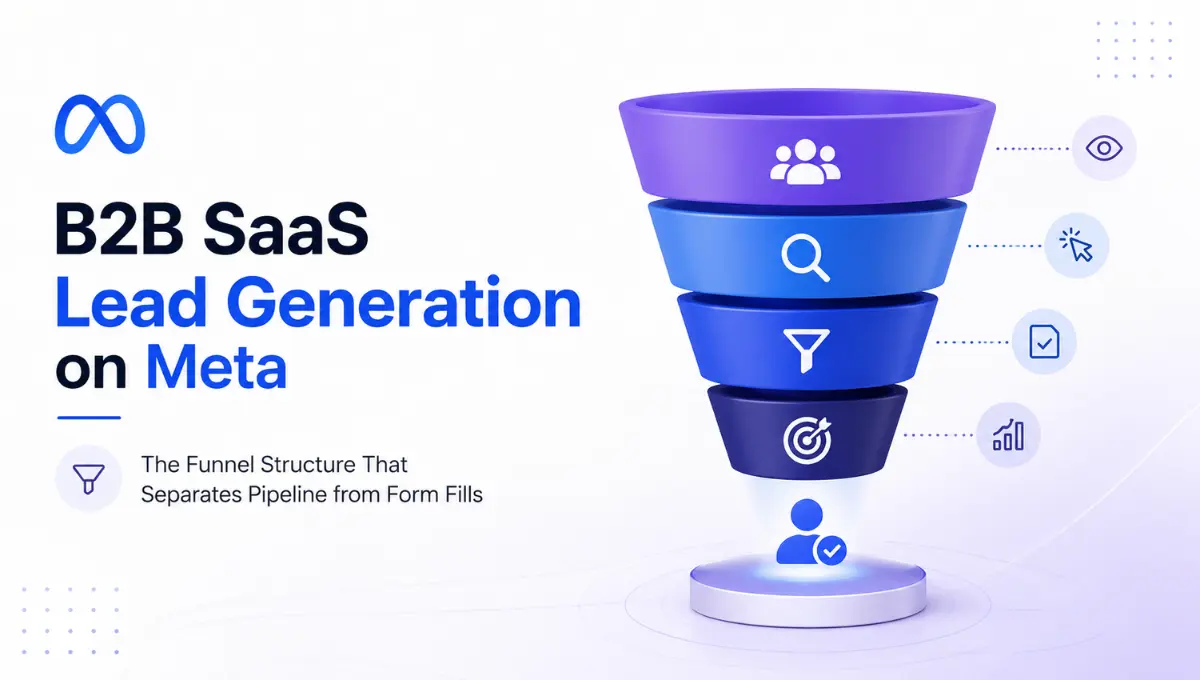
The three-stage funnel that works for B2B SaaS on Meta is straightforward when you see it written out. Cold audiences get problem-aware content, the kind that describes what a specific problem is costing companies like theirs, without asking for anything. Warm audiences who engaged with that content get the lead magnet offer, a download, a report, a calculator, something useful with low commitment. Hot audiences from the retargeting pool and CRM lookalikes get the direct CTA with social proof, case studies, and proof that the solution actually worked for someone like them.
Same audience, different messages at different stages. That is not a complicated funnel. It is just respecting where the buyer is in the conversation.
“The B2B Meta campaigns that generate pipeline share one structural characteristic: they never ask cold audiences to make a high-trust decision on first contact. The brands generating 200 leads/month with consistent pipeline are the ones running ‘Book a Free Demo’ to cold audiences who have never heard of them. The brands generating 200 leads/month with zero pipeline are offering something of value first and saving the demo ask for people who already believe the problem is real.”
— Vishal Singh, Performance Marketing Specialist
Why the CAPI and CRM Feedback Loop Is the Highest-Leverage Fix in 2026
Most Meta B2B SaaS accounts are optimising toward form fills because that is the event that fires when someone submits a lead form. The algorithm learns to find more people who fill forms. The problem is that form fills and pipeline have almost no reliable correlation in B2B SaaS without a qualification layer in between.
Configuring the Conversions API to send SQL-stage signals back to Meta from the CRM trains the algorithm on leads that actually became pipeline, not just form submissions. When a lead moves to sales-qualified status in HubSpot or Salesforce, that event fires to Meta. The algorithm adjusts. Over time, it stops finding the cheapest form fillers and starts finding people who look like the ones that actually converted to pipeline.
Advertisers using this Conversion Leads approach typically see 30 to 50 percent improvement in lead quality, with CPL increasing by only 10 to 20 percent, producing a lower cost per qualified lead overall. The raw CPL goes up slightly. The cost per actual opportunity goes down significantly. That is the trade-off most B2B SaaS accounts should be making and are not.
Cold Traffic Lead Magnets vs Direct Demo CTAs and What Each One Is Actually For
Cold traffic lead magnets: lower CPL, higher volume, lower initial intent. The job is to identify people who have the problem being solved, get them into the funnel at low friction, and let the nurture sequence do the qualification work. Retargeting CPL is typically 45 percent lower than cold acquisition CPL, which means the lead magnet is building the retargeting pool that produces the efficient pipeline leads downstream.
Direct demo CTAs on cold traffic: higher CPL, lower volume, mostly form fills from people who clicked out of curiosity rather than genuine intent. Works for very well-known brands with strong category recognition. Does not work for most B2B SaaS companies that are not yet household names in their vertical.
Choose cold traffic lead magnets if the brand is not yet established enough for a cold audience to trust a direct sales ask. Choose direct demo CTAs for retargeting audiences who have already seen the brand, engaged with content, or visited the pricing page. The Meta Ads B2B pipeline vs form fills strategy is mostly about which CTA hits which audience, not about which one is universally better.
What Lead Form Qualification Does Before the Lead Reaches the CRM
Meta lead forms now support email verification and SMS verification in 2026, which filters out personal email submissions and uncontactable leads at the capture stage before they ever reach the CRM or the sales team’s queue.
This is a small setup change with a disproportionate impact on the sales team’s experience of Meta-sourced leads. Personal Gmail addresses are one of the clearest signals of a low-intent submission. Filtering them at the form stage rather than after the fact means the leads that do reach the CRM have already cleared one basic qualification hurdle. Combined with a qualifying question about company size or role, the form becomes a lightweight filter rather than an open door.
What Usually Comes Up When B2B Teams Run Meta for the First Time
Q1. Is Meta actually worth it for B2B SaaS or should we just use LinkedIn?
Ans. Both, for different jobs. Meta’s CPM advantage makes it significantly more efficient for awareness and retargeting at scale. LinkedIn’s professional targeting makes it better for precise ICP reach at higher cost. The B2B SaaS accounts getting the best blended results are using Meta for volume and nurture and LinkedIn for surgical ICP targeting, not treating them as alternatives.
Q2. How long does it take for the CAPI and CRM feedback loop to change algorithm behaviour?
Ans. The algorithm needs enough downstream events to identify a pattern, which typically means four to six weeks of consistent SQL-stage data flowing back to Meta before targeting behaviour noticeably shifts. The accounts that see the fastest improvement are the ones with clean CRM data and consistent event firing from the start rather than retrofitting the integration after three months of optimizing toward raw form fills.
Q3. What is a realistic CPL expectation for B2B SaaS on Meta?
Ans. B2B SaaS CPL on Meta typically runs $20 to $80 for qualified leads with job-role targeting via lookalike or custom audiences. The CPL for unqualified form fills can be significantly lower and is almost entirely irrelevant as a performance metric. Cost per sales-qualified opportunity is the number worth tracking, and that requires the CRM integration to calculate it cleanly.
Written by Vishal Singh, Performance Marketing Specialist
I manage Meta lead generation campaigns for B2B SaaS and professional services clients. The funnel structure in this article comes from accounts where form fill volume was never the problem and pipeline was, which is the situation more often than most Meta dashboards would suggest.
For more on how we structure paid media campaigns for qualified B2B pipeline, visit our digital marketing services.