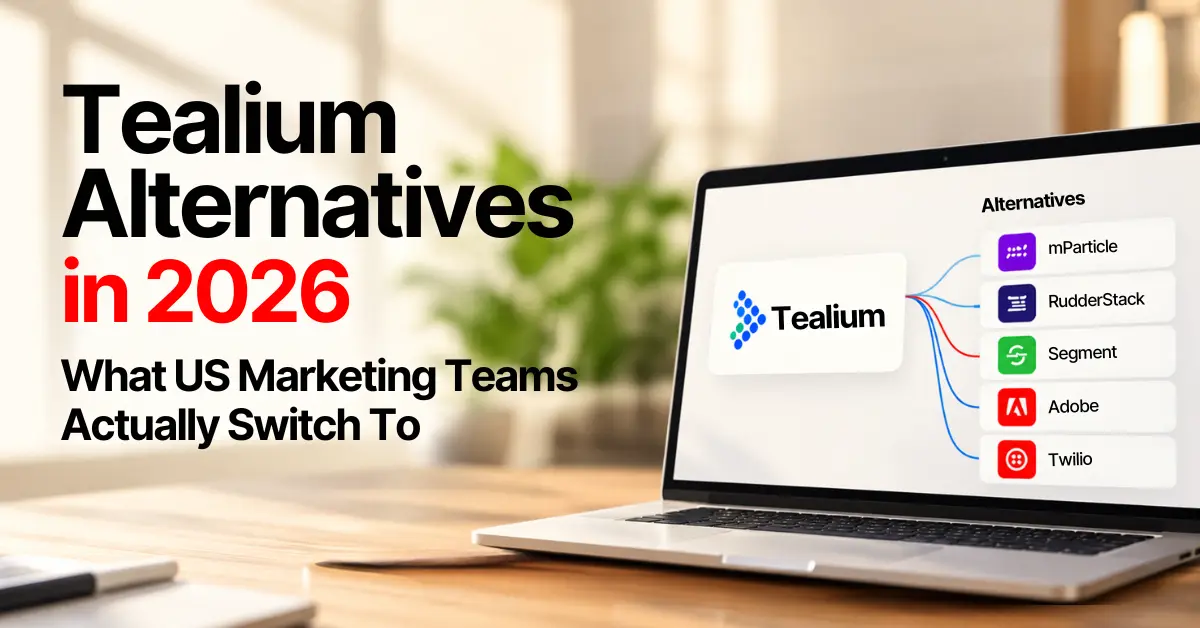
The most common Tealium alternatives in 2026 are Google Tag Manager for tag-focused teams, Twilio Segment and Rokt mParticle for event data and identity, and Adobe or Salesforce for teams already inside those ecosystems. The right choice depends less on features and more on where your data should live.
The email usually shows up about ninety days before renewal. It’s given us a fair chance to be honest.
Someone in marketing ops opens the Tealium quote, reads the number twice, and forwards it to their manager with one line. “Are we sure we need all of this?” The perfect marketing dilemma for buisness growth is at peak here.
Fair question. Plenty of US teams signed up for Tealium years ago, when it was the obvious enterprise answer to messy tags and scattered customer data. Since then the stack has changed around it. GA4 happened. Server-side tracking went mainstream. The data warehouse quietly became the centre of everything. And a few of the features being paid for are, let’s say, not seeing much action.
So people start looking at Tealium alternatives, and what they find is a crowded market with very confident marketing and not much honest guidance. Sorting through that is where good web data & analytics services earn their place. This isn’t the “top 10 tools” version. It’s the one based on what teams actually end up switching to, and why.
Why Are So Many Teams Looking at Tealium Alternatives Right Now?
Cost is the obvious one. Tealium’s pricing isn’t published and gets negotiated separately for each deal, which is normal for enterprise software but makes budgeting feel like guesswork. According to one pricing tracker, Tealium also cut its listed plans down to a single Customer Data Hub offering in February 2026, so buying just the piece you need has become harder.
Then there’s usage. A lot of teams bought the full platform and mostly use the tag manager. That’s a bit like leasing a truck to carry groceries. It works. It just isn’t great value.
And there’s architecture. More companies now want customer data to live in Snowflake, BigQuery or Databricks, with tools reading from it instead of keeping their own copy. Tealium supports that direction too, but it’s no longer the only route, and that opens the door.
Is This Really Just a Tag Manager Swap?
Almost never, and this is where projects go sideways. It’s n
Tealium rarely does one job. In most setups it handles tags, some event routing, maybe audience building, and it usually works alongside other collection layers, consent tools and activation platforms instead of replacing them. Rip it out thinking you’re only replacing tags, and three weeks later someone notices the email platform stopped receiving audience updates.
A better starting point is a handful of plain questions. Where does event collection live, how does identity get stitched, who owns schema changes, and how much depends on vendor logic versus your own warehouse?
Answer those first. The shortlist gets much shorter.
Which Tealium Alternatives Do Us Marketing Teams Actually Switch To?
From what we see in client accounts, most moves land in one of five places.
Google Tag Manager, often with server-side tagging. The most common move for teams that were really only using Tealium iQ. It’s free at the base level, nearly every marketer already knows it, and server-side containers cover a lot of the data control people used to pay for. The catch is that it’s a tag manager, not a CDP. If you need unified customer profiles, it won’t give you those.
Twilio Segment. The go-to for teams whose main job is getting clean event data into lots of tools. It offers identity resolution and a library of more than 700 connectors, and product and engineering teams tend to enjoy working with it.
Rokt mParticle. Strong on mobile apps and identity. Rokt acquired mParticle in January 2025, and it now positions itself as a hybrid of real-time streaming and warehouse-native architecture. Worth a look for app-heavy brands in retail, travel or media.
Adobe or Salesforce. If the business already runs on Adobe Experience Cloud, Adobe’s own tags and Real-Time CDP are the path of least resistance. Same logic for Salesforce shops, where the option is Salesforce Data 360, the name Salesforce’s CDP now goes by. You trade some independence for fewer integrations to babysit.
Warehouse-native tools. Teams with a solid data function increasingly collect events with something like RudderStack and push audiences out with a reverse ETL tool such as Hightouch. Flexible, often cheaper at scale, and it assumes you have people who genuinely enjoy SQL.
Treasure Data comes up too, mostly at the enterprise end. Don’t be thrown if you see it listed under a different name, since it rebranded as Treasure AI in April 2026.
Nobody should switch platforms because a renewal quote gave them a fright. The switch is worth it when you know exactly which jobs Tealium was doing and you’ve decided who does each of them next.
— Vishal Singh, Performance Marketing Specialist
How Do You Choose Without Regretting It Next Year?
A few things we’d do before signing anything.
Audit what Tealium actually does for you today. Every tag, every connector, every audience feeding another tool. Most teams are surprised by the list, in both directions.
Be honest about who’ll run the new setup. A warehouse-native stack looks lovely on a whiteboard and painful without data engineers. GTM is easy right up until you need profiles.
Plan for overlap. Run old and new side by side for a few weeks and compare numbers before switching anything off. Conversions have a nasty habit of quietly dropping during migrations, and your ad platforms will notice before you do.
And sort out consent handling early, especially if you sell into states with their own privacy laws. It’s the part that gets rushed, and the part that causes the most headaches later.
Honestly, this planning stage is where most of the value in web analytics services sits. The migration itself is mostly careful execution.
So, Which Tealium Alternative is Right for You?
Probably not the one with the slickest comparison page.
If you mostly need tags, GTM will likely do. If you need clean event data flowing everywhere, look at Segment or mParticle. If you live inside Adobe or Salesforce, stay close to home. And if your warehouse is already the source of truth, go composable.
Whichever way you lean, map the jobs first and pick the tools second. And if you’d like a second pair of eyes on that map, our web data & analytics services team helps US brands plan and run exactly these migrations.
Frequently Asked Questions
Q1. What are some companies similar to Tealium in digital marketing?
Ans. The closest alternatives are Twilio Segment, Rokt mParticle, Adobe Real-Time CDP, Salesforce Data 360 and Treasure AI, plus Google Tag Manager for teams that mainly need tag management.
Q2. Is Google Tag Manager a good replacement for Tealium?
Ans. It can be, if you mostly used Tealium for tags. Server-side GTM gives you more control over your data, but it won’t build unified customer profiles the way a CDP does.
Q3. How long does a Tealium migration usually take?
Ans. It depends on how much Tealium was doing. A tags-only move can take a few weeks, while replacing CDP features and audience feeds often takes a few months, including time running both systems side by side.
Q4. Why do companies switch away from Tealium?
Ans. Usually cost, paying for features they don’t use, or wanting customer data to live in their own warehouse instead of inside a vendor’s platform.
About the Author
Vishal Singh, Performance Marketing Specialist, spends a lot of time helping teams work out which parts of their martech stack are actually earning their keep. See how the team approaches web data and analytics.