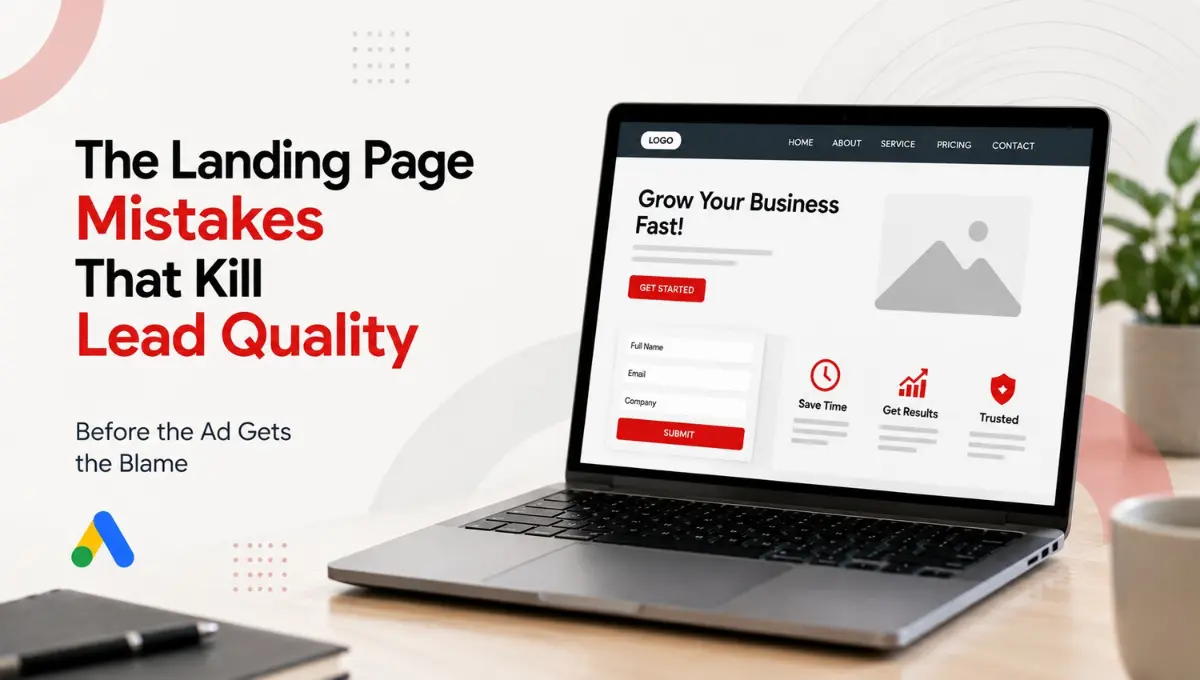
It’s funny how often we point fingers at the ad when CPL goes up, as if it’s the only culprit in the room. But more often than not, the real troublemaker is quietly sitting on the landing page. The ad just has to tempt the right person to click – that’s its whole job. What happens after that click, well, that’s a whole different story, and it’s the landing page’s stage. Over the years, I’ve seen the same six landing page mistakes pop up again and again, quietly sabotaging lead quality. Fixing these is usually the fastest way to see CPL drop, much faster than tweaking campaigns endlessly.
When a campaign underperforms, everyone naturally looks at what they can see inside the platform. The ad copy. The targeting. The bid strategy. The creative. Those are the things the team can actually change, so that’s where the investigation usually starts.
The landing page is usually a different story. It’s owned by another team, built by someone who isn’t managing the campaigns, and often isn’t even part of the regular performance review. That’s why the same page problem can sit there for months while the campaign gets adjusted around it. The ads keep changing. The targeting keeps changing. The page stays exactly the same. And CPL stays high.
The fix is rarely the ad.
What Happens When the Ad Promises One Thing and the Page Says Something Else
An ad reads, “Free Tax Consultation for UAE Businesses. Speak to a Specialist Today.” The landing page headline reads, “Professional Services for Your Business.”
The person clicking the ad was promised a tax consultation. They land on a page talking about “professional services” and suddenly have to figure out whether they’re even in the right place. Most won’t bother. They’ll just go back.
If I had to fix one thing on a landing page before touching the campaign, I’d start with message match. We’ve had accounts where changing one headline dropped CPL by 35 percent in ten days. Nothing else changed. No new campaign. No new creative. No bidding adjustment. We just made the landing page say what the ad had already promised.
Is the Form Asking for the Right Amount of Information From the Right Person
An eight-field form on cold traffic is asking for too much. But a two-field form on a warm retargeting audience can be just as wasteful because you’re throwing away information from people who already know the brand.
Form length should match audience temperature, not the administrative preferences of whoever built the CRM intake process. Cold traffic has low trust and limited commitment. Ask for name and phone. Get the lead in. Qualify on the call. Warm traffic has already seen the brand, considered the offer, and come back. They will tolerate more fields, and more fields give the sales team better information before the first contact.
Running the same form across cold and warm campaigns is a conversion architecture problem. It is not visible in the ads dashboard; it does not surface as a disapproval or a quality flag, and it compounds quietly into a CPL problem that nobody connects back to a form that was never designed for the audience it is receiving.
What Page Speed on Mobile Is Actually Doing to Campaigns Silently
Most of the traffic we’re talking about here is mobile traffic. Yet plenty of landing pages are still designed and checked on a desktop first. Then everyone is surprised when the mobile conversion rate is terrible.
If the page takes more than a few seconds to load on a phone, you’ve already lost some of the people you paid to bring there. It doesn’t matter how good the ad was at that point. For real estate and professional services campaigns targeting mobile-first markets, a page speed problem is a CPL problem that disguises itself as a targeting problem because the analytics show the traffic arriving and leaving without context for why.
A 3 percent improvement in landing page conversion rate compounds across the full campaign budget, reducing cost per qualified lead by roughly 30 percent without any change to the ad. Page speed is the version of that improvement most teams have not made yet.
“The landing page is the part of the campaign that the agency usually doesn’t own — and that’s exactly why it causes the most unfixed problems. When CPL rises, the audit starts at the ad. When it should start at where the ad sends people. We’ve seen accounts where fixing one headline mismatch between ad copy and LP dropped CPL by 35% in 10 days with no other changes.”
— Vishal Singh, Performance Marketing Specialist
Why Missing Trust Signals Above the Fold Cost More Than a Slow Page Does
Before someone gives you their phone number, they want to know one very basic thing: are you actually a business they can trust?
If there’s no phone number, no address, no client proof, and no obvious indication of who is behind the business, you’ve made that decision harder. And this isn’t just a conversion problem. Google looks at the destination page separately from the ad, so a page that doesn’t establish basic business legitimacy can create a policy problem even when the ad itself is completely clean.
Business name and contact information, a visible privacy policy, social proof in some form, and consistent naming between the domain and the ad destination are not optional additions for a high-converting LP. They are the floor. In professional services, this is one of the first things I’d check before touching the campaign
What Running One Landing Page for Every Campaign Does to Conversion Signal
Take a business running Visa Services, Corporate Tax, and Business Setup campaigns and sending all three to the same page. The problem isn’t just that the page is generic. You’re also giving the algorithm one messy pool of conversion data to learn from. The algorithm learns who converts from that page and finds more people like them. The people it finds are those most likely to submit a generic inquiry form, not those most likely to need a specific service.
Ideally, each major service gets its own page. That gives the buyer a much clearer journey and gives the platform cleaner conversion data to learn from. You also stop judging three completely different services using one blended CPL.
What the Difference Actually Looks Like Between A Landing Page That Converts vs One That Just Loads
A good landing page isn’t complicated. The headline matches the ad. The form isn’t asking for unnecessary information. The business looks legitimate. The page works properly on mobile. And once someone submits, they know exactly what happens next.
The bad version is usually pretty obvious once you stop looking at the ads. Generic headline. Eight-field form. No phone number. Slow mobile experience. And a thank-you page that says “Thanks, we’ll be in touch” and then leaves the user with absolutely nothing to do.
Choose the first setup if the goal is a CPL high landing page fix that holds. Choose the second if the goal is to keep adjusting the campaign every two weeks without finding the real problem.
Why the Thank-You Page Is the Most Wasted Moment in the Funnel
Someone who just submitted a form is about as interested as they’re going to be. And yet, most thank-you pages basically say “Thanks, we’ll be in touch” and call it a day.
At minimum, the thank-you page should confirm that the form went through, tell the person what happens next, and give them another option if they want to move faster, like WhatsApp or a brochure. And yes, the conversion pixel needs to fire there too.
What We Hear When CPL Stays High After Every Campaign Change
Q1. How do you know if the CPL problem is the landing page or the campaign?
Ans. Start with CTR and landing page conversion rate together. If people are clicking but not converting, don’t immediately rewrite the ad. The ad has already done its job well enough to get the click. Look at what happens after it.
Q2. Does a separate landing page per campaign actually move CPL meaningfully?
Ans. Yes, especially if the business offers multiple services. Someone looking for Corporate Tax shouldn’t land on a page that’s also talking about bookkeeping, business setup, and five other things. A focused page gives them exactly what they clicked for, and the conversion data is cleaner too. We’ve seen conversion rates move materially just by making that match tighter.
Q3. What is the fastest CPL high landing page fix to implement first?
Ans. Start with the headline. If the ad says “Free Tax Consultation for UAE Businesses,” the page should not open with “Professional Services for Your Business.” Fix that mismatch first. It’s usually a small change, doesn’t need a developer in most cases, and you can see the impact fairly quickly.
Written by Vishal Singh, Performance Marketing Specialist
I audit landing pages as part of every paid media onboarding across agency and direct-client accounts. The patterns in this article appear in almost every account where CPL has been blamed on the campaign for longer than it should have been.
For more on how we approach performance marketing and campaign architecture, visit our digital marketing services.