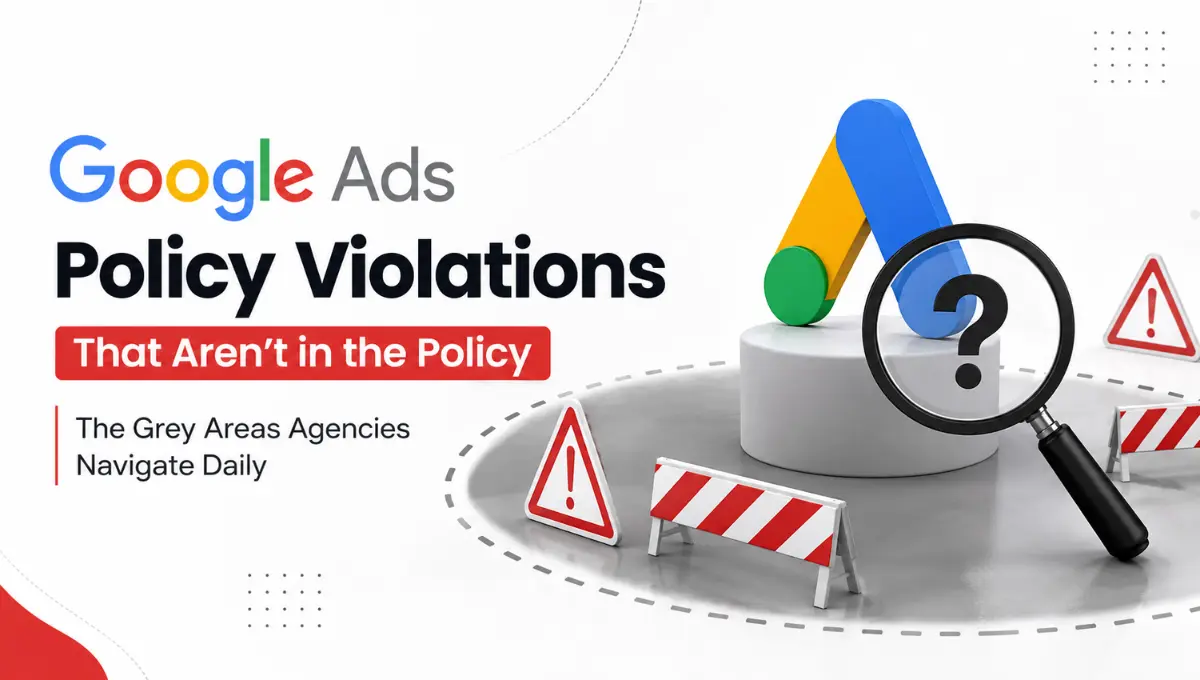
The Google Ads policy document does not tell you everything that gets disapproved. Google Ads policy violations grey areas agencies navigate in 2026 are not edge cases, they are the everyday situations where compliant-looking ads get flagged because of how the automated classifiers read intent, not because of what the written policy actually says. This is what the policy does not cover, but enforcement definitely does.
Here is a scenario that happens more often than it should. An account gets a disapproval. The team reads the policy. The ad does not appear to violate anything listed. A revised version goes in. Gets disapproved again. Someone spends three hours cross-referencing the ad copy against every policy section they can find and still cannot identify what triggered it.
The reason this happens is that Google’s enforcement runs on machine-learning classifiers, not on a checklist of prohibited phrases. Google’s review system scans ad copy, landing pages, keywords, images, and the entire digital footprint of the account, and the classifiers are trained to interpret intent, not just match prohibited words. Which means an ad that contains no explicitly prohibited language can still get flagged because the classifier read a pattern and reached a conclusion the advertiser never intended.
Reading the policy is necessary. It is not sufficient. The gap between what the policy says and what enforcement catches is where most unexplained disapprovals live.
Why Phrases Like “Apply Now” Get Ads Flagged When the Advertiser Is Perfectly Compliant
Intent classifier grey zones are the most common source of unexplained disapprovals in sensitive verticals. Phrases like “get approved,” “apply now,” and “register today” trigger government-service or financial-service classifiers in certain categories even when the advertiser is private, compliant, and has nothing to do with financial products or government services.
The policy does not list these phrases as prohibited. The classifier catches them anyway because the pattern matches what has historically appeared in ads that were genuinely violating policy in those categories. A private immigration consultancy using “apply now” on a visa services ad is not doing anything wrong. The classifier does not know that. It sees the phrase in a category that has a history of misrepresentation, and it flags it.
The fix is not to find the phrase in the policy and argue it is not listed there. The fix is to understand which verticals trigger which classifiers and rewrite the language so the pattern does not match. That knowledge only comes from running enough accounts in those verticals to see what consistently gets caught.
What Missing Trust Signals on the Landing Page Are Doing to Compliance Independently of the Ad
The landing page crawl is a separate review from the ad copy review, and it produces disapprovals through a completely different mechanism. Missing an About page, having an unverifiable business address, or showing inconsistent naming between the domain and the ad destination triggers misrepresentation flags independently of the ad copy.
The policy says misrepresentation. It does not describe what the crawler is specifically looking for on the page. An advertiser who reads the policy and concludes their ad is compliant may not think to check whether the business address on the landing page matches the registered domain, or whether the page has enough identity information visible to pass the crawler’s trust check.
Google’s review system evaluates the full experience, not just the ad. A disapproval that comes back labelled as misrepresentation after the ad copy was clearly clean is almost always a landing page issue. And the same ad can pass review one day and fail it later if a site update changes the page the crawler lands on.
The Competitive Conquest Grey Zone That Catches Most Agencies Off Guard
Bidding on competitor brand names is allowed under Google’s trademark policy. What is not allowed, and what is not clearly defined anywhere in the policy, is ad copy that implies affiliation, endorsement, or superior quality relative to the named competitor in a way that the classifier reads as unfair advantage.
The line between a legitimate comparison and a violation is not in the written rules. It is in how the classifier interprets the framing. An ad that says a product outperforms a named competitor, or that implies the user should switch from a named brand, can trigger a flag that the policy document would not clearly indicate was coming.
The practical approach is to use comparison framing without explicitly naming the competitor in the copy, even when bidding on their brand terms as keywords. The keyword and the ad copy are evaluated separately, and the copy is where the classifier makes the call.
Why Performance Claims Outside Financial Products Still Trigger Financial Services Restrictions
Before-and-after claims with specific percentages trigger financial services classifiers even when the advertiser has nothing to do with financial products.
An accounting firm advertising “reduce your tax bill by 40%” is making a performance claim that the classifier reads as a financial outcome promise. The policy covers financial products, but the classifier reads financial outcome language regardless of what category the advertiser is in. A legal consultancy, a SaaS company with ROI-focused copy, or a business advisory firm using specific percentage outcomes in ad copy all face the same risk.
Rewriting claims using hedging language, replacing absolutes like “will” and “guaranteed” with qualifiers like “may help” and “designed to,” is the standard fix, but the more useful fix is understanding that any specific financial outcome language in the copy is going to be read by the classifier before it is read by a human reviewer.
“The difference between an account that navigates Google’s policy environment cleanly and one that accumulates flags is almost never knowledge of the written policy. Every agency reads the policy. The difference is understanding how the automated classifiers interpret intent — which only comes from running enough accounts across enough verticals to mechanically pattern-match what triggers flags before the flag fires.”
— Vishal Singh, Performance Marketing Specialist
The Industry-Specific Semantic Traps That Are Not Listed Under Those Industries
Healthcare, legal, and real estate each have category-specific semantic traps that are not documented under those industry sections in the public policy.
Healthcare ads using “cure,” “treat,” or “diagnose” in any context trigger clinical claims classifiers regardless of whether the advertiser is making a clinical claim. Legal ads using “guaranteed” or “win your case” trigger outcome promise flags. Real estate ads using “best investment” or “guaranteed returns” trigger financial claims enforcement even when the advertiser is talking about property, not financial instruments.
None of these are listed as prohibited phrases in the healthcare, legal, or real estate policy sections. They show up in other policy areas, and the classifiers apply them cross-category. The Google Ads disapproval reasons not in policy that most teams encounter for the first time are almost always one of these industry-adjacent semantic triggers rather than a direct violation of the stated category rules.
What MCC-Level Risk Actually Means and Why the Policy Nowhere Mentions It
Policy violations can result in restrictions across multiple linked accounts, and the mechanism is not documented in the policy the way individual disapprovals are.
Accounts in the same manager account that share industry patterns, billing structures, or similar ad copy themes raise risk signals across the entire group when one account is flagged. An agency managing ten healthcare clients under one MCC and running a similar creative theme across all of them can find that a flag on one account accelerates scrutiny on the others.
The policy does not describe this explicitly. Enforcement applies it consistently. The practical implication is that compliance decisions for one account in an MCC need to be evaluated in the context of what else is running in the same manager, not just what the individual account is doing.
What an Account That Accumulates Flags Looks Like vs One That Consistently Stays Clean
An account that accumulates flags typically has a pattern of reacting after disapprovals, fixing the specific thing that was flagged, and not auditing for the adjacent issues that will fire next. Patterns of violations feed into Google’s three-strikes system, which escalates from warnings to temporary suspension to permanent account loss. Each disapproval that gets fixed individually without a full audit of what else in the account has the same pattern is a future disapproval waiting to happen.
An account that stays clean proactively audits ad copy, landing pages, audience names, and conversion event labels against the classifiers, not against the written policy. It treats the policy document as a starting point and accounts for the gap between what is written and what enforcement catches.
Choose proactive auditing if the goal is keeping campaigns running without interruption. Choose reactive fixing if the goal is gaining a detailed understanding of every grey area the hard way.
What Teams Ask When They Encounter These Grey Areas for the First Time
Q1. How do you know what is in the grey area before getting flagged?
Ans. Pattern recognition across accounts and verticals. There is no published list of what the classifiers catch beyond what the written policy states. Agencies that have run enough accounts in a given category develop a sense of what language consistently triggers flags before the flag fires. That pattern-matching is what the written policy cannot give you.
Q2. Is there a way to check in advance whether a specific phrase will cause a disapproval?
Ans. Not definitively. The Policy Manager inside Google Ads shows active violations but does not preview what a new ad will be flagged for before submission. The best pre-submission check is cross-referencing the copy against the known grey-area triggers for the relevant vertical and removing anything that matches the patterns, even if those patterns are not explicitly prohibited.
Q3. What happens if the same ad gets approved in one account and disapproved in another?
Ans. The classifier is not always consistent, and nearly identical ads can get different outcomes. This happens more often after policy updates when the classifiers are retrained. The practical response is not to assume approval in one account means the same copy is safe across all accounts, especially when the accounts are in different verticals or at different account age and history risk levels.
Written by Vishal Singh, Performance Marketing Specialist
I manage Google Ads compliance and strategy across accounts in healthcare, legal, financial services, and real estate. The grey areas in this article come from running into them directly, not from reading about them in documentation.
For more on how we approach paid search compliance and campaign management, visit our search engine marketing services.