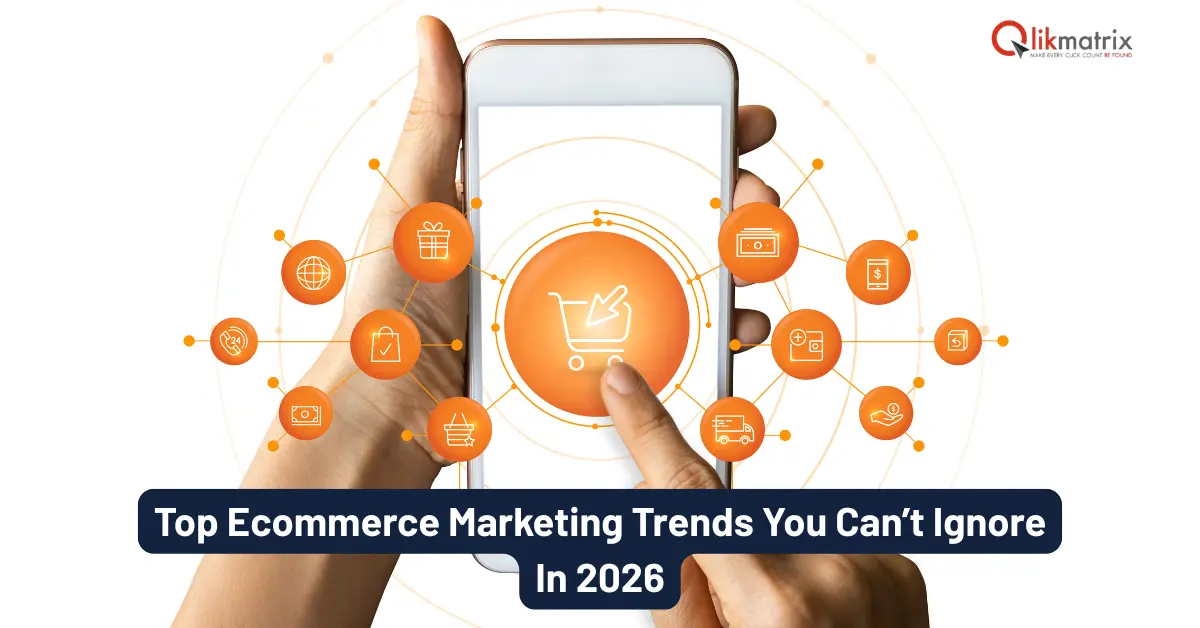
Most companies are unprepared for the rate of change in ecommerce marketing trends in 2026. What was effective in 2023 isn’t only going nowhere. In several cases, it’s actively affecting results.
If you’re working with ecommerce marketing services or running campaigns in-house, the gap between brands adapting and brands that aren’t has never been more visible. Conversion rates are splitting apart. Customer acquisition costs keep climbing for brands on old playbooks. The ones winning right now are doing things that weren’t even possible at scale two years ago.
This blog covers the trends actually moving numbers in 2026, why each one matters, and what a real ecommerce marketing strategy looks like when these are built into it properly.
Why 2026 is a Different Year for Ecommerce Brands?
Due to increased ad prices, decreasing organic reach, and declining confidence in traditional ads, ecommerce firms must focus on retention, first-party data, and consumer connections in 2026.
The online market is busier than ever. Meta and Google ad expenditures have risen over three years. Organic reach declines. Consumers trust generic brand advertising less than in 2020.
Growing brands spend less than others. They outthink them. Maintaining client relationships while ad spend pauses. Ecommerce marketing trends are not simply movements in the sector; they are also changing how businesses recruit customers, turn them into customers, and keep them as customers.
1. AI Personalization is No Longer a Nice-to-Have
Two years ago, this was enterprise-only. Big budgets, custom tech, dedicated teams. In 2026, tools like Klaviyo, Bloomreach, and Nosto brought it within reach of mid-size stores.
People misread what personalization means here. Product recommendations that rebuild based on what someone browsed last Tuesday, not what they bought six months ago. Email timing that shifts based on when a specific customer actually opens, not when the campaign was scheduled. A homepage that looks different to someone on visit four than to someone arriving cold from a paid ad.
Klaviyo’s 2025 benchmark report put the revenue gap between brands running behavioral personalization and those doing broadcast campaigns at 30 to 45 percent. That gap didn’t close. It got wider.
Batch-and-blast email in 2026 doesn’t just underperform. It trains your list to stop opening anything you send.
2. Short-Form Video is a Purchase Channel Now
TikTok Shop crossed real GMV numbers in multiple markets through 2025. Instagram and YouTube followed with native shopping that actually matured. In 2026, short-form video is not a brand awareness play. It’s where someone finds a product, watches a real person use it, and buys without switching apps.
For ecommerce digital marketing teams, the question is no longer whether to do video. It’s how many per week, which platform, and are they shoppable? Beauty, food, and apparel brands are pulling 20 to 35 percent of new customer acquisitions through short-form video as of early 2026.
Production value is not what matters. A genuine product demo three times a week beats a polished brand film once a month. Not sometimes. Always.
3. First-Party Data is a Moat Now
Third-party cookies gone. iOS wrecked Meta targeting. Attribution got harder to trust. Brands that built paid strategy around pixel tracking felt that badly.
Brands that didn’t had something in place before it all changed. Real email lists. SMS subscribers with actual opt-ins. Post-purchase surveys should question where buyers came from. Loyalty programs keep customers coming. To achieve 200,000 opted-in subscribers with clean behavioral data, repeat this across all touchpoints. At that point, your CAC is something cold-traffic buyers genuinely can’t touch. That’s not a strategy. That’s a moat.
Built one touchpoint at a time. A quiz before the first purchase. A one-question survey in the post-delivery email. A loyalty tier that makes customers want to identify themselves on return visits.
4. Retention is Doing the Work Acquisition Used to
Subscriptions are the most direct way to turn a one-time buyer into predictable monthly revenue. Loyalty programs only work if the incentive is something people actually want to earn. Points that expire, discounts on products they’ve never bought, tiers nobody reaches. Those aren’t retention tools. They’re noise.
Post-purchase sequences treat the 7 days after the first delivery as the most valuable marketing window in the customer journey because it is.
Brands above 40 percent repeat purchase rate are recovering CAC in under 60 days. Below 20 percent, paid acquisition keeps getting more expensive with no LTV to absorb it. Brands in those same categories still betting everything on new customer acquisition? Most of them are losing money on the first order and hoping the second one comes. Often it doesn’t.
A real ecommerce marketing strategy in 2026 starts with LTV. ROAS, CAC, spend allocation. All of it follows from there.
5. Social Proof Looks Different Now
Five stars and 200 reviews stopped moving people. Customers have seen too many inflated counts, too many products that looked nothing like the photos.
Video reviews where someone can see the product in real hands. Review content speaking to the doubt sitting in someone’s head right before they decide. Tools like Yotpo, Okendo, and Loox make collecting this without a large team something a mid-size brand can actually do.
Influencer strategy moved away from large accounts. Someone with 18,000 followers posting only about zero-waste living converts better for an eco-packaging brand than a lifestyle account with 2 million covering everything. Niche beats reach in 2026.
6. AI Search is Hitting Ecommerce Visibility
Google’s AI Overview is showing up for a growing portion of product-related searches now. Product pages that answer specific questions, category pages built around buying guide queries, brand content explaining ingredients and use cases in real depth. Pages like these are picking up visibility that product-listing-only stores are completely missing.
In 2026, ecommerce digital marketing needs a content layer built for AI search. Stores with nothing outside product descriptions are invisible in a portion of results that keeps growing every month.
Points to Remember
- Ecommerce marketing trends 2026 favor brands that own their customer relationships. Ones that don’t collapse when paid spend pauses.
- The gap between growing brands and stuck ones comes down to six things: personalization, conversion-driven video, owned data, repeat revenue, and real social proof.
- CAC up. Organic reach shrinking. The 2022 playbook is costing brands money in 2026.
Ecommerce marketing services worth working with lead with LTV and retention. Agency pitches that start and end with first-purchase ad performance are selling a 2021 strategy at a 2026 price.
FAQs
Q1. What is the biggest ecommerce marketing trend in 2026?
Ans. First-party data, honestly. Personalization runs on it. Retention runs on it. Every strategy that’s working right now traces back to brands that own their customer data and use it properly.
Q2. How important is short-form video for ecommerce right now?
Ans. Consumer brands don’t have a choice anymore. Beauty, food, and apparel brands are getting 20 to 35 percent of new customer acquisitions through video right now. Two years ago, that number was 8 to 10 percent.
Q3. Why does retention matter more than acquisition in 2026?
Ans. Because the numbers stopped working. CAC up 22 percent on average, doubled in some categories. Brands with strong repeat purchase rates recover that cost in under 60 days. Brands in those same categories are still betting everything on new customer acquisition.
Q4. Is AI personalization realistic for smaller ecommerce brands?
Ans. A store doing a few crore annually can run behavioral segmentation and dynamic product recommendations today without a big tech budget. Worth doing now while it still separates you from competitors. Give it two years, and every store will have it. Then you’ll need something else to stand out.