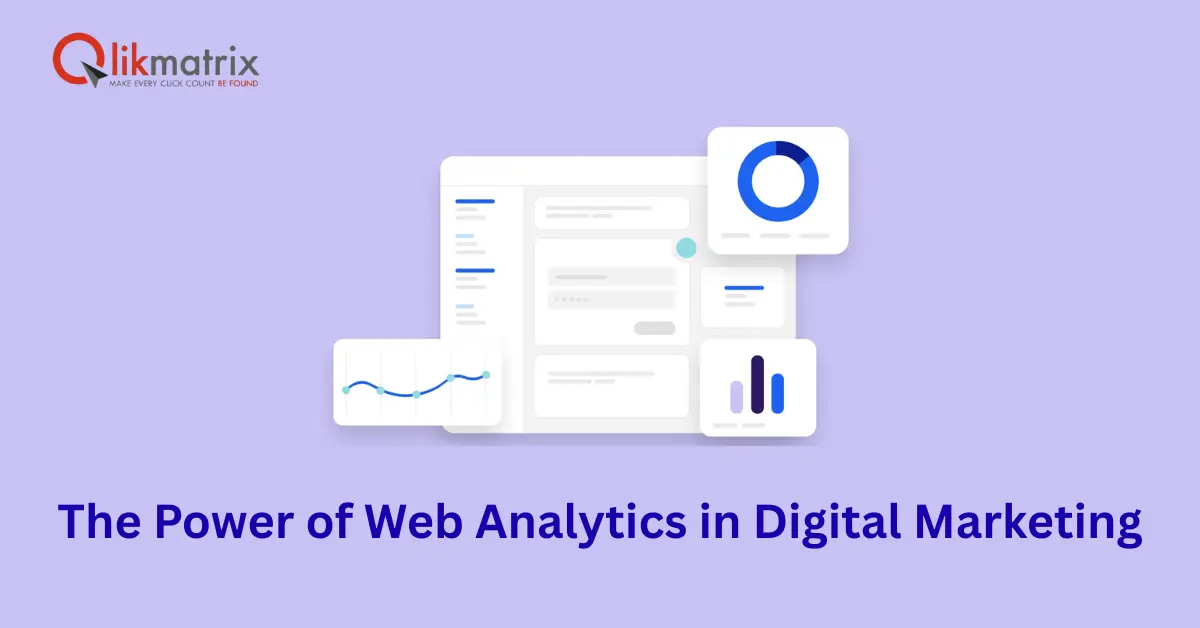
The Power of Web Analytics in Digital Marketing

Power of Web Analytics In Digital Marketing

Web analytics in digital marketing helps businesses decode the digital universe. From tracking clicks to advanced predictive analytics, it enables data-driven decisions, improves user experience, and drives conversions. This article explores fundamental and advanced techniques of web analytics in digital marketing and why partnering with an expert agency can accelerate your digital success.

Harnessing the Power of Web Analytics in Digital Marketing

Consider the world of astronomy. Just as astronomers study the cosmos to unlock universal mysteries, web analytics in digital marketing serves as your telescope for exploring the online world. Every click, interaction, and data point is like a star in the sky—small on its own but powerful when connected. Together, they reveal patterns and insights that can guide your business toward sustainable growth.

At QlikMatrix, a leading digital marketing agency specializing in web analytics, we help businesses harness the power of web analytics in digital marketing. Whether you’re just starting or are already familiar with analytics, understanding this tool can transform how you make decisions in the digital age.

The Fundamentals of Web Analytics in Digital Marketing

Web analytics in digital marketing is the practice of measuring, collecting, analyzing, and reporting website data to improve performance. Much like an astronomer’s first observation of the night sky, these insights form the foundation of digital success.

Core metrics include:

  • Page Views – Total number of times your web pages are viewed.
  • Unique Visitors – Distinct individuals who visit your site.
  • Bounce Rate – Percentage of users leaving after a single page view.
  • Conversion Rate – Percentage of visitors completing a desired action, such as purchases or sign-ups.

These metrics create a snapshot of user activity, helping businesses identify what’s working and where improvements are needed.

Advanced Web Analytics Techniques

As astronomers map constellations for deeper insights, advanced analytics helps uncover complex digital patterns. Here are key techniques:

1. Segmentation

Segmentation divides users into meaningful groups based on behavior, location, device type, or referral source. For example, an ecommerce company might discover that customers in Asia prefer mobile shopping while European buyers engage more with desktops. This knowledge allows for customized strategies that drive better results.

2. Attribution Modeling

Attribution modeling assigns credit to different marketing channels for conversions, like mapping gravitational pulls in a solar system. Options include:

  • Last-Click Attribution – Final touchpoint gets credit.
  • First-Click Attribution – First interaction receives credit.
  • Linear Attribution – All touchpoints share equal credit.
  • Time Decay Attribution – Recent interactions carry more weight.

Selecting the right model ensures accurate ROI measurement for marketing campaigns.

3. Cohort Analysis

This technique studies user groups over time to understand retention and long-term behavior. For instance, an online retailer may track customers acquired during a festival sale and discover higher repeat purchase rates compared to other periods.

Complex Web Analytics for Business Growth

Just as physics evolves from classical to quantum theories, analytics also moves into more complex methods:

Predictive Analytics

By using historical data, machine learning, and algorithms, predictive analytics forecasts customer behavior and future trends. Subscription-based businesses, for example, can predict which users may cancel services and proactively implement retention strategies.

Real-Time Analytics

This involves monitoring and reacting instantly to live data. For time-sensitive campaigns such as flash sales or live webinars, real-time dashboards help businesses pivot quickly to maximize engagement.

Customer Journey Mapping

A detailed customer journey map tracks every step from the first ad click to post-purchase interactions. By identifying pain points, businesses can refine the user experience, leading to higher satisfaction and conversions.

Why is a Digital Marketing Agency for Web Analytics?

Mastering analytics requires expertise and precision. A skilled agency like QlikMatrix provides end-to-end support—from tracking basic metrics to implementing predictive models and real-time dashboards. By translating data into actionable insights, businesses gain a competitive edge and achieve scalable growth.

Conclusion

At Qlikmatrix, we combine technology with expertise to help businesses thrive in this data-driven era. If you’re ready to navigate the digital cosmos, explore new opportunities, and grow sustainably, trust web data analyst services from QlikMatrix, the best digital marketing agency, to elevate your business success.


Q1. What is the most expensive online advertising mistake?

Ans. Audience targeting gone wrong, by a distance. A bad keyword wastes only the clicks it generates. Targeting the wrong people means every rupee goes to someone who was never going to buy. It doesn’t stop on its own. It runs until someone actually digs into who’s clicking and finds none of them were real prospects.

Q2. How often should campaigns be reviewed?

Ans. Every week for the first month without exception. After that, every two weeks at a minimum. The search terms report, audience performance breakdown, and creative fatigue all shift faster than a monthly review schedule can catch.

Q3. Does ad copy really change conversion rates that much?

Ans. The difference between two ads targeting the same audience with the same budget but different copy is regularly 200 to 400 percent in conversion rate. Copy is not a secondary consideration. It’s often the primary one.

Q4. How do I know if my conversion tracking is actually working?

Ans. Do a test conversion yourself. Check if it fires in real time inside your platform’s event manager. Then compare the conversion numbers from your ad platform against actual sales in your CRM every week. Consistent gaps between those two numbers mean something is broken in the tracking chain.

Some of the most expensive online advertising mistakes are sitting inside campaigns that look completely normal on the surface. Impressions coming in. Clicks happening. Budget spending cleanly. And underneath all of it, money going to the wrong people, for the wrong searches, tracked incorrectly, with copy that never had a chance.

Table of Contents

If you work with search engine marketing services or manage paid ads internally, this is where to look first.

1. Poor Audience Targeting

This mistake means paying for every click from people who were never going to buy. It doesn’t stay small. It scales with the budget.

A fitness brand running ads to everyone aged 18 to 65 interested in health is not targeting an audience. That’s broadcasting. Pull actual customer data. Who bought before? What age, location, device? Which pages did they visit before converting? Build lookalikes from real buyers on Meta, not from guesses about who might be interested. For B2B, LinkedIn’s job title and company size filters exist for a reason. Use them with behavioral data layered on top, not instead of it.

On Google, match types matter more in 2026 than most advertisers realise. Broad match without a solid negative keyword list shows ads for searches that have nothing to do with what you sell. Audience settings are not a one-time setup job. Review them every 30 days.

2. Wrong Keyword Selection

This is why campaigns look good in the dashboard and produce nothing in the bank account. Impressions up. Clicks up. Conversions flat.

Someone typing “how does retargeting work” is doing research. Someone typing “retargeting agency for ecommerce” is ready to talk to someone. Both live inside the same industry. Only one has buying intent. Bidding on both with the same budget treats research traffic like purchase traffic, and that’s where money disappears.

Good online advertising mistakes analysis starts with knowing which six areas drain the most money and in what order to fix them. Keyword intent is the first filter. Get it wrong here and everything downstream, the bids, the budget, the reporting, runs on bad inputs.

Negative keywords need to be built before the campaign launches, not discovered in the first week’s search terms report. “Free,” “DIY,” “how to,” and competitor names where you don’t want comparison traffic are the starting point, not the full list. Check the search terms report every week for the first month. What you think you’re targeting and what you’re actually showing for are different lists more often than not.

3. Lack of Conversion Tracking

No tracking means no real data. Every budget decision after that is a guess dressed up as a strategy.

The problem isn’t that advertisers skip tracking. It’s that they set it up wrong and never check whether it’s working. Page view is tracked instead of form submission. Most accounts have the tag firing on page load, not on actual form submission. Every false fire sits in your data as a real conversion, and you optimise against it without knowing. iOS 14 broke attribution in 2021 and most ad accounts still haven’t fixed it, which means Google Ads, Meta pixel, and GA4 are all showing different numbers, and none of them are complete.

Cross-reference them weekly against actual CRM data or backend sales numbers. If the numbers don’t match consistently, something in the tracking chain broke somewhere and you’re optimising campaigns based on wrong information.

4. Low Quality Ad Copy

This is what turns a perfectly targeted campaign into a money pit.

The pattern is almost always the same. The headline leads with the brand name. The body copy lists features. The language is vague. “High quality.” “Trusted.” “Industry-leading.” None of it means anything to someone who doesn’t already know you. And the person seeing your ad doesn’t know you yet.

In search, the headline has to match the intent behind the keyword. Someone searching for accounting software for a small business wants to see that reflected back, specifically, not a tagline that could apply to any software company on earth.

On social, the first two seconds are everything. A hook naming a specific problem the audience actually has, or a claim that catches them off guard, gets the read. A logo and a brand slogan does not. Run three different creative angles per ad set at a minimum. Pull the one that works and scale it. Replace the ones that don’t before they drain the budget.

FAQs

Q1. What is the most expensive online advertising mistake?

Ans. Audience targeting gone wrong, by a distance. A bad keyword wastes only the clicks it generates. Targeting the wrong people means every rupee goes to someone who was never going to buy. It doesn’t stop on its own. It runs until someone actually digs into who’s clicking and finds none of them were real prospects.

Q2. How often should campaigns be reviewed?

Ans. Every week for the first month without exception. After that, every two weeks at a minimum. The search terms report, audience performance breakdown, and creative fatigue all shift faster than a monthly review schedule can catch.

Q3. Does ad copy really change conversion rates that much?

Ans. The difference between two ads targeting the same audience with the same budget but different copy is regularly 200 to 400 percent in conversion rate. Copy is not a secondary consideration. It’s often the primary one.

Q4. How do I know if my conversion tracking is actually working?

Ans. Do a test conversion yourself. Check if it fires in real time inside your platform’s event manager. Then compare the conversion numbers from your ad platform against actual sales in your CRM every week. Consistent gaps between those two numbers mean something is broken in the tracking chain.

Request A Proposal

Our team will connect back with you within 24 hours.

Get In Touch