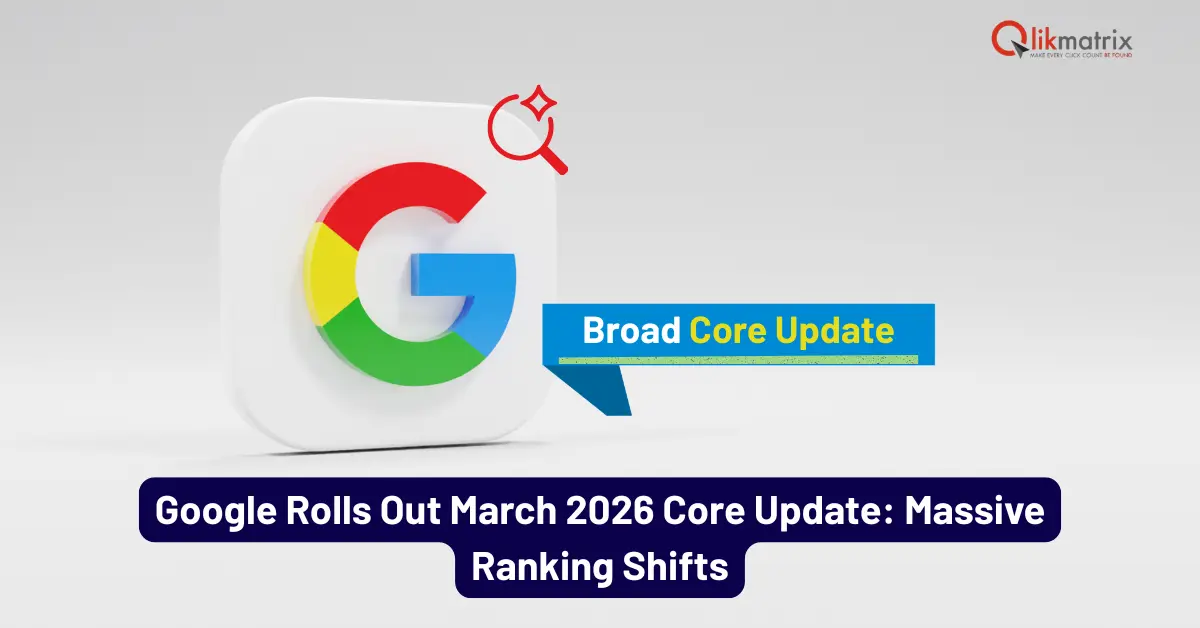
The March 2026 core update is live. Google confirmed the rollout began in the first week of March 2026, and if your rankings moved, up or down, this is the update behind it.
For anyone tracking SEO news today, Google ranking updates of this size don’t happen quietly. That’s why businesses relying on search engine optimization services need to pay close attention right now. Volatility started showing in rank trackers within 48 hours of the announcement. Some sites took visible hits. Others saw gains they hadn’t seen in months. Plenty are still waiting to see where they land.
The typical rollout time for core changes is two to three weeks. If your site was one of many that the update touched, this blog will explain what happened, who was affected, and what you can do based on the information we have thus far.
What is the Google March Core Update
The Google March core update is a broad core algorithm change. Broad core updates are how Google recalibrates the way it reads content quality across the entire web.
Google’s own guidance on these has been the same for years. Broad core updates aren’t built to penalize specific sites. They surface content that better serves search intent, and when that happens, sites getting more credit than they deserve tend to drop. Under-rewarded content comes up.
If your site got hit, Google isn’t saying something’s broken. It’s saying other content is now seen as more relevant for those queries.
That’s a harder thing to fix than a penalty. And a more important one.
What Did This Recent Google Update Actually Target
Based on early data from SEMRush Sensor, Ahrefs Rank Tracker, and Serpstat volatility reports, the March 2026 core update hit hardest in these areas:
- Thin content at scale. Sites running large volumes of short, surface-level articles, the kind that cover a topic without ever going deep, saw significant drops. This same pattern showed up in core updates going back to 2022. This one continued it.
- Unhelpful content dressed up as helpful. Pages that technically answer a question but don’t resolve what the person actually came looking for. Articles saying “it depends” across five paragraphs without ever explaining what it depends on. Google’s Helpful Content signals are now baked directly into the core algorithm, and this kind of content is getting hit hard.
- AI content with no editorial layer. Sites running automated content production without human review, fact-checking, or any original angle kept losing ground. Not about AI content across the board. Specifically about AI content that adds nothing to a topic already covered everywhere else.
- Weak E-E-A-T in YMYL niches. Health, finance, legal, and personal safety. Sites in these categories without clear author credentials, visible sourcing, and demonstrated expertise saw drops. Google’s focus on Experience, Expertise, Authoritativeness, and Trustworthiness has sharpened with every core update, and this one was no different.
What gained: Long-form, specific, well-sourced pages. Real authorship, original data or perspective, answers that actually closed the loop. Smaller niche sites with genuine depth in narrow topics also picked up ground, something that has shown up consistently across recent updates.
Early Data and Volatility Numbers
SEMRush Sensor hit 8.2 out of 10 in the first three days. Anything above 7 is considered high volatility. MozCast ran above 100 degrees for four straight days, same range as the September 2023 Helpful Content update and the March 2024 core update.
Industries with the highest movement in early tracking:
- Health and wellness: Heavy shifts both directions
- Finance and personal investing: Clear drops for thin affiliate content
- News and media: Mixed, with some established publishers gaining
- Ecommerce category pages: Drops where descriptions were duplicated or templated
Not a minor update. Early data puts this one on the same level as August 2023 and March 2024. Big update, not a background refresh.
Recent Google Update and How It Connects to the Helpful Content System
To understand what March 2026 is actually doing, you have to know what Google changed two years before it.
Back in September 2023, Google rolled out Helpful Content as its own separate system. Ran alongside everything else. Then March 2024 came, and that changed. Google pulled it into the core ranking system completely. Not a separate signal anymore. Not a layer you could isolate. Just part of how the whole thing works now.
So when March 2026 hit, it wasn’t running some new experiment. It was running on the same infrastructure that’s been judging content quality since early 2024. Sites that figured that out early are the ones gaining right now.
Sites chasing keyword density without depth are losing it. That direction is not new. This update just widened the gap.
What Should You Do If Your Site Was Affected
Don’t touch anything yet. Core updates take two to three weeks to finish. Rankings move around during rollout before they settle. Making changes mid-rollout muddies the water and makes it harder to read what actually happened.
Once it’s confirmed complete, run a content audit. Pull the pages that dropped and be straight with yourself:
- Does this page actually answer what someone searching this needs, fully and not just on the surface? Would they leave with what they came for or go look somewhere else?
- Does this page deserve to rank above everything else on this topic? Is there original data, real experience, a perspective, or depth that competitors don’t have?
- Who wrote this, and does the page actually show that?
If any of those answers are no, that’s the work.
Working with effective SEO services at this point matters more than it did a year ago. These services worth hiring right now aren’t doing surface-level keyword adjustments. They’re running content strategy audits, topical authority mapping, and E-E-A-T assessments. Exactly the things core updates are built to reward.
Points to Remember
- The March 2026 core update is sitting in the same volatility range as the major 2023 and 2024 updates. Not a routine refresh by any measure.
- Thin content, unhelpful answers, weak E-E-A-T in sensitive niches, AI content with no editorial layer. That’s what’s dropping. Specific, well-sourced, experience-backed content that actually closes the loop for the reader is rising.
- Site dropped? Content audit, not a technical fix. Core updates read content quality signals, not crawl errors or site speed.
- Search engine optimization services that actually understand Google’s Helpful Content framework are the ones worth working with right now. Surface-level SEO does not recover core update losses.
- Rollout is still ongoing. Don’t draw conclusions or make big moves until it’s confirmed complete.
FAQs
Q1. How long will the March 2026 Core Update take to fully roll out?
Ans. Google usually needs two to three weeks to complete a broad core update. Rankings can keep shifting until rollout is confirmed done. Don’t make decisions based on mid-rollout data.
Q2. My rankings dropped. Will they come back on their own?
Ans. No, not without fixing the content. Core update losses don’t flip back when the next update runs unless the actual quality issues get addressed. Google has said this plainly. Improving the content is the recovery path, not waiting it out.
Q3. Does this update affect all websites or just certain industries?
Ans. Broad core updates hit the whole web. Early data shows health, finance, and ecommerce moved the most. Probably because that’s where the highest concentration of thin or unhelpful content sits.
Q4. Is AI-generated content being specifically targeted?
Ans. Not across the board. What’s getting hit is low-quality content, shallow, unoriginal, no real value, regardless of how it was produced. Human-written thin content gets hit the same way.
Q5. What's the fastest path to recovery?
Ans. Find the pages that lost the most positions. Run them against Google’s quality guidelines honestly. Start with pages that were close to ranking well. Those respond to improvements faster than pages that fell completely off.