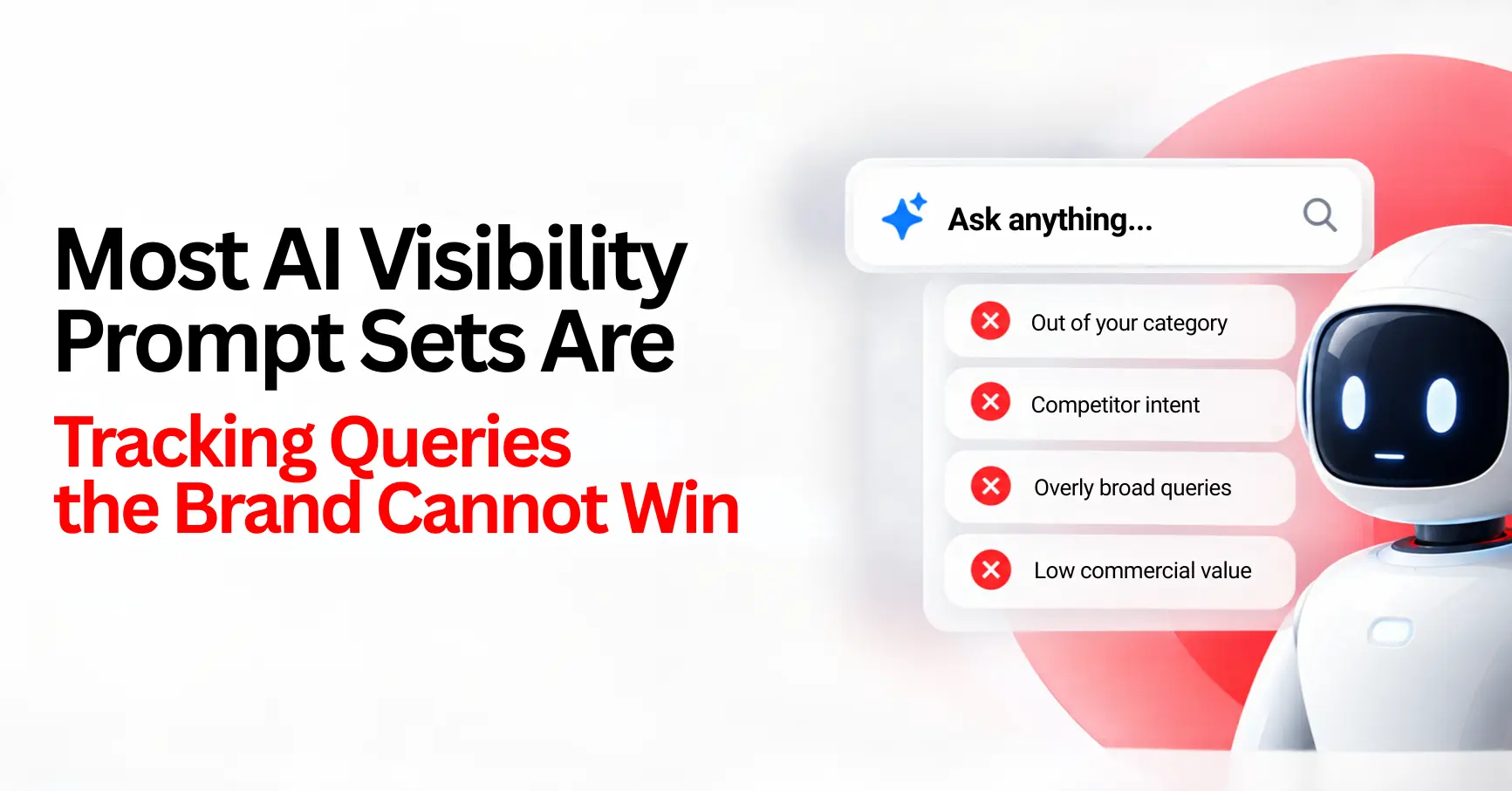
AI visibility prompt tracking only works when the prompts reflect questions your brand can realistically win. Most prompt sets are stuffed with broad category queries dominated by household names, which produces gloomy dashboards and bad decisions. A useful set is built around your niche, your buyers’ real language, and the stage where they’re choosing.
A marketing head once showed us a dashboard that looked like a crime scene. Forty prompts tracked across ChatGPT, Gemini, and Perplexity. The brand appeared in answers to two of them. By the time we joined the call, the room had already decided AI search wasn’t working for them.
Then we read the prompts.
“Best project management software.” “Top CRM tools in the world.” “Most trusted accounting platform.” The company sold appointment scheduling software for dental clinics in the UAE. It was never going to be named alongside Salesforce, and frankly it shouldn’t be. Nobody asking for a global CRM wants a dental booking app.
This is the quiet problem with a lot of AI visibility prompt tracking right now. The tracking tools are fine. The prompts are the issue. If you’re putting money into search engine optimization services so AI engines recommend you more often, your prompt set decides whether you ever see that progress or just watch a flat line and panic.
Why Do So Many Prompt Sets Start with the Wrong Questions?
Most prompt sets are born in a spreadsheet. Someone exports the top fifty SEO keywords, adds “what is the best” in front of each one, and calls it a strategy. It feels thorough. It’s also a bit like a neighbourhood café measuring success by whether it outsells Starbucks.
Keywords tell you where demand is. They don’t tell you where you can compete. AI engines build their answers from consensus, meaning the brands with years of reviews, press mentions, comparison listicles, and forum threads behind them. On a broad category prompt, that consensus is already settled, and it doesn’t include a company that launched in 2021.
There’s also a vanity angle nobody likes to admit. Leadership wants to see the brand next to the big names, so the big name prompts go in first. Understandable. Just not useful.
What Does a Prompt You Cannot Win Look like?
Usually it’s obvious once you look. Run the prompt in two or three AI tools and read the brands that come back. If every name is a global leader with ten times your review count, you’re not in the race. If the answer describes a product you don’t sell, or recommends providers in a country you don’t serve, that prompt is measuring someone else’s business.
A few other signs. The prompt is so broad that the AI answers with a generic definition instead of recommendations. Or the query assumes a price point or company size you don’t cater to. “Enterprise-grade” prompts for a tool built for three-person teams are a classic.
Tracking these every week is like checking whether you’ve been picked for the national cricket squad. You’re allowed to check. The answer just isn’t going to change by Tuesday.
Does It Really Hurt to Track a Few Long Shots?
It does, and not because the prompts are wrong to exist. The damage comes from how they bend the numbers.
Say a brand shows up in 70 percent of the prompts it can realistically win. Excellent. Now pad the set with enough long shots and the headline visibility score drops to something like 20 percent. Guess which number makes it into the monthly report.
We’ve noticed a pattern in client accounts when this happens. The team starts fixing the wrong things. Someone rewrites the homepage to sound more like a category leader. Budget drifts away from content that was actually earning mentions. The niche wins, the ones bringing in qualified leads, get buried under a score that was never fair to begin with.
A prompt set is a mirror of your strategy. Fill it with questions you have no business answering and the reflection gets ugly. Worse, it stops being accurate.
— Vishal Singh, Performance Marketing Specialist
How Do You Build an AI Visibility Prompt Set That’s Actually Useful?
Start with your customers, not your keyword tool. Sales calls, support tickets, onboarding forms, and the questions people ask in demos are gold here, because they show how buyers describe their problem before they know your name.
Then remember that nobody talks to ChatGPT the way they type into Google. A search query might be “dental booking software UAE.” The AI version sounds more like “I run a four-chair clinic in Sharjah and need booking software that sends reminders in Arabic, what should I look at?” Longer, messier, full of context. Your prompts should sound like that too.
Once you have a raw list, sort it into three rough groups.
Home ground covers prompts built around your niche, your location, and your specific use case. You should be winning most of these, and if you aren’t, that’s your first priority.
Contested prompts are comparisons and use case questions where you’re up against competitors of a similar size. This is where the real movement happens and where the best search engine optimization services earn their keep, because the gap is winnable with the right content and citations.
Stretch prompts are the big category questions. Keep a handful. Track them monthly, report them separately, and treat any mention as a bonus rather than a target.
Finally, cover the buying journey. Include prompts from someone who has just noticed the problem, someone comparing solutions, and someone ready to pick a provider. A set that only covers one stage tells you only a third of the story.
Around forty to sixty prompts is usually plenty. More than that and you’re managing a spreadsheet instead of a strategy.
How Often Should The Prompt Set Change?
More often than most teams think, but less often than they fiddle with it. A quarterly review works well for most brands. Add prompts when you launch a service or enter a new market. Promote stretch prompts to contested once you start appearing in them. Retire anything that no longer matches what you sell.
One more thing worth knowing. AI answers wobble. The same prompt can return different brands on Monday and Thursday, so run each one a few times before drawing conclusions. A single bad result is weather. A month of them is climate.
What Changes Once the Prompt Set is Honest?
Oddly enough, the mood in the room. When the dental scheduling brand rebuilt its set around clinics, UAE cities, and the reminder headaches their customers actually had, the visibility score went up overnight. Not because anything improved. The wins had been there all along, buried under questions about Salesforce. More importantly, the team could now see where they were close and what to write next. That’s the whole point of AI visibility prompt tracking. It should point you somewhere.
If your dashboard currently feels like bad news on repeat, check the questions before you blame the strategy. And if you’d like a team that builds prompt sets around where your brand can genuinely compete, our search engine optimization services start exactly there.
Frequently Asked Questions
Q1. What is AI visibility prompt tracking?
Ans. It’s the practice of regularly running a fixed set of prompts through AI tools like ChatGPT, Gemini, and Perplexity to see whether your brand gets mentioned or recommended in the answers.
Q2. How many prompts should an AI visibility prompt set include?
Ans. Most brands do well with forty to sixty prompts, weighted toward niche and comparison queries they can realistically win, with a small number of broad category prompts tracked separately.
Q3. Should we remove broad category prompts completely?
Ans. No. Keep a few as stretch prompts, but report them separately so they don’t drag down the score you use to make decisions.
Q4. How often should AI visibility results be checked?
Ans. Weekly checks are fine for spotting trends, but run each prompt several times per check and review the prompt set itself every quarter.
About the Author
Vishal Singh, Performance Marketing Specialist, works with brands on content, search, and AI visibility, and has a habit of reading the prompts before trusting the dashboard.