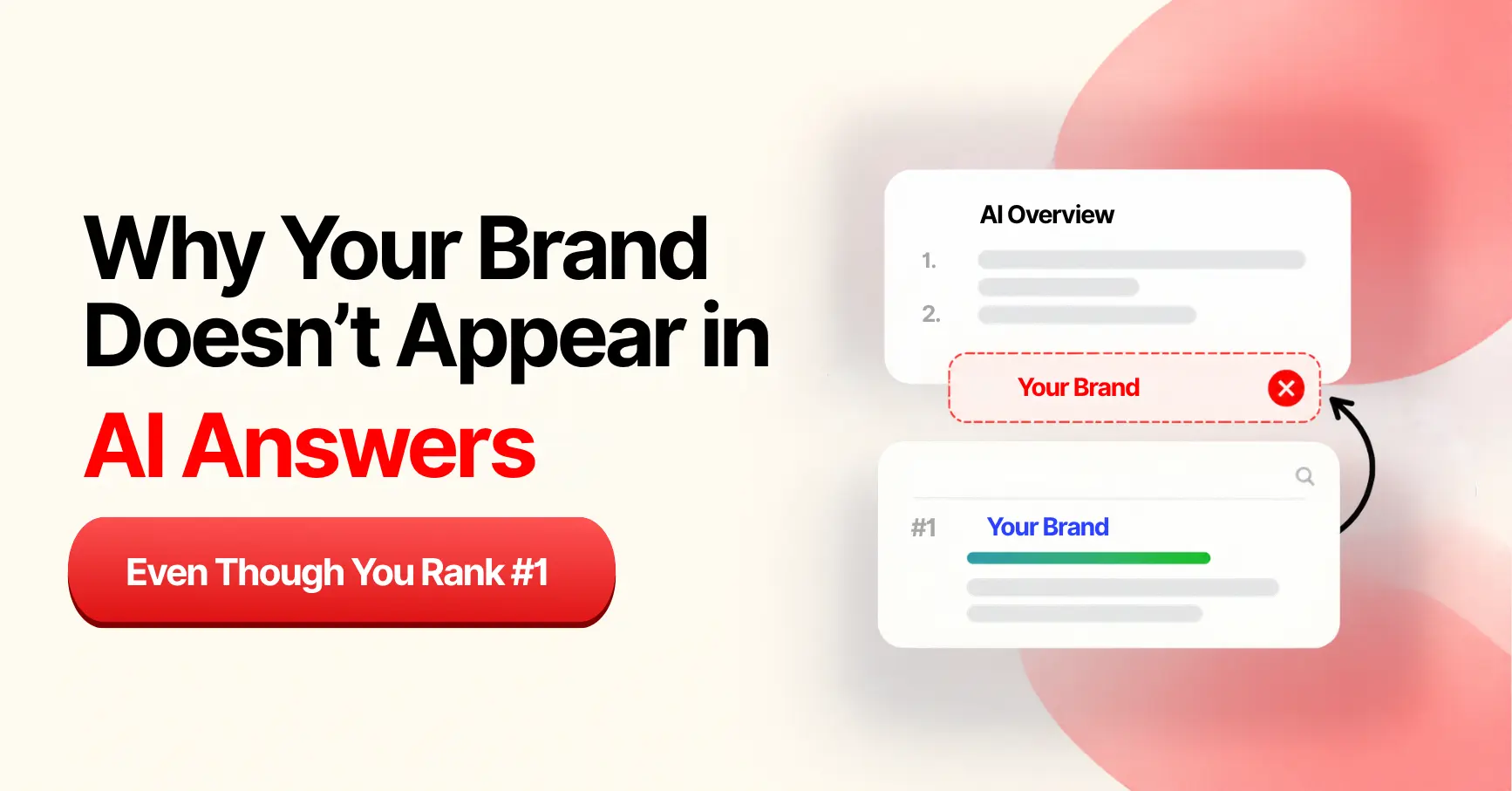
Ranking first on Google doesn’t guarantee a mention in AI answers. AI engines split a question into smaller searches, read several sources, and lean toward brands other people talk about. So if your brand is not showing in AI search, the problem is rarely your ranking. It’s usually trust, clarity or access.
Picture the meeting. Someone on the team opens ChatGPT, types in the one keyword the company has owned on Google for over a year, and hits enter.
The answer names three competitors. Then a Reddit thread. Then, somehow, a brand that closed down in 2024.
Nobody says anything for a second. (There’s usually a screenshot of that number one ranking pinned in a Slack channel somewhere, which makes it worse.)
We’ve watched some version of this happen in client accounts more often than we’d like to admit. And the first question is always the same. How? We did everything right.
Honestly, you probably did most things right. Getting cited by an AI just runs on slightly different rules than getting to the top of page one, and a brand not showing in AI search is missing out on conversations it has no idea are taking place. That’s why proper search engine optimization services now have to handle both jobs, not just the one we’ve all been measuring for years.
Isn’t Ranking First Supposed to Be Enough?
For a long time, yes. You typed a query, Google gave you ten blue links, and most people clicked the first one. Simple.
AI answers cut out the clicking. The person asks a question, the engine goes off and reads a handful of pages on their behalf, then comes back with one reply. Your page might well be in that handful. It could even be the best thing in there.
But the reply is a summary. And summaries are ruthless about what they leave out.
Here’s one way to picture it. You’re the best-rated restaurant on the street, and tourists have stopped walking the street. They just ask the hotel concierge. The concierge has read your reviews, sure. They’ve also read everyone else’s, plus whatever a food blogger wrote last month.
How Does an AI Engine Decide Which Brands to Mention?
This part surprises people. Most AI search tools don’t treat your question as one search. They break it apart, often into five or six smaller lookups, which is what people mean when they talk about query fan-out.
So a question like “which property consultant in Dubai is good for first-time investors” doesn’t go out as one query. It might become Dubai property consultants, advice for first-time buyers, consultant reviews, typical fees, maybe a quick comparison.
You rank first for “Dubai property consultant”? Great. That covers one of those lookups. For the rest, the engine leans on whoever keeps turning up.
Then there’s the question of what’s easy to quote. A page with a plain answer in the first few lines is a gift to an AI. A gorgeous page where the answer sits below the hero video, the testimonial carousel and a paragraph about company values is less of a gift. People will scroll past all that if they’re motivated. Machines, not so much.
Why Do Competitors with Weaker Rankings Keep Getting Named?
Short answer? Other people talk about them more.
AI engines put a lot of weight on what the rest of the internet says about you and noticeably less on what you say about yourself. When an answer lists recommended brands, it’s pulling from review sites, industry roundups, news coverage, forum threads, and those “top providers in Dubai” posts written by people you’ve never met.
So a competitor at position six can get named ahead of a brand at position one, simply because it shows up in thirty other places while the top-ranked brand mostly lives on its own website. Frustrating. Also very fixable.
Then there’s consistency, which sounds boring and matters a lot. If your website calls you one thing, your Google Business Profile says something slightly different and three directory listings still have your old address, the AI is less sure you’re a single, clear business. Less sure usually means less likely to recommend.
Ranking tells Google you’re relevant. Getting cited tells buyers you’re trusted. Those two used to be the same thing. They’ve drifted apart, and the brands that notice early are the ones that get named.
— Vishal Singh, Performance Marketing Specialist
Could Your Own Website Be Keeping AI Out?
Worth a look, because sometimes the answer is embarrassingly close to home.
Open your robots.txt file. Some sites block AI crawlers like GPTBot or PerplexityBot. Occasionally that’s deliberate. More often a developer copied a template in 2021 and nobody has opened the file since.
JavaScript can cause trouble too. If your key content only loads after a pile of scripts run, some crawlers basically see an empty page. Same goes for anything behind a form, a login, or a PDF that was only ever meant for a very patient human.
Your Google rankings won’t warn you about any of this. Which is exactly why it goes unnoticed for so long.
What Can You Do If Your Brand is Not Showing in AI Search?
First, go and look. Ask
ChatGPT, Gemini and Perplexity the questions your customers actually ask, worded the way they’d word them, typos and all. Write down who gets named and which sources get cited. That’s your real competitor list, and it often looks nothing like the one in your SEO report.
After that, most of the work falls into a few buckets.
Make your pages easy to quote. Lead with the answer. Use headings that sound like real questions. Add FAQ and organisation schema so there’s no confusion about who you are and what you do.
Get talked about somewhere other than your own site. Reviews, guest pieces, directories, credible roundups, and genuinely useful answers in the communities your buyers hang out in. This takes months, not weeks, and it’s where the best search engine optimization services earn their fee. Anyone can report rankings.
Fix the plumbing. Let in the crawlers you want, make sure important pages load properly without a wall of scripts, and get your business details matching everywhere.
So How Do You Know It’s Working?
Not from rankings, unfortunately. Pick a fixed set of realistic prompts and check them regularly. How often does your brand come up? How is it described? Which of your pages get cited? Expect the results to jump around, because AI answers change week to week. Watch the trend and ignore the odd bad Tuesday.
One genuinely good thing about all this. That number one ranking isn’t wasted. It tells you your content already has authority. You’re not starting from scratch, you’re just making that authority easier for an AI to use and getting a few more people to back it up.
And if you’re tired of ranking first and being mentioned never, our search engine optimization services were built for precisely that problem.
Frequently Asked Questions
Q1. Why is my brand not in AI answers when I rank first on Google?
Ans. Because AI engines don’t just grab the top result. They pull from several sources and favour brands that get mentioned widely and answer questions clearly, so a top ranking on its own often isn’t enough.
Q2. Do AI tools use Google rankings to choose sources?
Ans. Partly. A strong ranking helps a page get found, but AI tools also run a bunch of related searches and weigh what different sources agree on, so the top result doesn’t automatically get quoted.
Q3. How can I check if AI crawlers can access my website?
Ans. Start with your robots.txt file and look for rules blocking crawlers like GPTBot or PerplexityBot. Then check that your important content still shows up without heavy JavaScript.
Q4. How long does it take to start appearing in AI answers?
Ans. Technical fixes can show results in a few weeks. Building mentions and authority elsewhere usually takes a few months of steady effort.
About the Author
Vishal Singh, Performance Marketing Specialist, spends a lot of time asking AI tools awkward questions about brands and then working out why the answers look the way they do. See how the team approaches search engine optimization.