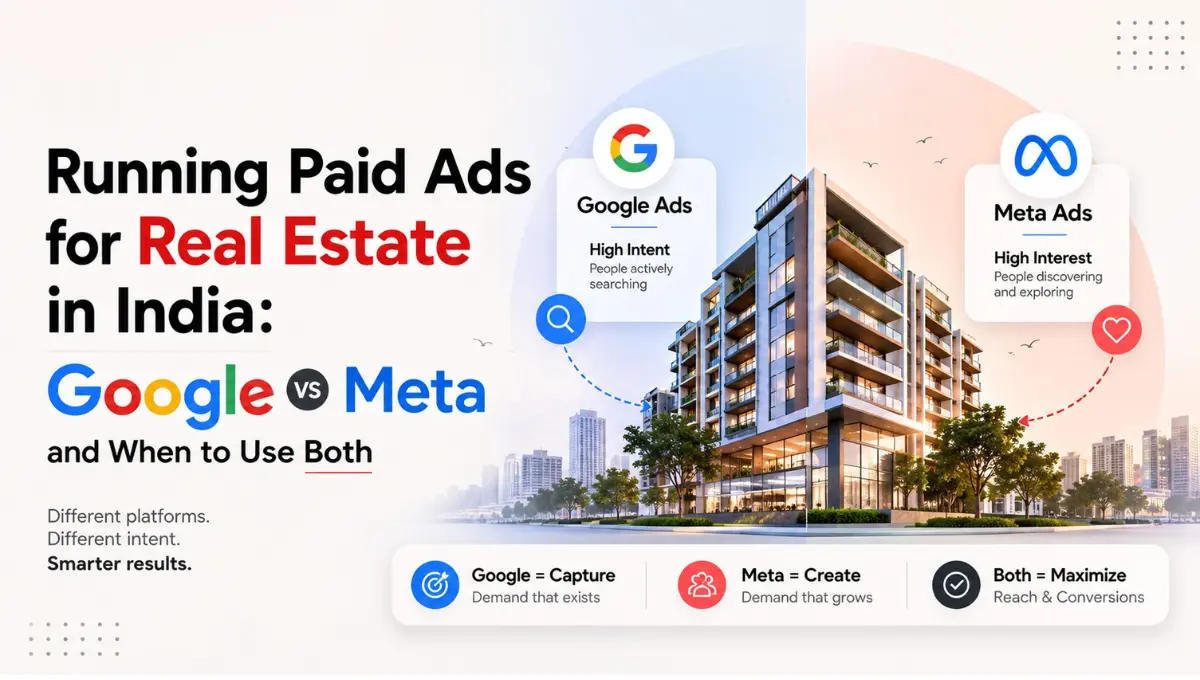
Google and Meta are like two very different guides on the Indian real estate journey. Google is the one who meets you when you’re already looking for a house, map in hand. Meta, on the other hand, is the friendly stranger who introduces you to a project you didn’t even know you might want. The magic really happens when both are doing what they’re best at, at just the right moment. If you only use one, you’re missing out on a whole set of buyers. If you use both but don’t play to their strengths, you might just end up spending double and getting half the results.
Most real estate teams we speak to tend to fall into one of two camps. They like Meta because the lead volume looks good, or they get frustrated with Google because the CPL looks expensive. Both reactions are understandable. The problem is that neither tells you much until you look at what happens to those leads afterwards.
The volume on Meta is real. So is the lower intent behind it. The higher CPL on Google is real. So is the significantly higher qualification rate on the other side of it. A lead that costs ₹900 on Google and converts to a site visit at 18 percent is a different asset than a lead that costs ₹300 on Meta and converts at 6 percent. The answer changes completely once you follow that lead past the form and into the sales process.
The channel question in Indian real estate is not Google or Meta. It is what each one is being asked to do and whether the ask matches what the platform actually delivers.
Why Google Search Is Where the Highest-Intent Real Estate Buyers Are Already Sitting
When someone searches “3BHK flats near Whitefield” or “ready-to-move apartments Baner Pune”, they have already done a fair amount of the thinking for you. They know the location. They usually know roughly what they want. In many cases, they are already comparing projects. Your job at that point is not to convince them to buy a home. It is to give them a reason to consider yours.
That is what makes Google valuable here. You are meeting the buyer when the intent already exists. Someone searched for exactly what you are selling, and you appear at that point of maximum intent. Cost per click in Indian real estate runs from ₹55 for mid-segment markets to ₹280 and above for metro and luxury segments where competition is higher. The CPL looks steeper than Meta in most accounts. The lead-to-site-visit conversion rate of 12 to 20 percent compared to Meta’s 5 to 10 percent is the number that reframes the comparison when tracked properly.
Bottom-funnel Google Search for exact buyer intent queries is where the qualified pipeline sits. Everything else is feeding that pipeline or warming it up.
What Meta Is Actually Good For in Real Estate and What It Is Not
Meta finds buyers who do not know your project exists yet. Lower intent, but a vastly larger audience. That is not a criticism. It is a description of what the platform does well and what it does not.
Meta is the right channel for awareness campaigns that introduce a project to audiences who fit the buyer profile but are not actively searching. It is the right channel for retargeting people who visited the site, watched a walkthrough video, or engaged with previous ads. Where it starts going wrong is when you take a cold Meta audience that has never heard of the project and immediately ask them to book a site visit.
A ₹150 CPL on Meta for a real estate project does not compare to a ₹900 CPL on Google if the Google lead closes at 12 percent versus the Meta lead at 2 percent. The CPL comparison that most clients lead with is not the useful comparison. The more useful number is what happens after the lead comes in. How many qualify, how many visit the site, and eventually, how many actually book.
What the Right Budget Split Actually Looks Like
There is no magic 70:30 split that works for every developer, but as a starting point, we usually want the larger share sitting with Google when there is enough search demand to support it. Google takes the high-intent searches. Meta does more of the awareness, retargeting and audience-building work. The exact split changes depending on whether the project is established, newly launched, or operating in a market where search demand is still limited.
Where this changes is for new project launches where no one is searching for the project yet and brand awareness has to be built first. In that window, the Meta allocation runs higher until search volume exists to capture.
“The biggest mistake we see in real estate paid media is running the same CTA on both Google and Meta. Google buyers have already decided they want to buy — they need a reason to choose your project. Meta audiences are browsing — they need a reason to want property at all. Same CTA on both channels means you’re either under-selling to Google’s high-intent audience or over-asking from Meta’s cold audience. Both waste budget.”
— Vishal Singh, Performance Marketing Specialist
Why Click-to-WhatsApp Is Outperforming Instant Forms in Indian Real Estate Right Now
Standard Instant Form campaigns on Meta see around a 30 percent drop-off before form submission in Indian real estate. The form fields, the extra tap, the moment of friction between intent and completion- all of it reduces the volume that makes it through.
Switching from Instant Forms to Click-to-WhatsApp has reduced CPL by up to 40 percent in some Indian real estate campaigns. The obvious reason is friction. There is less of it. A buyer taps the ad, a WhatsApp chat opens with a pre-filled message, and the conversation starts immediately in the app they already use for everything. Instead of asking the buyer to fill everything out before they even speak to someone, you start the conversation first and qualify them from there.
The trade-off is response time. WhatsApp leads expect a reply within minutes. If the sales team cannot match that speed, a well-optimised Instant Form with immediate callback will outperform an unanswered WhatsApp inbox every time.
When Each One Wins, Google Ads vs Meta Ads for Real Estate India CPL
Google Ads wins when the buyer is already searching, the project has an established brand and landing page, the sales cycle is short, and the team can handle quality leads at a higher CPL with confidence in the downstream conversion rate.
Meta Ads wins when the project is new, and awareness needs to be built before search volume exists, when retargeting a warm audience of site visitors and video viewers, and when targeting buyers in Tier 2 and Tier 3 cities where vernacular creative on Meta can reduce CPL by 28 to 40 percent compared to English-only campaigns.
So comparing Google and Meta purely on CPL is still the wrong exercise. The better question is whether each platform is doing the job you are paying it to do.
Why Most Real Estate CPL Problems Are Actually Landing Page Problems
Before blaming the channel, the creative, or the targeting, look at the landing page. In real estate, this is often where the biggest leak actually is.
Even a small improvement in landing page conversion rate can change the economics of the entire campaign. If more of the people who are already clicking actually convert, your CPL comes down without changing the audience, creative or bidding strategy.
Before increasing budget or switching platforms, checking the landing page load speed on mobile, the match between ad copy and landing page headline, and the friction in the lead capture form will move CPL faster than any channel optimisation will.
What Comes Up Every Time We Have This Conversation
Q1. Should a new real estate project start with Google or Meta?
Ans. If it is a brand-new project with no existing demand, I would usually start heavier on Meta. You need to create awareness before you can expect much project-specific search demand. Once people are actually searching for the project, the location or the type of property, Google becomes much more valuable. Launching Google Search on a project nobody has heard of means bidding on generic category terms at high CPC with low intent specificity.
Q2. Why does Meta CPL look lower but conversion rates stay poor?
Ans. Because Meta CPL reflects form submissions, not qualified buyers. The intent gap between someone who filled a form while scrolling and someone who searched for a specific project in a specific location is significant and shows up clearly in lead-to-site-visit and site-visit-to-booking rates.
Q3. Is WhatsApp integration worth setting up for every real estate campaign?
Ans. For Indian real estate, I would at least test it. The friction reduction is meaningful, and the format aligns with how buyers in India prefer to communicate with developers and brokers. The prerequisite is a sales team that can respond within minutes, which is the part most teams underestimate before switching.
Written by Vishal Singh, Performance Marketing Specialist
I manage paid media strategy for real estate clients across Indian markets. The channel split and CPL benchmarks in this article come from live campaigns, not aggregated industry reports.
For more on how we approach performance marketing across Google and Meta, visit our digital marketing services.