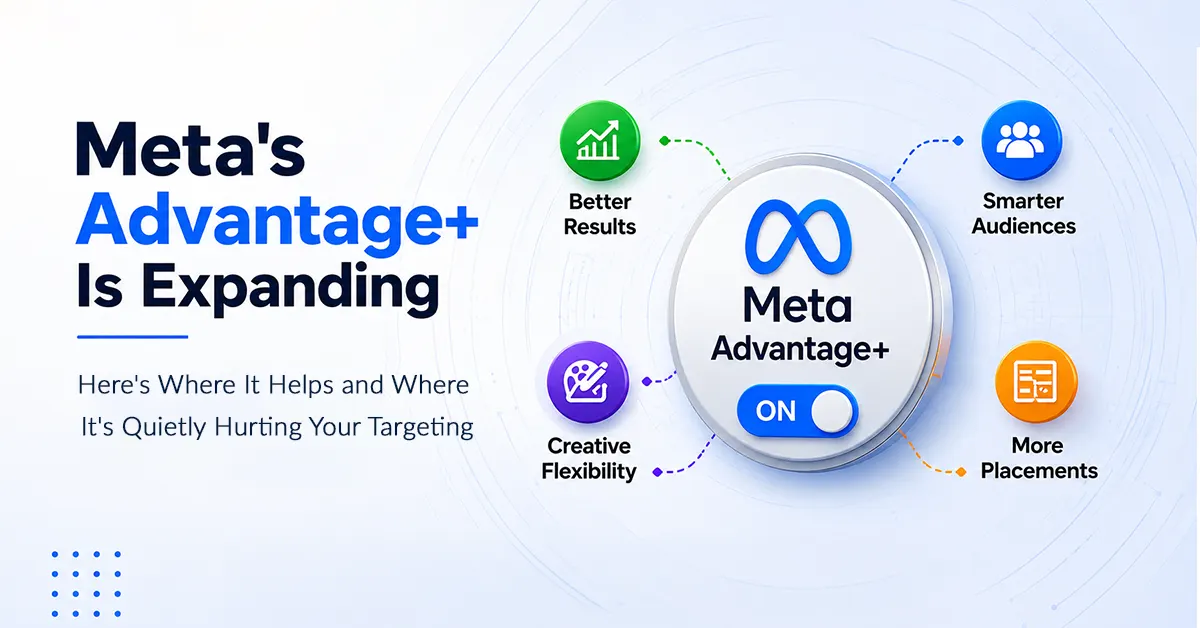
Meta Advantage Plus for B2B lead generation in 2026 isn’t just a single story with a neat ending. It’s more like two parallel tales, and which one you end up living depends entirely on what you feed the algorithm. If your conversion signals are sharp and your creative is actually pulling its weight, Advantage+ can really boost your returns. But if those pieces aren’t in place, the system just goes out and finds the easiest, cheapest audience it can, usually not the people you actually want to reach.
Earlier this year, a client walked in absolutely certain that Meta had somehow broken their account. Their cost per lead had doubled in just three months, lead quality had nosedived, and the trusty targeting they’d leaned on for two years had just fizzled out. Something had definitely changed. It just wasn’t the thing they thought it was.
On January 15, 2026, Meta stopped delivering ads from any ad set using deprecated detailed targeting interests. Campaigns that had not been updated were simply not serving impressions, and in a lot of cases nobody noticed immediately because the account still looked active. The targeting did not break. The targeting was removed, and the accounts that had been built on interest stackings suddenly had very little left for Meta to work with.
That’s the environment Advantage+ is working in now, which makes the real question much simpler. Is the account giving the algorithm enough useful signal, or isn’t it?
What January 15 Actually Changed and Why It Is Permanent
Meta removed dozens of specific detailed targeting interest categories on January 15, 2026, making granular interest stacking largely unavailable for most advertisers. Detailed targeting options still exist in Ads Manager, but the way Meta uses them has fundamentally changed. They are suggestions now, not constraints. The algorithm treats your interest selections as a soft starting point and delivers to whoever it believes will convert, regardless of the interests you specified.
Detailed targeting exclusions, which used to be a standard tool for audience hygiene, were fully removed on January 31, 2026. If a campaign was still running with excluded audiences after that date, delivery stopped. No warning, no grace period. Just stopped.
This is not a temporary test, and it is not a pendulum that will swing back toward manual control. Meta’s Andromeda delivery engine is the direction the platform is moving, and the practical implication is that the quality of your conversion data and the intelligence of your creative now matter more than any targeting configuration you build manually.
Why the 22 Percent ROAS Lift Stat Does Not Tell the Whole Story for B2B
The headline number on Advantage+ performance is real. Meta’s internal benchmarks show Advantage+ Audience delivers up to 32 percent lower CPA and 13 percent lower cost per catalog sale compared to manual targeting setups. Advantage+ campaigns represent the majority of e-commerce ad spend on Meta, and the results in high-volume B2C categories are consistent.
That’s where B2B starts to break away from those headline numbers. Most B2B accounts simply don’t produce the same volume of conversion data as e-commerce, so expecting the algorithm to behave the same way doesn’t really make sense.
Advantage+ requires at least 50 weekly conversions for the algorithm to exit exploration mode and start optimising meaningfully. Below that threshold, the system is not learning. It is guessing with your budget while it looks for enough signal to do something useful. Accounts running below that conversion volume on Advantage+ are not underperforming. They are running a campaign type that was not designed for their data reality.
Why Creative Is Now the Primary Targeting Lever Whether You Treat It That Way or Not
In a broad targeting environment where the algorithm decides who sees the ad, the creative is the only thing left that actually directs who gets reached. Meta’s system uses computer vision and natural language processing to read the content of an ad and infer which users are most likely to respond to it. At that point, the creative isn’t just speaking to potential customers anymore. It’s also telling Meta who those customers are.
One ad set with five distinct creative concepts, each speaking to a different problem, a different persona, a different buying stage, reaches fundamentally different audience segments even if the targeting configuration behind all five is identical. Five minor variations of the same concept with different headline colours reach the same audience five times. Most B2B teams are running the second setup and wondering why Advantage+ keeps finding the wrong people.
“The pattern we’ve seen across B2B accounts on Meta Advantage+ works exactly as advertised when the conversion signal is clean, and the creative is doing real targeting work. When neither condition is met — when the pixel is tracking form fills that never became leads, and when creative is five variations of the same headline — the algorithm explores broadly and finds the cheapest audience it can. That audience is never your ICP. Creative is not a production task anymore. It’s the primary input that tells Meta who to find.”
— Vishal Singh, Performance Marketing Specialist
What Sending Qualified Lead Signals Back Through CAPI Actually Does to the Algorithm
The biggest improvement we’ve seen has nothing to do with targeting. It starts with the conversion event you’re asking Meta to optimise for. Most B2B accounts tell the algorithm a form fill is a success. The business doesn’t. The business cares about qualified leads and closed deals. Those aren’t the same thing, and that’s where the learning starts to drift.
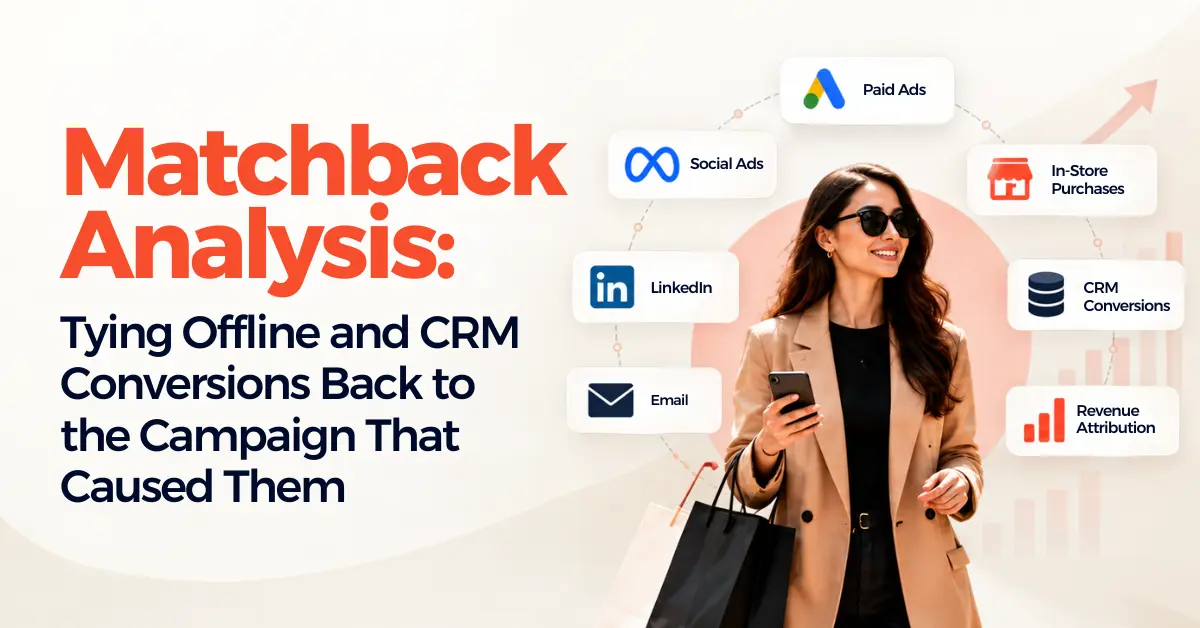
Configuring the Conversions API to send qualified lead signals back to Meta, specifically SQL stage events, pipeline stage updates, and closed-won outcomes from the CRM, trains the algorithm on the leads that actually became revenue rather than the ones that filled in a field and disappeared. Once Meta starts learning from qualified leads instead of every form submission, the audience it finds changes surprisingly quickly.
Clean conversion data has quietly become one of the biggest competitive advantages on Meta. The more control the platform takes over delivery, the more important those signals become.
Advantage Plus vs CRM Custom Audiences. When Each One Actually Wins
Advantage+ works well when the audience is broad enough for the algorithm to explore, conversion volume is above 50 per week, creative is conceptually diverse, and CAPI is sending qualified downstream signals back to Meta. E-commerce accounts, high-volume B2C lead generation, and B2B campaigns with relatively wide ICPs fall into this category. This is where the 32 percent CPA reduction and the ROAS improvements show up.
CRM custom audiences outperform Advantage+ when the total addressable market is genuinely small, when the ICP is defined by firmographic data that Meta’s interest categories cannot replicate, and when conversion volume is too low to give the algorithm meaningful signal. Selling to CFOs at SaaS companies with 50 to 200 employees is a use case where interest targeting combined with CRM custom audiences consistently outperforms broad AI exploration because the audience is too small for exploration to be efficient and the cost of reaching the wrong people is too high to absorb while the algorithm learns.
Choose Advantage+ if your ICP is broad enough for the algorithm to find them without manual guardrails and your data infrastructure is clean enough to train it properly. Choose CRM custom audiences if your audience is small, your deal size is large, and the cost of a misqualified lead is real money.
What We Hear Every Time This Comes Up
Q1. Does Advantage+ work for B2B at all or should it be avoided?
Ans. It works when the conditions are right. Sufficient conversion volume, clean CAPI signals, and creative that gives the algorithm something specific to work with. When those conditions are not met, it finds the cheapest reachable audience, which is almost never the right one for B2B. Most of the time, the platform isn’t what’s failing. It’s learning from the wrong inputs.
Q2. How many weekly conversions does a B2B campaign actually need before Advantage+ stops exploring?
Ans. The threshold is around 50 weekly conversion events for meaningful optimisation. Below that, the algorithm is in exploration mode, and CPA will swing significantly. Accounts running below that volume should focus on building conversion data first, using CRM lookalikes and retargeting to generate initial signal before transitioning to broad Advantage+ campaigns.
Q3. What is the fastest Meta Advantage Plus targeting problems fix for a B2B account that is generating poor quality leads?
Ans. Start with the conversion event. If the pixel is optimising toward form fills, reconfigure CAPI to pass qualified lead events from the CRM. The algorithm will start finding different people almost immediately. Then audit the creative for conceptual diversity. If all active creative is variations of the same message, the algorithm has no way to differentiate between audience segments regardless of what the targeting settings say.
Q4. Should B2B advertisers still use any detailed targeting at all in 2026?
Ans. As a seed signal for Advantage+, yes. As a hard audience constraint, no. The most effective B2B setup in 2026 layers CRM custom audiences and lookalikes into Advantage+ as starting signals rather than building manual ad sets around interest categories that the algorithm will override anyway. Use what you have in the CRM as the input. Let Advantage+ do the exploration from that starting point.
Written by Vishal Singh, Performance Marketing Specialist
I manage Meta lead generation campaigns across B2B accounts in the UAE and internationally. The Advantage+ patterns in this article come from live accounts navigating the January 2026 changes, not from benchmark reports written before the targeting environment changed.
For more on how we approach paid media strategy and lead generation, visit our SEM services.