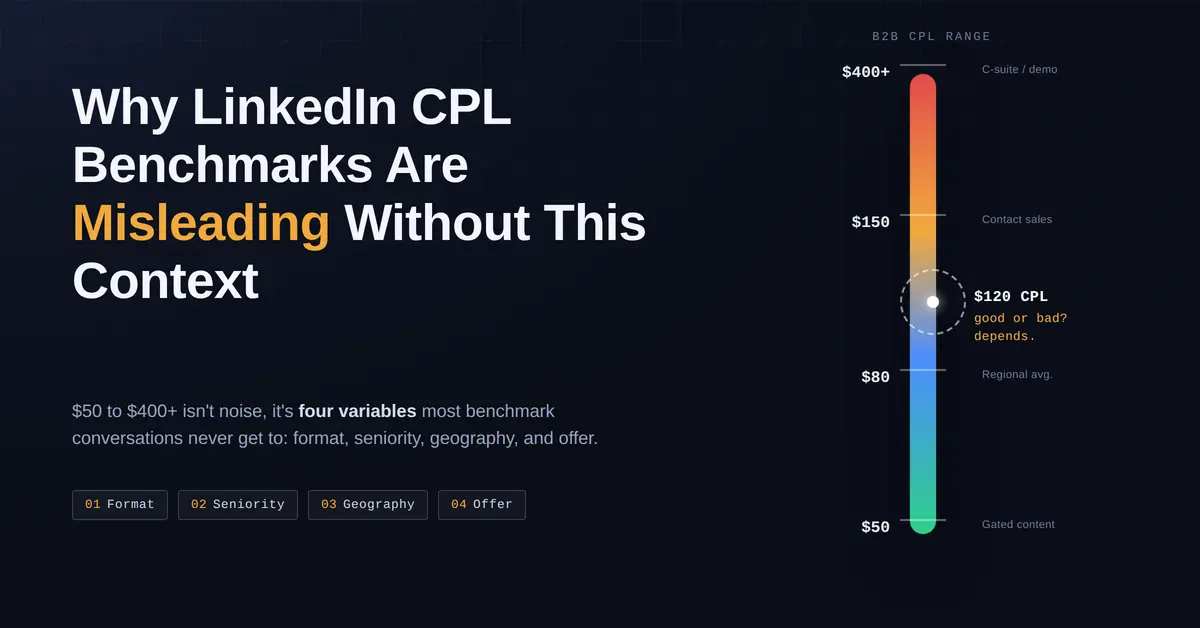
If you look at LinkedIn CPL benchmarks for B2B in 2026, you’ll see numbers anywhere from $50 to well over $400. It sounds like a wide range, but there’s a reason for it. The number itself isn’t wrong, it’s just missing the story behind it. The four big variables that decide if your CPL is something to celebrate or something to worry about. I want to walk you through all four, and also share what a real minimum budget looks like if you actually want LinkedIn’s algorithm to do its job.
I often get asked by clients if a $120 CPL on LinkedIn is good or bad. And honestly, the answer is always the same, it depends on things the number alone just can’t tell you.
Which format are they running? What seniority are they targeting? What is the offer? Where is the audience geographically? Because the same $120 CPL can be genuinely efficient or quietly catastrophic depending on the answers to those four questions, and most LinkedIn benchmark conversations never get that far. They stop at the number, compare it to a global average, and draw a conclusion that may have nothing to do with what is actually happening in the account.
LinkedIn CPL benchmarks B2B 2026 exist on a range from $50 all the way past $400, and the spread is not noise. Once you break the benchmark into the factors driving it, the range starts making a lot more sense.
Why Two Campaigns Targeting the Same Person Can Have Completely Different CPLs
The format decision alone can swing CPL by 30 to 50 percent, and most advertisers do not realise this because they are comparing campaigns that are not actually comparable.
Lead Gen Forms, the ones where the user fills in their details without leaving LinkedIn, run at $50 to $130 CPL across most B2B categories in 2026. The same campaign, with the same audience, sent to an external landing page instead, runs 30 to 50 percent higher on CPL. Not because the audience changed. Not because the creative changed. Because LinkedIn pre-fills the form with profile data and the friction nearly disappears, so more people complete it.
It sounds obvious once you see it, but this is where a lot of benchmark comparisons go wrong. One is running Lead Gen Forms, one is sending traffic to a landing page. Their CPLs look very different, and the instinct is to assume the higher one is underperforming. It might just be on the wrong format.
What Happens to Your CPL the Moment You Move Up or Down the Seniority Ladder
Seniority targeting is the most reliable lever for moving LinkedIn CPL in either direction, and it works exactly the way you would expect once you see the numbers.
Targeting individual contributors rather than senior decision-makers brings CPL down 30 to 40 percent. Targeting the C-suite exclusively pushes CPL up 40 to 60 percent compared to the director-level baseline. The audience gets smaller and more competitive at every step up, and the auction reflects it immediately.
Here’s why this changes the conversation. The $120 CPL targeting VPs and Directors is a very different result from a $120 CPL targeting the C-suite. The first one might be above benchmark. The second one is actually below it. The raw number is the same. The context is completely different and changes what you should do next.
Why Most Teams Are Running the Most Expensive Format Out of Pure Habit
Single image ads are the default in LinkedIn Campaign Manager. They are the first format in the list, the easiest to set up, and the one most teams have always used. They are also consistently among the more expensive formats on a cost per click basis.
Thought Leader Ads, which run from a personal profile rather than a brand page and appear as organic-looking content in the feed, regularly deliver CPC well below what single image sponsored content costs at equivalent targeting. CTR runs two to five times higher on average. The format has been around for a while, but surprisingly few B2B teams are using it. Most stick with single image ads because that’s what they’re familiar with, not because it’s necessarily the better choice.
Document Ads follow a similar pattern. Users can swipe through content natively without leaving the feed, engagement runs high, and CPL tends to land below single image campaigns on the same audience. If you have never run either format and you are currently unhappy with your LinkedIn CPL, this is where to start before touching the audience or the budget.
“In UAE B2B targeting, we consistently see CPL running 2.5–3x global benchmarks at equivalent seniority levels — a $80 global CPL becomes $200–$240 in the UAE market. The audience is smaller, the advertiser pool competing for the same decision-makers is growing, and most clients who brief us with global benchmark expectations need to be recalibrated before month one ends.”
— Vishal Singh, Performance Marketing Specialist
What Your Offer Is Doing to Your CPL Before the Targeting Does Anything
Offer type is the biggest single variable in LinkedIn CPL, and it is also the one that gets the least attention in benchmark conversations.
A gated content download runs around $45 CPL. A webinar registration sits around $55. A demo request comes in around $115. A contact sales CTA lands closer to $150. The same audience, the same format, the same targeting, just a different ask at the end of the ad. The CPL difference is not performance. It is friction. The further down the funnel the offer sits, the fewer people will convert at any given cost.
This is exactly why comparing CPL without looking at the offer can be misleading. A $150 CPL on a contact sales campaign shouldn’t be measured against a $45 CPL on a content download. They are measuring different things. One is capturing curiosity. The other is capturing intent. Comparing them is like saying a test drive lead is underperforming against a newsletter signup because it cost more.
What a LinkedIn Ads Minimum Budget for Lead Generation Agency Work Actually Requires
This is the question most briefs get wrong from the start. LinkedIn’s algorithm can only optimise once it has enough conversion data to learn from. If the campaign isn’t generating enough impressions, clicks, and conversions, it never gets the signal it needs to improve.
Running a LinkedIn Ads minimum budget lead generation campaign at $300 to $500 a month is not a campaign. It is a test that will never generate enough conversions for the algorithm to learn anything useful, and the CPL that comes out of it will look bad not because the targeting is wrong but because the system never had enough signal to work with.
The minimum viable budget for a single LinkedIn campaign to generate enough conversion data for meaningful optimisation is $1,000 to $2,000 per month. Per campaign. That is the floor for getting numbers you can actually make decisions from. Below that, you are not optimising. You are guessing slowly at a premium CPM.
Industry Average CPL vs Your Deal Size Ceiling
This is where industry benchmarks start reaching their limit. Most benchmark reports combine thousands of campaigns across different offers, seniority levels, geographies, and deal sizes into a single average. That’s useful for understanding the market, but it doesn’t tell you whether your own campaign is performing well.
A much better benchmark is your own deal economics. Work backwards from your average contract value, close rate, and customer acquisition target to figure out the maximum CPL your business can comfortably sustain. That’s the number your campaigns should be measured against.
A $150 CPL with a 20% sales accepted rate is far less valuable than a $300 CPL with a 60% sales accepted rate if the deals justify the acquisition cost. Ultimately, the only benchmark that really matters is whether your CPL still makes sense once revenue enters the conversation.
What Usually Comes Up When We Have This Conversation With Clients
Q1. Is a $200 CPL on LinkedIn too high?
Ans. Without knowing the format, seniority, offer, geography, and deal size, there is no way to answer that. A $200 CPL targeting the C-suite in the UAE on a demo request offer could be very efficient. The same $200 CPL targeting individual contributors on a content download in North America would be a significant problem. Context is the only thing that makes the number meaningful.
Q2. Should every campaign use Lead Gen Forms instead of landing pages?
Ans. For top-of-funnel volume and lower CPL, Lead Gen Forms almost always win. For bottom-of-funnel qualification, landing pages give more control over the experience and tend to produce better lead quality at the cost of higher CPL. The right answer depends on what the campaign is trying to do and where in the funnel it sits.
Q3. What is the minimum LinkedIn Ads budget lead generation agency teams should recommend to clients?
Ans. Per campaign, $1,000 to $2,000 a month is the practical floor for generating enough data to optimize against. If a client cannot commit to that, I’d usually recommend waiting until the budget is there instead of stretching a LinkedIn campaign so thin that it never has a chance to optimise properly.
Q4. How much does geography change CPL?
Ans. Significantly. North American benchmarks are often used as global defaults but do not reflect what happens in smaller or more competitive markets. UAE B2B targeting specifically runs at 2.5 to 3 times global benchmarks at equivalent seniority levels because the addressable audience is smaller and the advertiser pool competing for the same decision-makers is growing every quarter.
Written by Vishal Singh, Performance Marketing Specialist
I work across LinkedIn and paid media strategy for B2B clients in the UAE and internationally. The numbers in this article come from campaigns we’ve actually managed, not just benchmark reports. That’s why we treat industry averages as a starting point, not the final answer when we’re evaluating performance. Why do we think the aggregators need more context around them.
For more on how we approach paid media strategy, visit our search engine marketing services.