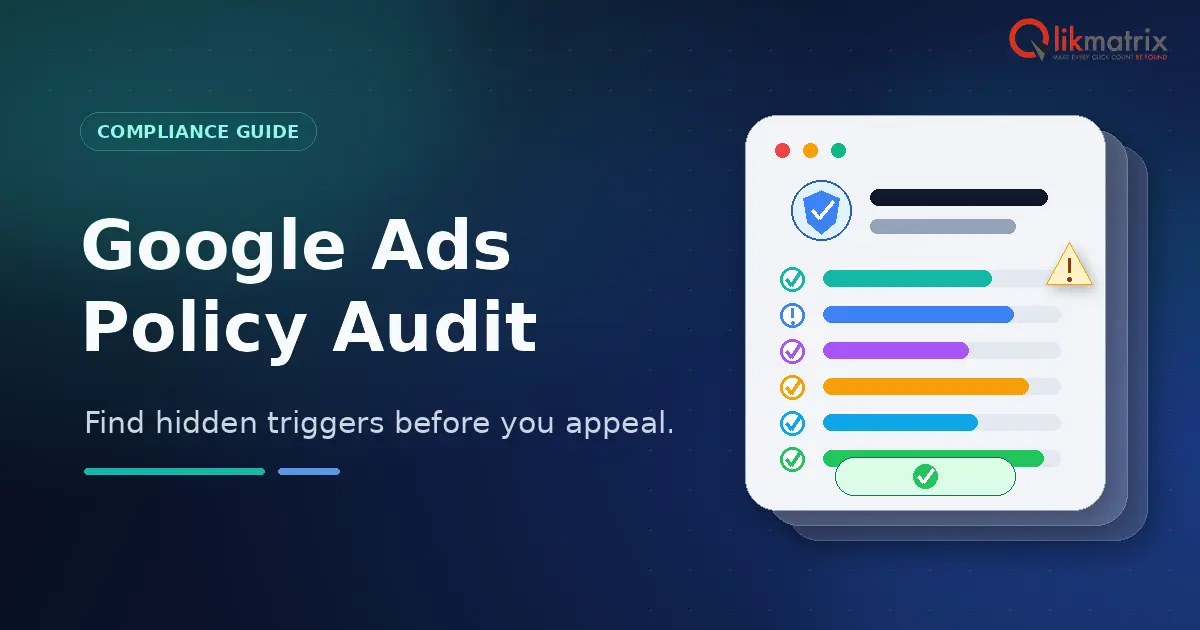
A Google Ads policy disapproval audit that starts at the ad is already starting at the wrong place. Most flagged accounts have three or four additional violation triggers beneath the one that surfaced. This six-layer framework covers what those triggers are, where to find them, and why fixing them has to happen before any appeal gets written.
Does Google Remember Every Flag Your Account Has Ever Had
Yes, and this is the layer most audits do not even get to. Google’s enforcement does not look at each violation fresh. It looks at everything the account has on record and calibrates how hard it responds based on what it already knows about you.
A first disapproval in a clean account and a first disapproval in an account with three resolved warnings from the past year are not the same thing, even if the violation is identical. Those old warnings did not go away when they were resolved. They became part of how the account gets treated going forward.
A proper Google Ads policy disapproval audit starts here, with a full pull of policy history across every campaign, every period of Limited Ad Serving, every warning that got closed without a real structural fix underneath it. That history is the lens through which everything else gets read. Skip it, and the rest of the audit is already working with incomplete information.
Why Is the Landing Page Getting Your Ad Disapproved
This is the one that catches people off guard every single time. Google’s crawler looks at your landing page on its own, separately from whatever the ad copy says. Which means a destination page with the wrong trust signals, or missing ones entirely, can fire a misrepresentation flag without the ad doing anything wrong at all.
Over 95% of Google Merchant Center suspensions are flagged for misrepresentation, and almost every time, the landing page is where the actual signal is sitting. The LP crawl checks for business name and contact details you can see without scrolling, a privacy policy that does not take three clicks to find, consistent naming between your domain and your ad destination, and no broken or half-built content anywhere in the flow a user would actually travel.
If someone lands on your page and cannot tell within a few seconds who they are dealing with or what happens after they fill in their details, Google’s crawler already clocked that. Your ad copy had nothing to do with it.
Why Does “Apply Now” Get an Ad Flagged and What Does Your Billing Have to Do With It
Google is reading intent you didn’t even know you were broadcasting.On the ad copy side, Google’s intent classifiers work on patterns, not interpretation. Phrases like “apply now,” “get approved,” or “register today” land in government and financial service intent categories in sensitive verticals, regardless of what you are actually selling. A Google Ads account flagged policy fix at this layer is rarely about cutting the phrase. It is about adding enough context around it that the classifier stops reading the intent wrong.
On the billing side, unverified advertiser identity sitting alongside an active violation is not two separate issues to Google. It reads as one compounded risk signal. Billing verification gaps account for about 6% of suspensions by category, but where they really show up is as fuel when something else is already burning. Any account with an open violation and incomplete verification is in a worse spot than the violation alone would suggest. That needs to be confirmed clean before an appeal goes anywhere.
“Every flagged account we’ve audited had the disapproval as the first catch, not the only violation. The real audit finds the 3–4 other triggers that would have fired in the next campaign cycle and fixes those before a single appeal is submitted.”
— Vishal, Performance Marketing Specialist
Can One Suspended Client Account Cause Problems for Every Account in Your MCC
This is the one nobody thinks about until it is already their problem.
Google looks at linked accounts and manager account structures when it is reviewing for policy violations. A suspended client account sitting inside an MCC, especially one that shares industry patterns, ad copy themes, or billing structures with other accounts in the same manager, can push risk signals across the whole group. The suspension does not stay neatly contained on its own.
Any performance marketing agency running accounts at real volume needs to be treating client account health as something it checks regularly, not something it looks at when a flag appears. If a client account is already suspended, the first question the audit should be asking is what that account has in common with everything else in the MCC, before anything else gets touched.
Here Is What Actually Separates Them in a Documented Appeal vs a Vague One
It is not about how well the appeal is written. It is about whether it gives the reviewer anything concrete to work with.
A documented appeal names the layer where the problem was found, describes exactly what was changed, and confirms the fix was live in the account before the appeal was submitted. Accounts that do this consistently see around a 73% success rate on the first attempt. The AI reviewer has something real to match against the flag.
A vague appeal says the account has been reviewed and is now in line with policies. Nothing specific, no confirmation of what actually changed, usually submitted before the fix is even done. These fail at a high rate regardless of whether the underlying issue was genuine, because there is nothing for the reviewer to verify against.
If the audit is not finished, the appeal is not ready. That sequence is not negotiable.
The Questions We Get Asked Every Time Someone’s Google Ads Account Gets Flagged
Q1. Is fixing the disapproved ad usually enough to get it reinstated?
Ans. Rarely, if there are other unresolved signals sitting underneath it. Google reviews the account as a whole, not just the item that got flagged. A landing page gap or an incomplete billing verification can keep things held up even after the ad is corrected.
Q2. How fast does Google actually review appeals now?
Ans.As of 2026, 99% of appeals are resolved within 24 hours through AI review. Fast is not the same as accurate, though. First-attempt rejections are still common, which is exactly why the first appeal needs to be documented properly rather than sent quickly.
Q3. Can a resolved disapproval still cause problems later?
Ans. Yes. Resolved flags stay in account history and raise enforcement severity on future violations. Fixing the immediate issue without auditing for patterns that could retrigger it is how accounts end up in the same situation three months later.
Q4. What does a proper Google Ads account flagged policy fix 2026 actually look like from start to finish?
Ans. It starts with a full account history pull, goes through a landing page crawl, checks ad copy semantics against intent categories, confirms billing and identity verification, looks at MCC-level exposure, and documents every single finding before anyone writes a word of the appeal. Anything less than that is not really an audit. It is a guess with extra steps.
Written by Vishal, Performance Marketing Specialist
I have run Google Ads compliance audits across accounts in finance, lead generation, and e-commerce for agencies and direct clients. The framework in this article comes from real flagged accounts, not theory.
For more on how we approach paid search strategy and account management, visit our search engine marketing services.