Your online store doesn’t have a traffic problem. It has a persuasion problem.
Every day, people visit ecommerce websites, browse products, add items to their carts… and disappear. Not because they didn’t like the product. Not because they couldn’t afford it. But because something in the journey failed to convince them.
And that gap between interest and purchase is exactly where ecommerce marketing services operates. If you think ecommerce marketing is just running ads or posting on Instagram, this blog will change the way you see it.
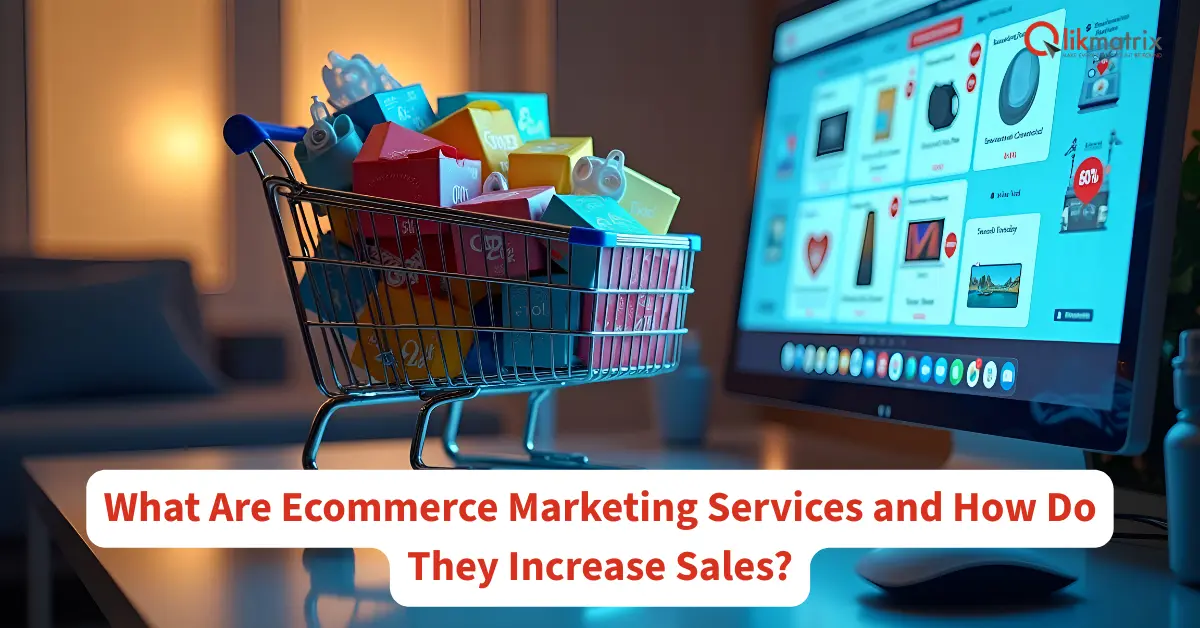
Ecommerce Marketing Services: What Are They?
Ecommerce marketing services are specific tactics for online companies that help them generate qualified traffic, convert visitors into customers, and enhance long-term profitability.
Compared to general marketing, ecommerce marketing concentrates on:
- Product visibility
- Buyer intent
- Conversion optimization
- Retargeting
- Customer retention
- Revenue tracking
It’s not about visibility alone. It’s about profitable growth.
Because in ecommerce, traffic without sales is just an expense.
Why Online Stores Can’t Rely on “Just Having a Website”?
Launching an online store today is easy. Platforms like Shopify and WooCommerce make setup simple.
But scaling?
That’s different.
- Your competitors are running ads.
- They’re optimizing checkout flows.
- They’re retargeting visitors.
- They’re building email lists.
- They’re analyzing every click.
This is why online store marketing solutions exists: to create a system that moves people from awareness to purchase smoothly and strategically.
Without a system, growth becomes random. With one, growth becomes predictable.
Let’s break down the real drivers behind effective ecommerce marketing services.
1. Search Engine Optimization (SEO) for Product Visibility
When someone searches for “wireless noise cancelling headphones,” they are already close to buying.
If your product doesn’t appear in search results, you don’t exist to them.
SEO in ecommerce includes:
- Optimized product descriptions
- Keyword-focused category pages
- Technical site structure
- Faster loading speeds
- Mobile optimization
Good SEO reduces dependency on ads and builds long-term revenue stability.
And here’s the important part ecommerce SEO is different from blog SEO. It’s structured around buying intent, not just information.
2. Ecommerce Advertising Services for Immediate Results
If SEO builds long-term growth, ecommerce advertising services create momentum.
These include:
- Google Shopping Ads
- Search Ads
- Instagram & Facebook Ads
- Retargeting Campaigns
- Performance Max campaigns
Effective paid ads attract purchasers with high intent.
For example:
Someone searches “buy leather laptop bag online.” A Google Shopping ad appears with price and image. They click. They compare. They buy.
But without proper targeting and optimization, ads become expensive quickly.
That’s why the best ecommerce marketing services focus on:
- Audience segmentation
- Creative testing
- Budget allocation
- Conversion tracking
- Return on ad spend (ROAS)
Paid traffic is powerful, but only when managed strategically.
3. Conversion Rate Optimization (CRO)
Here’s a simple math shift.
Today, opening an internet store is a breeze. Shopify and WooCommerce are platforms that make setup simple.
Conversion optimization includes:
- Testing headlines
- Improving product images
- Simplifying checkout
- Adding reviews and testimonials
- Reducing form fields
- Displaying trust badges
A lot of online shops only care about getting more visitors and not about making sales. The brands that do the best treat their website like a sales machine that is always being tried and improved.
4. Retargeting and Cart Recovery
Most customers don’t buy on the first visit. That’s normal.
Retargeting reminds them.
Through display ads, social ads, and automated emails, ecommerce brands bring visitors back to complete their purchase.
For example:
- Abandoned cart email within 1 hour
- Reminder with social proof after 24 hours
- Small incentive after 48 hours
This alone can recover a significant portion of lost revenue. Strong online store marketing solutions always include a retargeting framework.
5. Email and Customer Retention Marketing
Acquiring a new customer costs more than retaining an existing one.
Yet many stores ignore retention.
Smart ecommerce strategies include:
- Post-purchase sequences
- Cross-sell recommendations
- Loyalty programs
- Personalized offers
- Replenishment reminders
When repeat purchase rate increases, profitability increases. This is where a skilled ecommerce marketing company adds long-term value.
How Ecommerce Marketing Services Actually Increase Sales?
Let’s move from theory to reality.
Example 1: The Home Decor Brand
A small home decor brand was spending on Instagram ads but seeing inconsistent results.
The problem?
- No proper tracking
- Poor landing page structure
- No retargeting
After restructuring campaigns under structured ecommerce marketing services:
- Product pages were redesigned
- Checkout friction reduced
- Retargeting ads launched
- Email flows automated
Within 90 days, revenue stabilized and ROAS improved significantly.
Traffic didn’t dramatically increase. Efficiency did.
Example 2: The Fitness Supplement Store
This store had good traffic but low repeat purchases.
Solution:
- Subscription offers introduced
- Post-purchase email sequences added
- Personalized recommendations implemented
Result? Higher customer lifetime value and predictable monthly revenue.
That’s the power of a complete ecommerce marketing system.
What Makes the Best Ecommerce Marketing Services Stand Out?
Not all providers deliver results.
The best ecommerce marketing services stand out because they:
1. Track Everything
- From clicks to conversions to lifetime value.
2. Focus on Profit, Not Just Traffic
- Vanity metrics don’t pay bills. Revenue does.
3. Combine Organic and Paid Strategies
- SEO + Ads + Retargeting + Email = Sustainable growth.
4. Optimize Continuously
- Testing never stops. Markets evolve fast.
Why Hiring an Ecommerce Marketing Company Matters?
Managing ads, analytics, SEO, email automation, and optimization internally can overwhelm small teams.
A professional ecommerce marketing company brings:
- Technical expertise
- Strategic clarity
- Faster testing cycles
- Better media buying decisions
- Data-backed optimization
Instead of guessing what works, you follow proven frameworks.
And that reduces wasted budget.
The Real Difference: Marketing as a System
The biggest misconception about ecommerce marketing services is that they’re individual tactics.
They’re not.
They’re interconnected.
- SEO drives intent traffic.
- Ads accelerate growth.
- CRO increases conversion rate.
- Retargeting recovers lost sales.
- Email boosts lifetime value.
When aligned properly, revenue becomes scalable.
When scattered, revenue becomes unpredictable.
Points to Remember
- Ecommerce marketing services are designed to increase traffic, conversions, and repeat sales systematically.
- Ecommerce advertising services deliver fast results but require optimization to stay profitable.
- Online store marketing solutions combine SEO, paid ads, CRO, and retention strategies.
- The best ecommerce marketing services focus on revenue and data — not just impressions.
- Hiring a specialized ecommerce marketing company simplifies scaling and reduces marketing waste.
An online store without marketing is like a beautifully designed shop in the middle of nowhere.
It may look perfect.
It may have great products.
But if the right people don’t see it and if the journey doesn’t persuade them sales won’t happen.
That’s why ecommerce marketing services are not optional for growth-focused brands.
They transform random traffic into structured revenue.
They convert interest into income.
They turn potential into profit.
And in ecommerce, that difference defines whether you survive or scale.