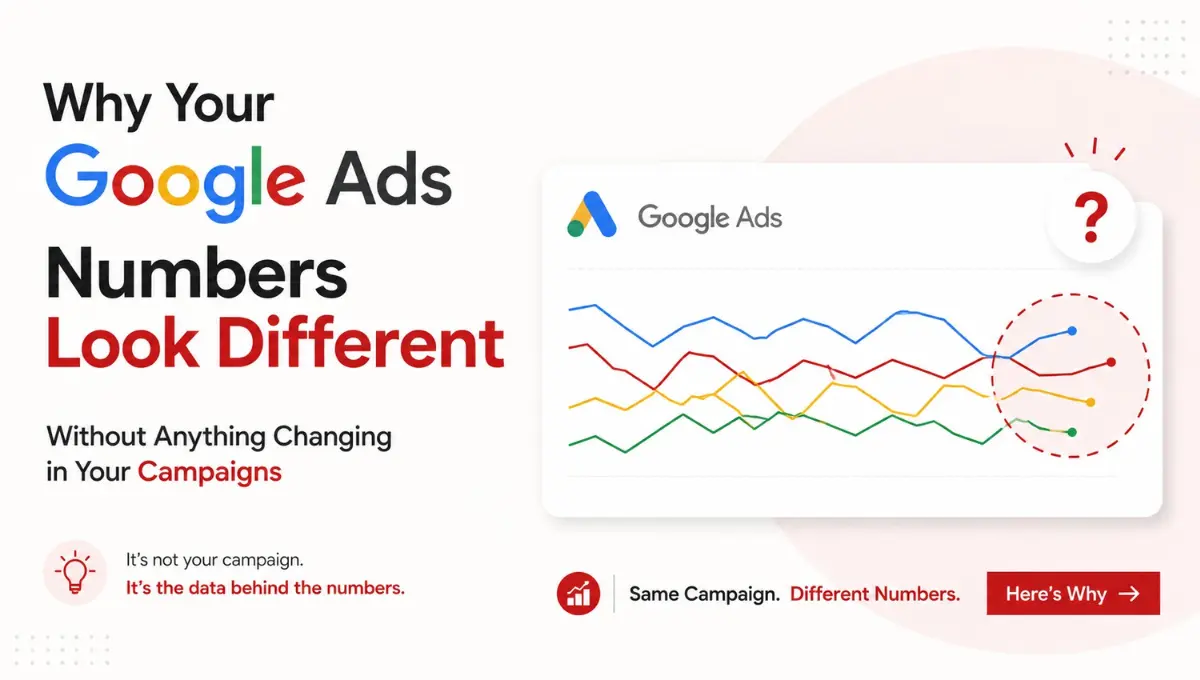
In 2026, there were three big changes on the platform side that quietly rewrote the rules for how conversions are counted, how credit is handed out between channels, and how consent signals travel between GA4 and Google Ads. The funny thing is, none of these actually touched your campaign performance. But they did change the numbers you see. So, if you ever spot a sudden drop in Google Ads performance without touching your campaigns, chances are, it’s one of these three culprits. Figuring out which one is at play is half the battle.
Most times when we start working with a new client, the story begins the same way. Suddenly, performance drops. Maybe it was April. Maybe June. Somewhere around the middle of the year, the numbers just stopped making sense. The team combs through the campaigns, scratching their heads, but nothing seems off. They tweak a few things just in case, but the numbers refuse to budge. Eventually, someone throws up their hands and wonders if it’s time to pause the channel altogether.
Eight times out of ten, when we dig into it, something in GA4, the consent setup, or tracking changed around the same time. The campaign did not break. The measurement did. Those are completely different problems, and they have completely different fixes, and confusing one for the other is how good campaigns get paused. Budgets get redistributed away from channels that were actually working.
What Three Platform Updates Did to Your Numbers Between April and June 2026
The GA4 attribution model update in April, the consent mode restructure on June 15, and the traffic source regrouping on June 11 all landed within roughly eight weeks of each other. None were announced loudly. All three changed what the reporting showed.
The April attribution update changed how data-driven attribution was being applied and reset some properties to DDA even when they had previously been set to another model. That redistributed credit across channels. Upper-funnel channels started picking up more of it, while last-touch channels received less. Any comparison of Search or Paid Social performance across the April boundary compares two different attribution states without a clean way to separate them in native reporting.
On June 11, Google added a Source Group dimension to GA4 that consolidates the fragmented source strings a single social campaign used to scatter across reports. A single Facebook campaign could previously show up as facebook, fb, m.facebook.com, and several other source variations, splitting sessions, conversions, and CPA across separate rows that were difficult to compare. That consolidation is useful, but it changes historical data appearance retroactively.
On June 15, the Consent Mode ad_storage parameter became the single control over whether GA4 passes ad cookies and identifiers to a linked Google Ads account. The Google Signals fallback that previously backfilled cross-device ad data no longer applies. Any channel credit that was flowing through Signals and not through ad_storage stopped flowing after June 15.
Any one of these changes is enough to move the numbers you see in reporting. Having all three happen within the same quarter is why so many accounts started looking like they had a campaign problem when the campaigns themselves hadn’t really changed.
Why GA4 and Google Ads Will Never Perfectly Match and When the Gap Becomes a Problem
GA4 and Google Ads have always used different attribution models, different conversion counting methods, and different session definitions. That gap is normal. It’s not something you need to eliminate. You just need to understand what is causing it and know when it has moved enough to matter.
The problem is when the gap widens suddenly. A stable 15 percent discrepancy between GA4 and Google Ads conversions that has existed for months is normal. A discrepancy that jumps from 15 percent to 35 percent in April without any campaign changes is a signal that something changed at the measurement layer.
The conversion discrepancy we kept seeing between GA4 and Google Ads in April and June wasn’t coming from the campaigns. It was caused by attribution logic, consent signals, and traffic source grouping all shifting at once in a period when the campaigns themselves were stable.
What Consent Mode Drift Looks Like in the Reporting and Why It Is Easy to Miss
If a consent banner does not fire the ad_storage signal correctly after June 15, conversions, audiences, and Smart Bidding signals can go dark with no Signals fallback to catch the gap. And that’s what makes it so easy to miss. There’s no obvious error or warning. You just start losing conversion and audience signals without immediately knowing why.
A consent banner change can do it. So can a CMP update that changes the default consent state, or a tag container change that affects how ad_storage fires. In reporting, all three can look exactly like a campaign performance problem. The reported conversion volume falls. The channel attribution shifts. Smart Bidding starts receiving a weaker signal. And the campaign appears to be underperforming when it is actually being measured with a broken consent layer.
This is the one that is hardest to catch because there is no obvious alert. The way to find it is to cross-reference the period when the numbers shifted against any changes made to the consent banner, the GTM container, or the CMP configuration in the same window.
“Every time we onboard a new client who says ‘performance dropped suddenly’, the first question we ask is whether anything changed in GA4, consent banners, or tracking setup in the same period. In 8 out of 10 cases, something did. The campaign didn’t break. The measurement did. Those are completely different problems with completely different fixes.”
— Vishal Singh, Performance Marketing Specialist
How Smart Bidding Gets Quietly Recalibrated When the Measurement Floor Shifts
Smart Bidding doesn’t need you to manually tell it that the conversion signal changed. It starts responding to the new signal on its own. If GA4 attribution shifted in April and GA4 conversions are imported into Google Ads, the bidding algorithm recalibrated to the new signal without any manual instruction to do so.
A tCPA campaign that drifted off-target from April onwards may not have a bid strategy problem. It may simply be getting a different conversion signal than it was getting before. The algorithm is doing exactly what it was designed to do, optimising toward the conversion data it is receiving. If that data changed because the attribution model changed, the algorithm’s behaviour changes with it, and it looks like the campaign stopped working when what actually happened is that it started optimising toward a different picture of performance.
How to Tell Whether the Number Changed or the Measurement Did
The first thing we’d do is compare the platform-reported conversions against the CRM pipeline for the same period. That’s usually the quickest way to work out whether the business actually lost demand or whether the reporting just stopped giving the campaigns credit for it.
If the CRM shows stable pipeline while GA4 shows a conversion drop, the measurement changed. If both show a drop in the same period, performance changed. Those two situations require completely different responses, and platform-native reporting alone cannot tell you which one you are looking at.
The longer-term fix is building a blended measurement layer that sits outside any single platform. Marketing Efficiency Ratio, total revenue divided by total ad spend across all channels, gives a stable sanity check that does not depend on how GA4 distributes credit or how Consent Mode fires on a given day. It doesn’t replace channel-level reporting. It just gives you a second number to sanity-check against when the platform numbers suddenly stop lining up.
What We Get Asked When Clients See This Pattern
Q1. How do you know if the GA4 conversion tracking discrepancy with Google Ads is measurement or performance?
Ans. We usually start with the CRM. A stable CRM pipeline with a platform conversion drop points to measurement. Both dropping together points to performance. Do not start adjusting campaigns until you know which one it is.
Q2. Did the June 15 consent change affect accounts that were not actively managing consent mode?
Ans. Yes. In fact, these can be some of the accounts worth checking first because they may have been relying on Google Signals without anyone actively thinking about it. Properties that had Google Signals enabled and were relying on it to backfill ad data lost that fallback from June 15. If Consent Mode was not properly implemented, that data flow simply stopped with no error surfacing in the interface.
Q3. Should GA4 conversions be the primary Smart Bidding input after these changes?
Ans. Only after you’ve checked the GA4 attribution and consent setup and know the data going into Google Ads is clean. If neither has been checked since early 2026, the conversion signal going into Smart Bidding may be reflecting measurement changes rather than real buyer behaviour. An independent CRM conversion import is a more reliable Smart Bidding input for accounts where GA4 setup is uncertain.
Q4. What is the Marketing Efficiency Ratio and why does it help here?
Ans. Total revenue divided by total ad spend, calculated across all channels without relying on any single platform’s attribution. It is a blended sanity check rather than a channel diagnostic. When individual channel numbers are shifting because of measurement changes, MER tells you whether the business outcome is actually moving or whether you are looking at attribution noise.
Written by Vishal Singh, Performance Marketing Specialist
I manage Google Ads and analytics strategy across agency and direct-client accounts. The measurement shifts in this article are things we diagnosed in live accounts during the April to June 2026 window, not patterns assembled from documentation after the fact.
For more on how we manage paid search performance and conversion tracking, visit our SEM services.