SEO vs SEM: Which Services are Ideal for Fast Growth

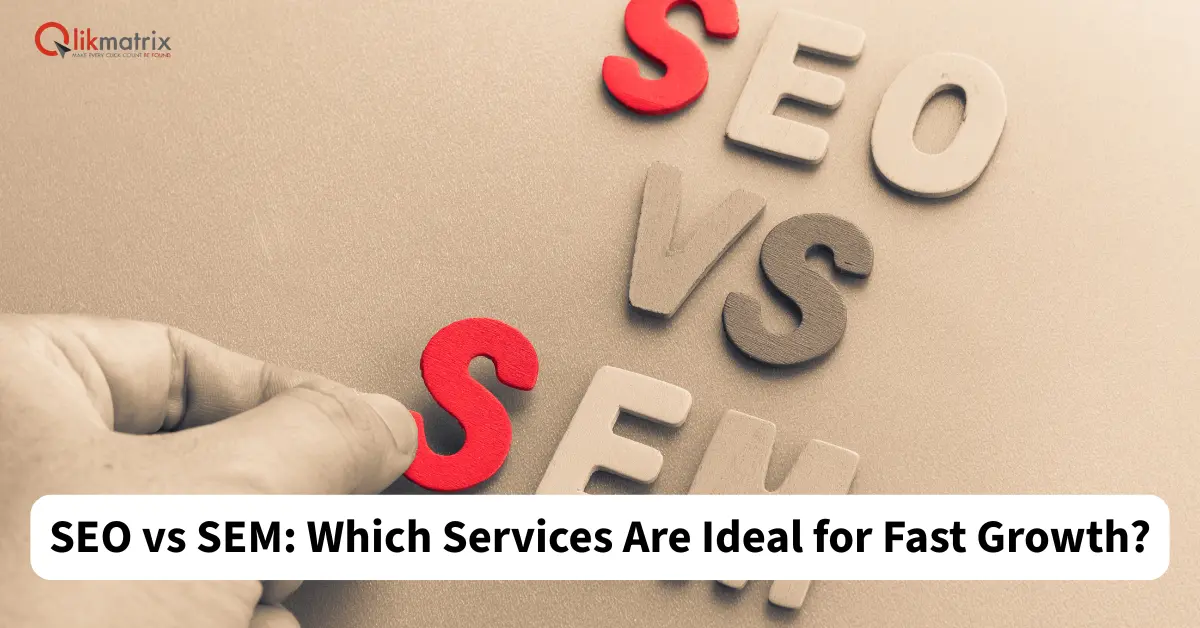
SEO vs SEM: Which Services Are Ideal for Fast Growth

You’ve built the website.

You’ve launched the brand.

You’re ready to grow.

But then comes the hardest part being seen.

You Google services similar to yours and notice something strange.

Some brands appear instantly at the top. Others show up quietly, consistently, every single time you search.

That’s when the confusion hits:

Should you invest in ads for quick results?

Or should you focus on long-term visibility?

This is where the debate of SEO vs SEM begins.

If you’re serious about growth and not just traffic, but real growth understanding the difference between search engine optimization services and paid search marketing can change everything.

This blog breaks it down simply, honestly, and clearly so you can choose a strategy that doesn’t just work today, but still works months from now.

Understanding SEO and SEM

Before we jump into comparison, let’s simplify both concepts.

What Are Search Engine Optimization Services?

Search engine optimization services help your website appear organically on search engines like Google. That means you don’t pay for each click; you earn your position.

These services focus on:

  • Creating helpful content
  • Optimizing keywords
  • Improving website structure
  • Building trust and authority
  • Increasing organic visibility

The best search engine optimization services don’t chase algorithms. They build websites people trust and search engines reward.

What is SEM?

SEM, or search engine marketing, usually means paid ads that appear on search results.

With SEM:

  • You pay to appear at the top
  • You get traffic instantly
  • Results stop when spending stops

SEM is fast. SEO is steady.

That difference matters more than most people realize.

SEO vs SEM Comparison: Speed vs Stability

Let’s be real every business wants fast growth. But fast growth without stability often doesn’t last.

SEM: Fast Results, Short span

SEM works well when:

  • You need instant visibility
  • You’re running a time-sensitive campaign
  • You want quick leads

But here’s the catch:

  • Costs increase over time
  • Competition drives up ad prices
  • Traffic disappears when the budget ends

SEM is like renting attention.

SEO: Slow Start, Strong Finish

SEO takes time but once it works, it keeps working.

With the right search engine optimization company, SEO delivers:

  • Consistent organic website traffic
  • Higher trust from users
  • Lower cost per lead over time
  • Long-term brand authority

SEO is like building property online you own it.

Organic vs Paid Traffic: Why Trust Changes Everything

This is one of the most important parts of the SEO vs SEM comparison.

Paid Traffic (SEM)

  • Immediate visibility
  • Lower trust from users
  • Short-term results
  • Higher long-term costs

Organic Traffic (SEO)

  • Earned visibility
  • Higher credibility
  • Long-term growth
  • Compounding returns

People know when something is an ad.

They trust organic results more because they believe those brands deserve to be there.

That trust is powerful. And it converts better.

Why Businesses Rely on Search Engine Optimization Services?

Search behavior has changed.

People don’t just click the first result anymore. They:

  • Read blogs
  • Compare options
  • Look for credibility
  • Search multiple times before deciding

This is why search engine optimization services matter more than ever.

A reliable search engine optimization company helps you:

  • Answer real customer questions
  • Show up consistently in searches
  • Build authority in your niche
  • Reduce dependency on paid ads

SEO doesn’t interrupt people it supports them.

When SEM is the Right Choice?

SEM is not the enemy. It just has a specific role.

SEM is useful when:

  • You’re launching something new
  • You need immediate data
  • You want quick testing results
  • You’re supporting SEO campaigns

But SEM alone creates pressure constant spending, constant monitoring, constant optimization.

Without SEO, SEM becomes expensive survival.

Why the Best Search Engine Optimization Services Win Long-Term?

The best search engine optimization services focus on systems, not shortcuts.

They work on:

  • High-quality content
  • Technical SEO health
  • Keyword intent
  • User experience
  • Sustainable rankings

SEO compounds quietly. What you publish today can bring traffic for years.

That’s not slow growth that’s smart growth.

SEO vs SEM: Which is Actually Better for Fast Growth?

Here’s the honest answer:

If “fast growth” means quick traffic, SEM wins.

If “fast growth” means lasting momentum, SEO wins.

Real businesses don’t just want clicks.

They want trust, leads, and consistency.

That’s why SEO becomes the backbone and SEM becomes the accelerator.

The Smartest Growth Strategy: SEO First, SEM Second

The most successful brands don’t choose one.

They:

  • Build SEO as the foundation
  • Use SEM to boost visibility when needed
  • Lower ad costs over time
  • Increase ROI across channels

A strong search engine optimization company helps you move from dependency to independence.

And that shift changes how growth feels from stressful to steady.

Points to Remember

  • SEO builds long-term visibility and trust
  • SEM provides fast but temporary results
  • Organic traffic compounds over time
  • Paid traffic stops when spending stops
  • The best search engine optimization services focus on sustainability
  • SEO + SEM together create balanced growth
  • A strategic search engine optimization company prioritizes long-term success

You don’t have to choose speed over stability.

With the right search engine optimization services, your website can become a silent growth engine working for you even when you’re offline.

SEO is quiet. The effect persists.

And that’s where real growth lives.

Q1. What is the most expensive online advertising mistake?

Ans. Audience targeting gone wrong, by a distance. A bad keyword wastes only the clicks it generates. Targeting the wrong people means every rupee goes to someone who was never going to buy. It doesn’t stop on its own. It runs until someone actually digs into who’s clicking and finds none of them were real prospects.

Q2. How often should campaigns be reviewed?

Ans. Every week for the first month without exception. After that, every two weeks at a minimum. The search terms report, audience performance breakdown, and creative fatigue all shift faster than a monthly review schedule can catch.

Q3. Does ad copy really change conversion rates that much?

Ans. The difference between two ads targeting the same audience with the same budget but different copy is regularly 200 to 400 percent in conversion rate. Copy is not a secondary consideration. It’s often the primary one.

Q4. How do I know if my conversion tracking is actually working?

Ans. Do a test conversion yourself. Check if it fires in real time inside your platform’s event manager. Then compare the conversion numbers from your ad platform against actual sales in your CRM every week. Consistent gaps between those two numbers mean something is broken in the tracking chain.

Some of the most expensive online advertising mistakes are sitting inside campaigns that look completely normal on the surface. Impressions coming in. Clicks happening. Budget spending cleanly. And underneath all of it, money going to the wrong people, for the wrong searches, tracked incorrectly, with copy that never had a chance.

Table of Contents

If you work with search engine marketing services or manage paid ads internally, this is where to look first.

1. Poor Audience Targeting

This mistake means paying for every click from people who were never going to buy. It doesn’t stay small. It scales with the budget.

A fitness brand running ads to everyone aged 18 to 65 interested in health is not targeting an audience. That’s broadcasting. Pull actual customer data. Who bought before? What age, location, device? Which pages did they visit before converting? Build lookalikes from real buyers on Meta, not from guesses about who might be interested. For B2B, LinkedIn’s job title and company size filters exist for a reason. Use them with behavioral data layered on top, not instead of it.

On Google, match types matter more in 2026 than most advertisers realise. Broad match without a solid negative keyword list shows ads for searches that have nothing to do with what you sell. Audience settings are not a one-time setup job. Review them every 30 days.

2. Wrong Keyword Selection

This is why campaigns look good in the dashboard and produce nothing in the bank account. Impressions up. Clicks up. Conversions flat.

Someone typing “how does retargeting work” is doing research. Someone typing “retargeting agency for ecommerce” is ready to talk to someone. Both live inside the same industry. Only one has buying intent. Bidding on both with the same budget treats research traffic like purchase traffic, and that’s where money disappears.

Good online advertising mistakes analysis starts with knowing which six areas drain the most money and in what order to fix them. Keyword intent is the first filter. Get it wrong here and everything downstream, the bids, the budget, the reporting, runs on bad inputs.

Negative keywords need to be built before the campaign launches, not discovered in the first week’s search terms report. “Free,” “DIY,” “how to,” and competitor names where you don’t want comparison traffic are the starting point, not the full list. Check the search terms report every week for the first month. What you think you’re targeting and what you’re actually showing for are different lists more often than not.

3. Lack of Conversion Tracking

No tracking means no real data. Every budget decision after that is a guess dressed up as a strategy.

The problem isn’t that advertisers skip tracking. It’s that they set it up wrong and never check whether it’s working. Page view is tracked instead of form submission. Most accounts have the tag firing on page load, not on actual form submission. Every false fire sits in your data as a real conversion, and you optimise against it without knowing. iOS 14 broke attribution in 2021 and most ad accounts still haven’t fixed it, which means Google Ads, Meta pixel, and GA4 are all showing different numbers, and none of them are complete.

Cross-reference them weekly against actual CRM data or backend sales numbers. If the numbers don’t match consistently, something in the tracking chain broke somewhere and you’re optimising campaigns based on wrong information.

4. Low Quality Ad Copy

This is what turns a perfectly targeted campaign into a money pit.

The pattern is almost always the same. The headline leads with the brand name. The body copy lists features. The language is vague. “High quality.” “Trusted.” “Industry-leading.” None of it means anything to someone who doesn’t already know you. And the person seeing your ad doesn’t know you yet.

In search, the headline has to match the intent behind the keyword. Someone searching for accounting software for a small business wants to see that reflected back, specifically, not a tagline that could apply to any software company on earth.

On social, the first two seconds are everything. A hook naming a specific problem the audience actually has, or a claim that catches them off guard, gets the read. A logo and a brand slogan does not. Run three different creative angles per ad set at a minimum. Pull the one that works and scale it. Replace the ones that don’t before they drain the budget.

FAQs

Q1. What is the most expensive online advertising mistake?

Ans. Audience targeting gone wrong, by a distance. A bad keyword wastes only the clicks it generates. Targeting the wrong people means every rupee goes to someone who was never going to buy. It doesn’t stop on its own. It runs until someone actually digs into who’s clicking and finds none of them were real prospects.

Q2. How often should campaigns be reviewed?

Ans. Every week for the first month without exception. After that, every two weeks at a minimum. The search terms report, audience performance breakdown, and creative fatigue all shift faster than a monthly review schedule can catch.

Q3. Does ad copy really change conversion rates that much?

Ans. The difference between two ads targeting the same audience with the same budget but different copy is regularly 200 to 400 percent in conversion rate. Copy is not a secondary consideration. It’s often the primary one.

Q4. How do I know if my conversion tracking is actually working?

Ans. Do a test conversion yourself. Check if it fires in real time inside your platform’s event manager. Then compare the conversion numbers from your ad platform against actual sales in your CRM every week. Consistent gaps between those two numbers mean something is broken in the tracking chain.

Request A Proposal

Our team will connect back with you within 24 hours.

Get In Touch