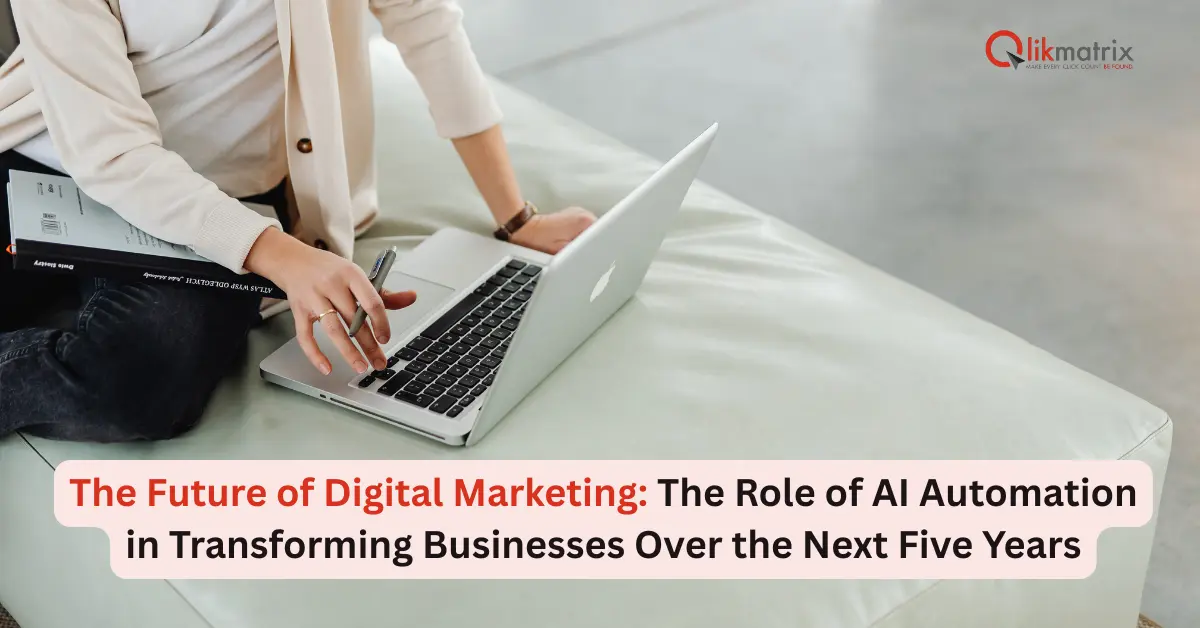
AI Automation Shaping the Future of Digital Marketing Over Five Years

The Future Of Digital Marketing

We’re moving into an era where AI no longer merely assists marketing… it drives it.

From analytics to automated content development, companies are progressively moving towards more intelligent, quicker, and tailored approaches. And AI-powered digital marketing services will be the quiet engine behind those results.

These days, businesses who employ AI in their marketing strategies achieve results that were previously impossible, with faster deployment, better comprehension, and improved relationships with customers. Digital marketing is also become more personalized, intuitive, and focused on humans as AI develops.

1. Customer Targeting Will Become Fully Predictive

AI tools use behavioral signals, which include search intent, click patterns, dwell time, and past purchases for analysis.

The following five years will see this analysis develop into predictive audience modelling, which AI will use to forecast customer behaviour beyond their current actions.

What this means for businesses:

  • The marketing campaigns will deliver their messages to users when they show readiness to perform their desired actions.
  • The marketing campaign will use probability scores instead of using general demographic information for its targeting strategy.
  • The system will distribute budget funds to segments which show the highest level of purchasing intent.

Actionable takeaway:

  • Start integrating tools like Google’s Predictive Audiences and Meta’s Advantage+ now; your systems need long-term data to improve accuracy.

2. Personalised Marketing Campaigns Will Establish Themselves As The Standard Approach For Businesses

Every user will experience AI-driven automation through customised versions of ads and landing pages, emails, and website experiences.

AI systems will handle:

  • Automatic content adjustments based on user behaviour
  • Personalised product recommendations
  • Dynamic pricing elements
  • Adaptive email triggers

The system enables automated customization at levels that would be unattainable through human operation.

Practical example:

  • A fitness brand won’t send the same email to all users.

Instead:

  • Beginners receive tutorials.
  • Mid-level users get new routine updates
  • Advanced users get product upsells
  • All of this will run automatically.

3. Content Production Will Shift to Hybrid AI models

AI won’t replace marketers; it will work alongside them.

Content teams will build hybrid workflows where AI handles:

  • Topic research and competitor analysis
  • Headline variations and data summarisation
  • SEO structuring

Humans will focus on:

  • Creativity, brand storytelling, strategic direction, refining tone and accuracy

Why this matters:

  • In order to improve your search engine results, audience engagement, and brand visibility, the system lets you produce more high-quality content quickly.

4. There Will Be No Getting Around Real-Time Optimization

In the next five years, manual optimization will disappear.

AI will automatically:

  • Increase budgets on winning campaigns and pause ads with low performance
  • Test new creative combinations
  • Shift targeting based on live signals
  • Choose the best placements and formats

This will make digital marketing services significantly more efficient, reducing wasted spending.

Business impact:

  • Companies won’t wait for weekly reports; decisions will happen within minutes.

5. Search Will Get More conversational and Intent-Driven

Search engines are moving toward AI-powered responses instead of traditional blue links.

This means SEO will focus on:

  • Structured data
  • Question-based optimisation
  • Conversational keywords
  • Online authority

Google Assistant and other voice-activated search engines will soon be the industry standard.

Top digital marketing agencies should help businesses shift their attention from written to spoken communication by tailoring their content to human speech patterns.

6. AI-Powered Customer Support Will Replace Basic Chats

The development of chatbots has led to systems which provide support through interactions that approach the level of human communication.

They will be able to:

  • Resolve queries instantly
  • Analyse sentiment
  • Provide personalized solutions and follow up based on user behavior
  • Connect seamlessly with CRM systems

This reduces manual workload and increases customer satisfaction.

Tip: Begin integrating AI support systems gradually so your dataset becomes richer and more accurate.

7. Data Will Drive Every Decision

AI can process massive datasets faster than any team. This leads to clearer insights into:

  • Which audiences convert the most
  • What type of content performs best
  • Which products drive maximum repeat purchases
  • Where customers tend to drop off
  • How market trends are shifting

Businesses using online marketing services will rely on dashboards powered by machine learning rather than manual interpretation.

Actionable step: Set up data tracking foundations now—AI only works as well as the information it is trained on.

8. Automation Will Reduce Operational Costs

Over the next five years, teams will spend less time on:

  • Reporting and scheduling
  • Manual content distribution
  • Lead qualification and follow-ups
  • Monitoring campaign metrics

Automation tools will handle this at scale

Teams can dedicate their efforts to strategy development and innovation and customer experience improvement because these activities require human involvement that cannot be substituted.

9. Predictive Sales Funnels Will Become Smarter

AI will track the entire customer journey and automatically determine:

  • The next best action
  • Ideal time to send offers
  • Expected purchase value
  • Likelihood of churn and customer lifetime value

The acquired knowledge enables businesses to boost their conversion rates through better ad performance without needing to raise their advertising budget.

10. Competition Will Increase But So Will Opportunities

As AI levels the playing field, any brand using the best digital marketing agency or tools will have access to advanced marketing capabilities.

However, the difference will be in:

  • How early you adopt AI
  • How strong your data foundation is
  • How strategically you integrate automation
  • How creative you are with the insights

The future belongs to teams who combine creativity with AI-powered efficiency.

Key Takeaways

AI technology will transform marketing operations by creating predictive models which deliver personalized results at higher operational efficiency.

  • Data will guide every major decision.
  • Content creation will become hybrid—AI + human.
  • Real-time optimization will cut costs and improve performance.
  • Search behavior will become conversational and intent-driven.

To stay competitive, start implementing AI tools now, not later. The businesses that prepare early will dominate the next wave of digital growth.

Q1. What is the most expensive online advertising mistake?

Ans. Audience targeting gone wrong, by a distance. A bad keyword wastes only the clicks it generates. Targeting the wrong people means every rupee goes to someone who was never going to buy. It doesn’t stop on its own. It runs until someone actually digs into who’s clicking and finds none of them were real prospects.

Q2. How often should campaigns be reviewed?

Ans. Every week for the first month without exception. After that, every two weeks at a minimum. The search terms report, audience performance breakdown, and creative fatigue all shift faster than a monthly review schedule can catch.

Q3. Does ad copy really change conversion rates that much?

Ans. The difference between two ads targeting the same audience with the same budget but different copy is regularly 200 to 400 percent in conversion rate. Copy is not a secondary consideration. It’s often the primary one.

Q4. How do I know if my conversion tracking is actually working?

Ans. Do a test conversion yourself. Check if it fires in real time inside your platform’s event manager. Then compare the conversion numbers from your ad platform against actual sales in your CRM every week. Consistent gaps between those two numbers mean something is broken in the tracking chain.

Related Blogs

Some of the most expensive online advertising mistakes are sitting inside campaigns that look completely normal on the surface. Impressions coming in. Clicks happening. Budget spending cleanly. And underneath all of it, money going to the wrong people, for the wrong searches, tracked incorrectly, with copy that never had a chance.

Table of Contents

If you work with search engine marketing services or manage paid ads internally, this is where to look first.

1. Poor Audience Targeting

This mistake means paying for every click from people who were never going to buy. It doesn’t stay small. It scales with the budget.

A fitness brand running ads to everyone aged 18 to 65 interested in health is not targeting an audience. That’s broadcasting. Pull actual customer data. Who bought before? What age, location, device? Which pages did they visit before converting? Build lookalikes from real buyers on Meta, not from guesses about who might be interested. For B2B, LinkedIn’s job title and company size filters exist for a reason. Use them with behavioral data layered on top, not instead of it.

On Google, match types matter more in 2026 than most advertisers realise. Broad match without a solid negative keyword list shows ads for searches that have nothing to do with what you sell. Audience settings are not a one-time setup job. Review them every 30 days.

2. Wrong Keyword Selection

This is why campaigns look good in the dashboard and produce nothing in the bank account. Impressions up. Clicks up. Conversions flat.

Someone typing “how does retargeting work” is doing research. Someone typing “retargeting agency for ecommerce” is ready to talk to someone. Both live inside the same industry. Only one has buying intent. Bidding on both with the same budget treats research traffic like purchase traffic, and that’s where money disappears.

Good online advertising mistakes analysis starts with knowing which six areas drain the most money and in what order to fix them. Keyword intent is the first filter. Get it wrong here and everything downstream, the bids, the budget, the reporting, runs on bad inputs.

Negative keywords need to be built before the campaign launches, not discovered in the first week’s search terms report. “Free,” “DIY,” “how to,” and competitor names where you don’t want comparison traffic are the starting point, not the full list. Check the search terms report every week for the first month. What you think you’re targeting and what you’re actually showing for are different lists more often than not.

3. Lack of Conversion Tracking

No tracking means no real data. Every budget decision after that is a guess dressed up as a strategy.

The problem isn’t that advertisers skip tracking. It’s that they set it up wrong and never check whether it’s working. Page view is tracked instead of form submission. Most accounts have the tag firing on page load, not on actual form submission. Every false fire sits in your data as a real conversion, and you optimise against it without knowing. iOS 14 broke attribution in 2021 and most ad accounts still haven’t fixed it, which means Google Ads, Meta pixel, and GA4 are all showing different numbers, and none of them are complete.

Cross-reference them weekly against actual CRM data or backend sales numbers. If the numbers don’t match consistently, something in the tracking chain broke somewhere and you’re optimising campaigns based on wrong information.

4. Low Quality Ad Copy

This is what turns a perfectly targeted campaign into a money pit.

The pattern is almost always the same. The headline leads with the brand name. The body copy lists features. The language is vague. “High quality.” “Trusted.” “Industry-leading.” None of it means anything to someone who doesn’t already know you. And the person seeing your ad doesn’t know you yet.

In search, the headline has to match the intent behind the keyword. Someone searching for accounting software for a small business wants to see that reflected back, specifically, not a tagline that could apply to any software company on earth.

On social, the first two seconds are everything. A hook naming a specific problem the audience actually has, or a claim that catches them off guard, gets the read. A logo and a brand slogan does not. Run three different creative angles per ad set at a minimum. Pull the one that works and scale it. Replace the ones that don’t before they drain the budget.

FAQs

Q1. What is the most expensive online advertising mistake?

Ans. Audience targeting gone wrong, by a distance. A bad keyword wastes only the clicks it generates. Targeting the wrong people means every rupee goes to someone who was never going to buy. It doesn’t stop on its own. It runs until someone actually digs into who’s clicking and finds none of them were real prospects.

Q2. How often should campaigns be reviewed?

Ans. Every week for the first month without exception. After that, every two weeks at a minimum. The search terms report, audience performance breakdown, and creative fatigue all shift faster than a monthly review schedule can catch.

Q3. Does ad copy really change conversion rates that much?

Ans. The difference between two ads targeting the same audience with the same budget but different copy is regularly 200 to 400 percent in conversion rate. Copy is not a secondary consideration. It’s often the primary one.

Q4. How do I know if my conversion tracking is actually working?

Ans. Do a test conversion yourself. Check if it fires in real time inside your platform’s event manager. Then compare the conversion numbers from your ad platform against actual sales in your CRM every week. Consistent gaps between those two numbers mean something is broken in the tracking chain.

Request A Proposal

Our team will connect back with you within 24 hours.

Get In Touch