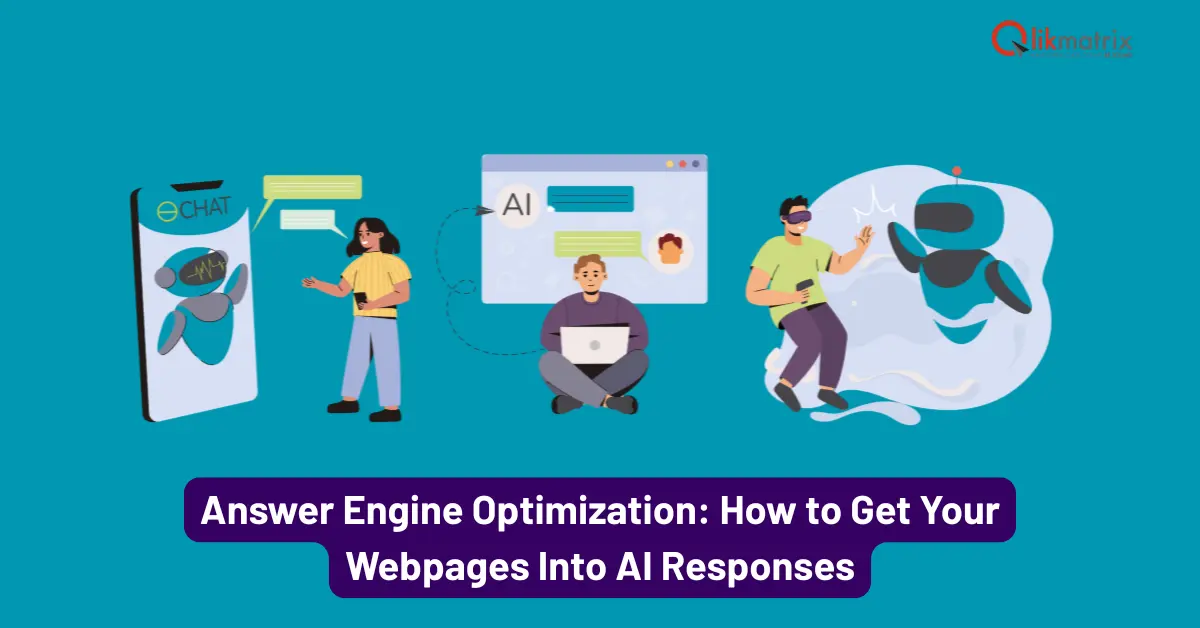
Answer Engine Optimization: How to Get Your Webpages Into AI Responses

Answer Engine Optimization (AEO)

Search is changing slowly, and most websites haven’t caught up yet.

You can still be on the first page and not be seen.

You can still get impressions and not get attention.

Because today, users aren’t just searching anymore. All they are doing is asking, and AI is responding.

Moreover, here is the unsettling reality… AI doesn’t show ten blue links. It picks a few sources, gets the clearest answer, and then goes on.

It doesn’t matter how good your information is if it’s not set up to be chosen.

This is exactly where answer engine optimization comes in and why businesses are now turning to the best search engine optimization services to stay ahead. It’s not an add-on to SEO, but a change in the way information needs to be written.

What is Answer Engine Optimization and Why Does It Change the Game

The main goal of answer engine optimization is to make your material usable, not merely easy to find.

It implies writing in a way that lets AI systems take your answer and show it to users without them having to go to your page.

That changes the goal completely.

Earlier, success meant:

  • Ranking higher
  • Getting clicks

Now, success means:

  • Being selected
  • Being quoted
  • Being trusted as the answer

A page optimised for AEO doesn’t just explain, it resolves a query immediately, clearly, and without friction.

How Does Answer Engine Optimization Actually Work

If you strip away the jargon, AEO works on a very simple principle:

AI selects clarity over effort.

When a system scans your page, it is not “reading” like a human. It is identifying patterns:

  • Where is the question?
  • Where is the answer?
  • Can this answer stand alone?

If the answer is buried, diluted, or stretched, it gets ignored.

If it is direct, structured, and self-contained, it gets picked.

For example:

  • A typical paragraph might circle around a definition before arriving at the point.
  • An AEO-optimized response does the opposite; it starts with the answer, then explains if needed.
  • That small shift is often the difference between being indexed and being used.

So, How Do I Get My Website in AI Results

This is where most advice becomes vague, but the process is actually quite practical when you look at it closely.

It starts with understanding that AI rewards precision.

  • First, your content needs to reflect how people actually ask questions. Not keywords questions. The kind someone would type or speak without thinking twice.
  • Second, your answers need to appear immediately. Not after a story, not after context right where the question is addressed. A straightforward answer that doesn’t depend on the text underneath.

Organization matters more than most people realise. Splitting text into obvious pieces, short paragraphs, and logical flows makes it easier to extract. Deep blocks of knowledge, however useful, are harder for AI systems to understand. And finally, depth still matters. A page that answers one question well is useful. A page that answers the main question and the related ones becomes reliable, and reliability is what gets selected.

The Four Stages of Answer Engine Optimization (AEO)

AEO isn’t a trick; it’s a process. And when you look at it closely, it follows a very clear progression.

  • The first stage is understanding the query. Not just what is being asked, but why. A search like “How does answer engine optimization work?” is not looking for theory; it’s looking for clarity. Missing that intent leads to over-explaining instead of answering.
  • The second stage is structuring the content. This is where most content fails. A well-structured page doesn’t feel heavy. It moves naturally from one question to the next, with each section resolving something specific.
  • The third stage is refinement. This is where unnecessary words are removed, sentences are tightened, and ideas are simplified. Not dumbed down, just made clearer. AI systems favour content that is easy to extract, not content that tries too hard to sound intelligent.
  • The final stage is building trust. Because if it doesn’t seem trustworthy, not even the most obvious response will be chosen. Truthfulness, applicability, and novelty are all factors here. Material that seems real and up-to-date has a lot better chance of being utilized.

Where SEO Still Fits Into This

It’s easy to assume that AEO replaces SEO. It doesn’t.

It changes its role.

SEO still brings visibility. It ensures your page is indexed, ranked, and discoverable. Without it, your content may never even reach the stage where AI considers it.

AEO, on the other hand, determines what happens next.

You can think of it this way:

  • SEO gets you into the room.
  • AEO decides whether you speak.

That’s why combining both is not optional anymore. Content needs to be written with keywords in mind, but shaped around questions, clarity, and structure.

What Good AEO Content Actually Feels Like

You can usually tell when a piece of content is AEO-ready not because it looks different, but because it feels easier to read.

  • You don’t have to search for the answer.
  • You don’t have to decode the explanation.
  • You don’t have to reread sentences.
  • Everything is where you expect it to be.

For example, when a heading asks a question, the next few lines resolve it. Then, if needed, the explanation expands the idea but the core answer is already clear.

That flow creates two advantages:

  • The reader stays engaged
  • The system can extract the answer cleanly
  • Where Most Content Goes Wrong

The problem is rarely lack of knowledge. It’s usually how that knowledge is presented.

When they could have been clearer, a lot of people try to sound authoritative by employing complicated language. Some people put too much emphasis on keywords and say them in ways that break up the natural flow of the article.

Some pages don’t change at all, even while search behaviour does. They were only written once and haven’t been changed. Everything about this makes it less likely that you will be chosen, even if the content is right.

They were only written once and haven’t been changed. Everything about this makes it less likely that you will be chosen, even if the content is right.

Points to Remember

  • Answer engine optimization is not about writing more; it’s about writing with intent.
  • It focuses on making content selectable, not just searchable
  • It requires clear question-and-answer structuring
  • It puts a lot of weight on straightforward, self-contained answers.
  • It works best if you know the principles of SEO effectively.
  • It cares more about being clear, organized, and relevant than being long or hard.
  • The transformation is already taking place. The pages that adapt will not just rank; they will be referenced, quoted, and used.
  • And in a search environment where answers are delivered instantly, being used matters far more than simply being found.

Q1. What is the most expensive online advertising mistake?

Ans. Audience targeting gone wrong, by a distance. A bad keyword wastes only the clicks it generates. Targeting the wrong people means every rupee goes to someone who was never going to buy. It doesn’t stop on its own. It runs until someone actually digs into who’s clicking and finds none of them were real prospects.

Q2. How often should campaigns be reviewed?

Ans. Every week for the first month without exception. After that, every two weeks at a minimum. The search terms report, audience performance breakdown, and creative fatigue all shift faster than a monthly review schedule can catch.

Q3. Does ad copy really change conversion rates that much?

Ans. The difference between two ads targeting the same audience with the same budget but different copy is regularly 200 to 400 percent in conversion rate. Copy is not a secondary consideration. It’s often the primary one.

Q4. How do I know if my conversion tracking is actually working?

Ans. Do a test conversion yourself. Check if it fires in real time inside your platform’s event manager. Then compare the conversion numbers from your ad platform against actual sales in your CRM every week. Consistent gaps between those two numbers mean something is broken in the tracking chain.

Some of the most expensive online advertising mistakes are sitting inside campaigns that look completely normal on the surface. Impressions coming in. Clicks happening. Budget spending cleanly. And underneath all of it, money going to the wrong people, for the wrong searches, tracked incorrectly, with copy that never had a chance.

Table of Contents

If you work with search engine marketing services or manage paid ads internally, this is where to look first.

1. Poor Audience Targeting

This mistake means paying for every click from people who were never going to buy. It doesn’t stay small. It scales with the budget.

A fitness brand running ads to everyone aged 18 to 65 interested in health is not targeting an audience. That’s broadcasting. Pull actual customer data. Who bought before? What age, location, device? Which pages did they visit before converting? Build lookalikes from real buyers on Meta, not from guesses about who might be interested. For B2B, LinkedIn’s job title and company size filters exist for a reason. Use them with behavioral data layered on top, not instead of it.

On Google, match types matter more in 2026 than most advertisers realise. Broad match without a solid negative keyword list shows ads for searches that have nothing to do with what you sell. Audience settings are not a one-time setup job. Review them every 30 days.

2. Wrong Keyword Selection

This is why campaigns look good in the dashboard and produce nothing in the bank account. Impressions up. Clicks up. Conversions flat.

Someone typing “how does retargeting work” is doing research. Someone typing “retargeting agency for ecommerce” is ready to talk to someone. Both live inside the same industry. Only one has buying intent. Bidding on both with the same budget treats research traffic like purchase traffic, and that’s where money disappears.

Good online advertising mistakes analysis starts with knowing which six areas drain the most money and in what order to fix them. Keyword intent is the first filter. Get it wrong here and everything downstream, the bids, the budget, the reporting, runs on bad inputs.

Negative keywords need to be built before the campaign launches, not discovered in the first week’s search terms report. “Free,” “DIY,” “how to,” and competitor names where you don’t want comparison traffic are the starting point, not the full list. Check the search terms report every week for the first month. What you think you’re targeting and what you’re actually showing for are different lists more often than not.

3. Lack of Conversion Tracking

No tracking means no real data. Every budget decision after that is a guess dressed up as a strategy.

The problem isn’t that advertisers skip tracking. It’s that they set it up wrong and never check whether it’s working. Page view is tracked instead of form submission. Most accounts have the tag firing on page load, not on actual form submission. Every false fire sits in your data as a real conversion, and you optimise against it without knowing. iOS 14 broke attribution in 2021 and most ad accounts still haven’t fixed it, which means Google Ads, Meta pixel, and GA4 are all showing different numbers, and none of them are complete.

Cross-reference them weekly against actual CRM data or backend sales numbers. If the numbers don’t match consistently, something in the tracking chain broke somewhere and you’re optimising campaigns based on wrong information.

4. Low Quality Ad Copy

This is what turns a perfectly targeted campaign into a money pit.

The pattern is almost always the same. The headline leads with the brand name. The body copy lists features. The language is vague. “High quality.” “Trusted.” “Industry-leading.” None of it means anything to someone who doesn’t already know you. And the person seeing your ad doesn’t know you yet.

In search, the headline has to match the intent behind the keyword. Someone searching for accounting software for a small business wants to see that reflected back, specifically, not a tagline that could apply to any software company on earth.

On social, the first two seconds are everything. A hook naming a specific problem the audience actually has, or a claim that catches them off guard, gets the read. A logo and a brand slogan does not. Run three different creative angles per ad set at a minimum. Pull the one that works and scale it. Replace the ones that don’t before they drain the budget.

FAQs

Q1. What is the most expensive online advertising mistake?

Ans. Audience targeting gone wrong, by a distance. A bad keyword wastes only the clicks it generates. Targeting the wrong people means every rupee goes to someone who was never going to buy. It doesn’t stop on its own. It runs until someone actually digs into who’s clicking and finds none of them were real prospects.

Q2. How often should campaigns be reviewed?

Ans. Every week for the first month without exception. After that, every two weeks at a minimum. The search terms report, audience performance breakdown, and creative fatigue all shift faster than a monthly review schedule can catch.

Q3. Does ad copy really change conversion rates that much?

Ans. The difference between two ads targeting the same audience with the same budget but different copy is regularly 200 to 400 percent in conversion rate. Copy is not a secondary consideration. It’s often the primary one.

Q4. How do I know if my conversion tracking is actually working?

Ans. Do a test conversion yourself. Check if it fires in real time inside your platform’s event manager. Then compare the conversion numbers from your ad platform against actual sales in your CRM every week. Consistent gaps between those two numbers mean something is broken in the tracking chain.

Request A Proposal

Our team will connect back with you within 24 hours.

Get In Touch