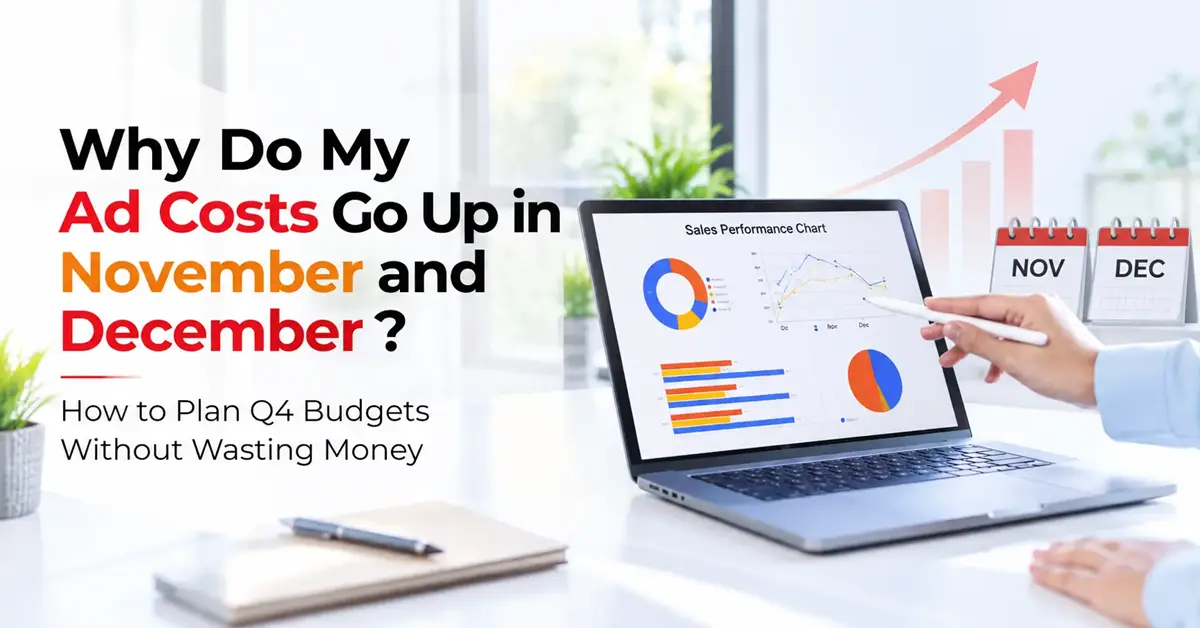
Why are ad costs higher in Q4? Because more advertisers chase the same people from late October to December, so CPMs and CPCs climb even if your campaigns don’t change. The fix isn’t panic. It’s choosing which weeks deserve the premium and building cheap audiences in October.
Third week of November. A client forwards a screenshot of their Meta CPMs shaped like a hockey stick, with one line underneath. “Did something break?”
Nothing broke. Same ads, same audiences, same budget. What changed was everyone else.
People don’t scroll a lot more in November than they did in September. The number of ad slots stays roughly the same. What jumps is the number of brands fighting for them, and every one of them has a holiday target to hit. GeistM’s Q4 2025 Meta data showed CPMs climbing about 11 percent in the second half of November and roughly another 11 percent in the first half of December. Same feeds. More bidders.
So the real question isn’t how to stop costs rising. You can’t. It’s which Q4 weeks are actually worth paying for, and what you build in October so December hurts less.
Why Does CPM Rise in Q4 Even If I Change Nothing?
Because the auction got crowded, not because your campaign broke. Come November, every shoe brand, gadget store and saree shop with a Diwali or Black Friday deal piles into the same Instagram feeds and Google results you’re in. The ad slots don’t multiply. The bidders do. So prices climb for everyone in the room, even the ones with nothing to sell for the holidays.
That last bit catches people out. A physiotherapy clinic in Pune has no Black Friday offer. Doesn’t matter. It’s bidding for the same 35-year-old’s Instagram feed as a clothing brand with a 40 percent off sale, and the clothing brand is paying whatever it takes.
Should I Pause Ads in November–December If I’m Not Running a Sale?
Not necessarily pause, but stop holding budget flat. If you’re B2B or lead-gen with no holiday offer, you’re paying peak prices for people busy shopping for gifts. Cut prospecting, keep retargeting and brand search running, and move the savings into January when costs settle.
Going fully dark is the other mistake. Switch it all off for six weeks and three annoying things happen. A competitor quietly starts showing up when people search your name. The people you were retargeting drift out of your lists. And come January, the algorithm’s forgotten everything, so you’re paying to relearn what worked in October.
One exception worth knowing. Some B2B buyers have year-end budgets they need to spend before the books close. If that’s your market, early December can actually be a good time to be visible. Check last year’s CRM before you decide anything.
Why Are Ad Costs Higher in Q4 for Brands that Ignored October?
Because they show up cold to the most expensive auction of the year. October is the cheap month. In that same GeistM data, Meta CPMs in the first half of October actually dipped about 12 percent.
That’s your window. Run video and engagement campaigns in October and collect people. Video viewers, page engagers, site visitors, anyone who’s shown a flicker of interest. Then, when peak weeks arrive, a big share of your budget goes to those warm pools instead of strangers.
Retargeting still costs more in November. But it converts far better than cold prospecting, and a brand that only appears on Black Friday morning is competing for attention with nobody remembering who it is. Good holiday season ad budget planning starts six weeks before the holiday, not on it.
Most Q4 overspend is not caused by bad campaigns. It is caused by holding the same budget split through a period when the auction has completely changed. The brands that come out of December with healthy unit economics are the ones that planned their October audience build as seriously as their Black Friday offer.
— Vishal Singh, Performance Marketing Specialist
How Much Extra Budget Do I Need for Black Friday?
There isn’t a magic number. Work backwards from what a sale is worth to you at peak-week costs, then raise budget only for the days that clear that bar. Most brands should front-load October, spend hard on the sale window itself and keep a reserve for the final days.
Quick example. Say a customer is worth ₹2,000 in margin and your normal cost per sale is ₹800. If Black Friday week pushes that to ₹1,200, you’re still fine, so spend. If it pushes to ₹2,300, you’re paying to lose money, however exciting the revenue graph looks.
The pacing we use most is boring but works. October goes on prospecting and audience building. Peak weeks shift toward retargeting and brand search. And something gets held back for the last two days of the sale, when shoppers who’ve been browsing all week finally buy.
Both platforms help a little. Meta’s budget scheduling lets you raise a campaign’s daily budget for a set window and then drops it back automatically. On Google, a campaign can already spend up to twice its daily budget on a busy day, but the monthly charge is capped at 30.4 times the daily figure, so for a planned spike you’re better off raising the budget yourself a few days early. That’s holiday season ad budget planning in practice. Get the numbers agreed while it’s still calm, ideally over chai in October, not in a panicky WhatsApp thread at 7am on sale day.
Should I Use Seasonality Adjustments in Google Ads?
Mostly no, with one exception. If you’re running a short sale, say three or four days, and last year’s data shows conversion rates genuinely shoot up, an adjustment can help Google bid ahead of it. Google built them for events of roughly one to seven days. For the general Q4 rise, Smart Bidding already adjusts, and adding an adjustment on top of that can make it overbid.
Google’s own seasonality guidance says they may not work as well for periods longer than 14 days. And on Search and Shopping they only apply if you’re using target CPA or target ROAS.
Where they backfire is when the sale underperforms. You tell Google conversion rates will be 40 percent higher, it bids like they are, and if shoppers don’t turn up you’ve paid peak prices for a normal day. Use last year’s data for the size of the adjustment, not optimism. Nice bit, though. Once the event ends, bidding goes back to normal by itself, so no clean-up adjustment needed afterwards.
How Do I Avoid a Bad January After a Heavy Q4?
Hands off the account from about mid-December. Anything big you launch or change then, a new campaign, a new target, a big budget jump, sends the algorithm back to school right as everyone goes on holiday. It’s still finding its feet in January, which is a slow month anyway. Save the Q1 shake-up for the first or second week of January.
Google says the learning period usually takes one or two conversion cycles. Fine if people buy your product the same day they click. Not so fine if you sell B2B software with a month-long sales cycle. Tweak a bid strategy just before Christmas and it might still be finding its feet when Valentine’s Day rolls round.
Honestly, just stick a note on the team’s calendar. “No new campaigns after 15 December.” That’s the whole rule. You’d be amazed how many accounts we take over in January with a “quick test” launched on Christmas Eve. Good search engine marketing services should be guarding Q1 as hard as they push Q4. And if you’re comparing the best search engine marketing services for next year, ask them what they changed last December and why.
Questions We Get Asked About Holiday Season Ad Budget Planning
Q1. Is it cheaper to advertise in October than in November?
Ans. Usually, yes. Early October tends to be one of the calmer stretches before the rush, which is why it’s the best time to build audiences you’ll retarget later.
Q2. Do Google Ads costs rise as much as Meta costs in Q4?
Ans. Not always. Meta feels it across the board because everyone’s fighting for the same feeds. On Google the jump depends on the keyword. Retail terms get hammered, niche B2B terms often barely move.
Q3. When should I start holiday season ad budget planning?
Ans. September, ideally. October at the latest. By November you’re reacting to the auction instead of planning around it.
Written by Vishal Singh, Performance Marketing Specialist
I manage Google and Meta campaigns for brands across retail, B2B and local services, and every November someone asks whether their account is broken. It almost never is. The auction just got busier, and the plan didn’t change with it.
If you’d like help planning your Q4 budget so December doesn’t eat your margins, take a look at our search engine marketing services.