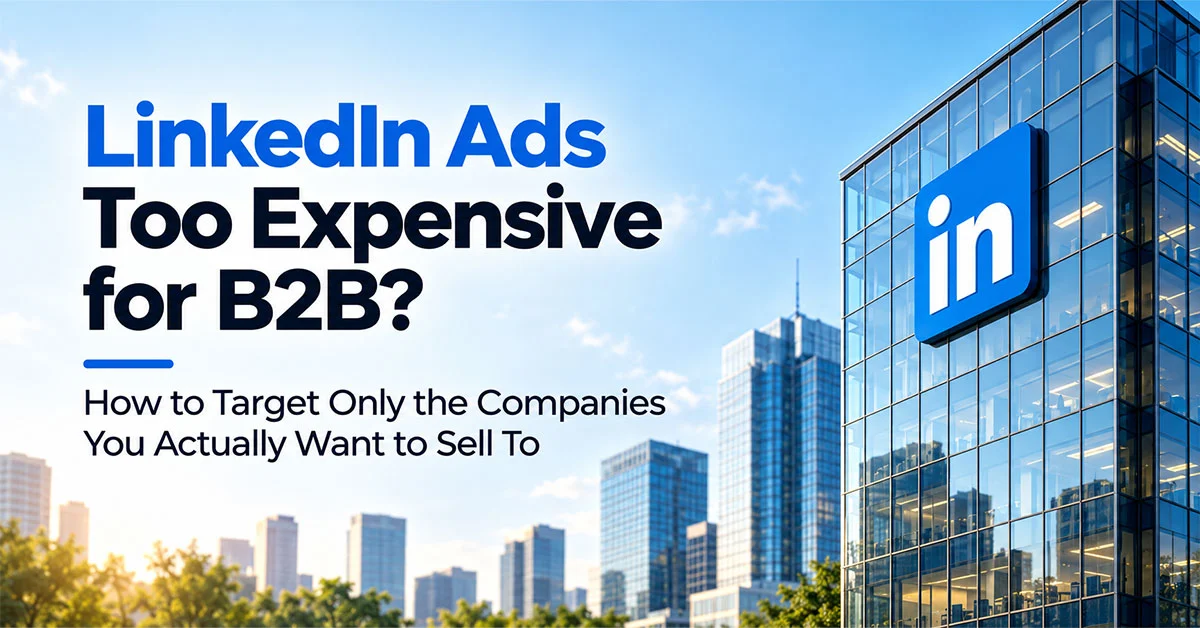
LinkedIn ads too expensive for what you’re getting back? Usually you’re paying to reach people who were never going to buy. Upload a list of the companies you actually want and LinkedIn stops wasting money on everyone else. Just be ready to measure it differently, because account engagement shows up long before the leads do.
The complaint always sounds similar. “We spent ₹4 lakh on LinkedIn last quarter and got eleven leads. Three were students. One was a competitor.”
Ouch. But not surprising.
Most LinkedIn campaigns get set up with job titles and industries and not much else. “Marketing managers in IT services, India.” That’s a lot of people. Some of them work at companies you’d love to sell to. A lot more work at firms that are too small, too big, the wrong kind, or already locked into a three-year contract with someone else. You’re paying premium LinkedIn prices to reach all of them equally.
So the fix isn’t usually a better ad. It’s a better list.
Why is LinkedIn Cost Per Lead So High?
Partly because LinkedIn’s clicks are genuinely pricey, and partly because broad targeting spends that pricey budget on the wrong people. Job title targeting alone pulls in everyone with the right words in their profile, at companies you’d never close. You pay for all of them, so the cost per useful lead balloons.
There’s a deeper reason too. Most of your target buyers aren’t buying right now. Research from the Ehrenberg-Bass Institute with LinkedIn’s B2B Institute, written up in Marketing Week, suggests only around 5 percent of B2B buyers are in the market at any given moment. The other 95 percent might buy next year, or the year after.
So if every LinkedIn campaign is a “book a demo” form, you’re asking that 95 percent for something they’re not ready to give. No wonder it’s expensive.
Can I Upload a List of Target Companies to LinkedIn?
Yes. In Campaign Manager you can upload a spreadsheet of company names and website domains as a matched audience, then show ads only to people who work there. Layer job function and seniority on top and you’re reaching the actual buying group, not the whole office.
LinkedIn’s company list targeting guide walks through the upload. Use company website domains wherever you can, not just names, because “ABC Solutions” could be fifteen different businesses. Domains match far more reliably.
Once it processes, check the match rate. If only half your list matched, clean it up. Wrong domains, subsidiaries listed under a parent, tiny firms with barely any LinkedIn presence. It’s dull work. It also decides whether the whole campaign works.
How Many Companies Do I Need on the List?
Usually a few hundred at least. LinkedIn needs a minimum audience size before a campaign will even run, and once you layer job function and seniority on top, a small list shrinks fast. Under a hundred companies and it often makes more sense to have your sales team reach out directly.
Here’s the maths that catches people out. Two hundred target companies sounds like plenty. Then you narrow it to finance decision-makers at director level and above, and you’re down to maybe a few thousand people. LinkedIn can still serve that, but now every one of them will see your ads a lot.
So there’s a balance. Tight enough to be relevant, big enough to actually run. We usually start with a few hundred accounts, see what the audience size looks like after layering, then loosen the job filters before we loosen the company list.
Why Are My Impressions So Low After Uploading a List?
Because a small, specific audience simply has fewer people to show ads to, so LinkedIn charges more per impression to reach them. Low impressions and high CPMs are normal for ABM. Budget for reaching the same people several times, not for big volume, and the numbers make a lot more sense.
People panic at this stage. The CPM looks awful compared with their broad campaign. But a broad campaign reaching 200,000 random people and an ABM campaign reaching 3,000 of the right ones aren’t really comparable.
If impressions are near zero, though, that’s a different issue. Check the match rate, check you haven’t stacked too many filters, and check the bid isn’t set so low LinkedIn won’t bother serving it.
What Does a Linkedin Company List Targeting ABM Sequence Look like?
Don’t open with “book a demo”. Nobody at a company that’s never heard of you is booking a demo.
A sequence works better. First, something easy to watch or read, like a short video or a thought leader ad, which is a post from one of your actual team members promoted as an ad. It feels like a person talking, not a brand selling. Second, for the companies that engaged, something more useful, like a document ad with a case study or a short guide they can flip through right in the feed. Only then, for accounts clearly warming up, the consultation or demo offer.
That’s LinkedIn company list targeting ABM done properly. Slower than a lead form. Much less wasted money.
The ABM campaigns that work on LinkedIn are judged on whether target accounts are warming up, not on cost per lead. When a client asks for CPL in month one of an ABM program, the program has already been set up to fail. Picture a software company targeting 400 mid-size manufacturers. In month one, the right number to watch is how many of those 400 have had several people engage with the ads, not how many filled in a form.
— Vishal Singh, Performance Marketing Specialist
How Do I Know ABM is Working If Leads Are Slow?
Watch the accounts, not the forms. Which target companies are engaging, how many people from each one, and whether that number is climbing month to month. Then check your CRM. Are those warming accounts taking sales calls, replying to emails, turning up in pipeline?
LinkedIn’s Campaign Manager shows company-level engagement, so you can see that, say, 60 of your 400 accounts have had three or more people interact with the ads. That’s a list your sales team should be looking at every week.
Sales alignment is honestly where most LinkedIn company list targeting ABM programmes win or lose. Marketing warms up the account. Sales gets told which accounts are warm and reaches out while the timing’s good. If marketing never shares that list, half the value disappears.
Leads do come. They just come later, and they usually close at a better rate because the buyer already knows who you are.
When is LinkedIn ABM Not Worth It?
When you’ve got fewer than about a hundred target accounts, when nobody in sales will follow up on engaged accounts, or when the deal size is too small to justify LinkedIn’s prices. In those cases, direct outreach or a broader channel will usually do a better job for less.
Selling a ₹15,000 software subscription? LinkedIn ABM probably costs more than the deal is worth. Selling a ₹40 lakh implementation project to fifty specific banks? Now it makes a lot of sense, if sales is ready to pick up the phone.
A good social media marketing services partner should be willing to tell you when ABM isn’t the right move. And if you’re comparing agencies offering the best social media marketing services, ask how they’d report on ABM in the first three months. If the answer is cost per lead, they’ve missed the point.
LinkedIn Ads Too Expensive? More Questions We Get Asked
Q1. Are LinkedIn ads too expensive for small B2B companies?
Ans. Often, yes, if they’re running broad lead gen campaigns. A tight company list with a small budget and a clear follow-up plan can still work well.
Q2. Can I upload contacts as well as companies?
Ans. Yes, you can upload contact lists too. Match rates are usually lower, and you need to make sure you’re handling personal data in line with privacy rules.
Q3. How long before ABM on LinkedIn shows results?
Ans. Give it at least a quarter. Engagement shows in weeks, pipeline in months.
Written by Vishal Singh, Performance Marketing Specialist
I run LinkedIn campaigns for B2B brands across India, the UAE and beyond, and “LinkedIn is too expensive” is one of the first things I hear on a new account. Usually the money’s going to the wrong people, not too many of the right ones.
If you’d like help targeting the accounts you actually want to win, take a look at our social media marketing services.