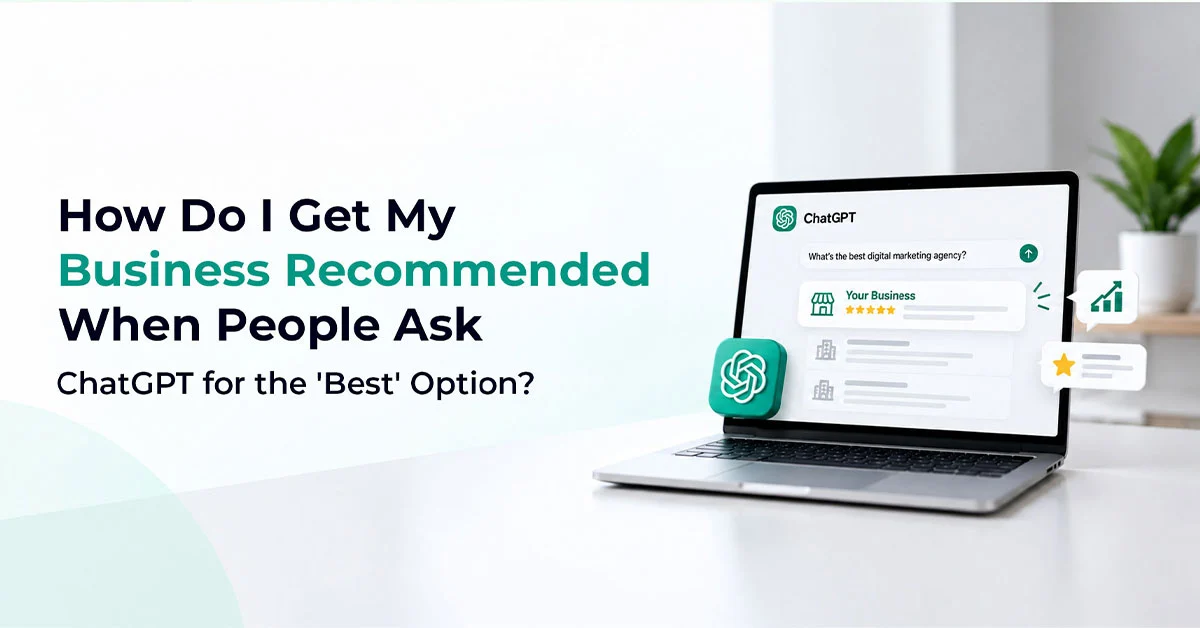
Typed “how to get my business recommended by ChatGPT” into Google lately? Here’s the bit nobody tells you. Ask an AI who the best caterer in Indiranagar is and it doesn’t go and read the caterers’ websites. It goes and reads what everyone else has said about them. Reviews, roundup posts, old directory pages, a forum thread from last year. Your own website is just one voice in that crowd.
It usually starts with a screenshot. Somebody on the team asks ChatGPT “best digital marketing agency in Pune”, gets five names back, and three of them are competitors they’ve beaten on actual pitches. Their own agency? Nowhere.
First reaction is always the website. “Should we redo the homepage?” Probably not, honestly.
Think about how a person would answer that question if you asked them cold. They’d go and check Google reviews, look at a couple of “top agencies” lists, maybe ask in a WhatsApp group. AI does a version of the same thing, just faster and with less gossip. If you’re barely mentioned anywhere outside your own site, it doesn’t have much to go on.
The AI isn’t ignoring you. It just can’t find enough people talking about you.
Where Does ChatGPT Get Its ‘best of’ Lists from?
Mostly from other people’s pages, not yours. For “best X” questions ChatGPT leans heavily on review platforms, comparison listicles, directories, news mentions and forum threads like Reddit. It pulls those together into a shortlist. So the brands that show up are usually the ones mentioned most often, in the most places.
Ahrefs dug into this in their ChatGPT ranking research earlier this year. Reddit came out as ChatGPT’s most-cited domain by a long way, ahead of Wikipedia. Branded mentions across the web, and YouTube mentions especially, had the strongest link to how visible a brand was. Your own homepage didn’t come close.
One more thing from the same piece that people find unsettling. Ask ChatGPT the same “best” question a hundred times and you’ll almost never get the exact same list twice. So don’t panic over one screenshot. Look for patterns across lots of runs.
Why Does It Matter If My Business Is Described Differently on Every Site?
Because the AI has to work out that all those mentions are actually you. If Clutch says “digital agency”, your Google profile says “advertising consultant”, LinkedIn says “growth partner” and an old directory still has your previous office address, that’s four slightly different businesses as far as a machine’s concerned.
So settle on how you describe yourself and copy-paste it, literally, onto every profile you’ve got. The name with or without “Pvt Ltd”, whichever, just stick to one. Boring admin. Weirdly powerful though. Cleaning up five or six old listings nobody’s touched since 2021 is often the quickest win going.
Do Google Reviews Affect AI Recommendations?
They do, more than people expect. Reviews feed straight into Google’s own AI answers and show up on the review sites other AI tools read too. Lots of reviews, recent ones, and ones that say what you actually did for the customer, all give the AI something concrete to repeat about you.
Google says outright in its local ranking guidance that more reviews and positive ratings can help your local ranking, and that replying to them shows you value feedback. Those same reviews are what AI summaries borrow from when they describe a business as “known for fast turnaround” or “good with small budgets”.
So, do Google reviews affect AI recommendations beyond Google’s own results? Indirectly, yes, because the wording ends up quoted elsewhere. That’s why specificity matters so much. “Great service!” tells an AI nothing. “They rebuilt our Google Ads account and cut our cost per lead in half in three months” gives it a reason to recommend you for exactly that. You can’t write reviews for customers, obviously. Nothing stopping you from nudging them though. “If you’ve got a sec, could you mention the Ads rebuild?” goes a long way.
When we audit why a brand does not show up in AI recommendations, the cause is rarely the website. It is that competitors are listed on 15 review and comparison sites and the brand is on three. The AI is not ignoring you. It simply has fewer sources saying you exist. Run “best digital marketing agency in Pune” through ChatGPT a few times and check what it cites, and you’ll usually find the same handful of review profiles, two or three listicles and a Reddit thread doing most of the work for whoever gets named.
— Vishal Singh, Performance Marketing Specialist
Do Reddit and Forum Mentions Matter?
Real ones do, a lot. Reddit is one of the sources AI tools quote most, so a genuine thread where customers recommend you can carry real weight. The fake stuff, though? Redditors sniff it out in about ten minutes, a mod deletes it, and occasionally someone screenshots it for everyone to laugh at. Not the mention you were hoping for.
The version that works takes patience. Somebody from your team, posting as themselves, helping people with their actual questions in r/IndiaInvestments or r/dubai or wherever your buyers hang out, and only bringing up the business when someone genuinely asks. Months of that, not a weekend. Happy customers who happen to be on Reddit, posting their own experience. Industry forums and Quora, if that’s where your buyers hang out.
What doesn’t work? Creating five accounts to praise yourself in the same thread. Moderators have seen it all before, and most communities have rules against self-promotion anyway.
Should I Pay to Be in ‘top 10’ Listicles?
Being in credible “best of” lists helps. Paying for low-quality ones usually doesn’t. A respected industry roundup or a local news feature is worth chasing. A site that publishes “Top 10 Agencies” pages for anyone who pays, and ranks itself first, is a lot less useful than it looks.
AI tools seem to be getting pickier about this. Seer Interactive found ChatGPT’s listicle citations dropped about 30 percent in a single month earlier this year, while Wikipedia and Reddit gained ground. The lists that kept getting cited tended to be recent, thorough and backed by something external, not just a sales page with a ranking slapped on top.
So before saying yes to a paid listing, look at the site. Does it rank for anything? Does it list real competitors fairly? Would you trust it as a buyer? If not, the AI probably won’t either.
How Do I Check Which Sources AI Uses for My Category?
Pick the five to ten “best” questions your buyers actually ask, run each one through ChatGPT, Perplexity and Google AI Mode a few times, and write down every source they cite. Then compare. Wherever competitors show up and you don’t, that’s your gap list.
Keep it in a plain sheet. The question, the engine, which brands got named, which sources were cited. After a couple of rounds the same sites keep popping up, and those are the ones to work on first. A Clutch profile with no reviews, a directory with your old phone number, a listicle that’s never heard of you.
That’s basically the job. good digital marketing services teams now treat this as part of normal reputation and SEO work, not a separate AI project. And if you’re comparing agencies that claim to offer the best digital marketing services, ask them to show you which sources ChatGPT cites for your category. If they’ve never looked, that’s an answer too.
Questions We Get Asked on How to Get My Business Recommended by ChatGPT
Q1. How long does it take to start showing up?
Ans. Fixing listings and profiles can help within weeks. Earning new reviews, mentions and list placements usually takes a few months to show up properly.
Q2. Does my website still matter?
Ans. Yes. It’s still one of the sources AI reads, and a clear page about what you do and who you do it for helps it describe you accurately. It just isn’t enough on its own.
Q3. Do Google reviews affect AI recommendations if I only have a few?
Ans. A handful still helps, especially if they’re recent and specific. Just don’t expect to outrank a competitor with 200 reviews overnight. Ask every happy client, steadily.
Q4. Can I ask ChatGPT to add my business?
Ans. Not really. There’s no submission form. The only way in is being talked about in the places it already reads.
Written by Vishal Singh, Performance Marketing Specialist
I work with brands on SEO and AI search visibility, and “why does ChatGPT recommend them and not us?” is one of the most common questions I get. The answer’s almost always somewhere other than the website.
If you’d like help getting your business into the places AI tools actually read, take a look at our digital marketing services.