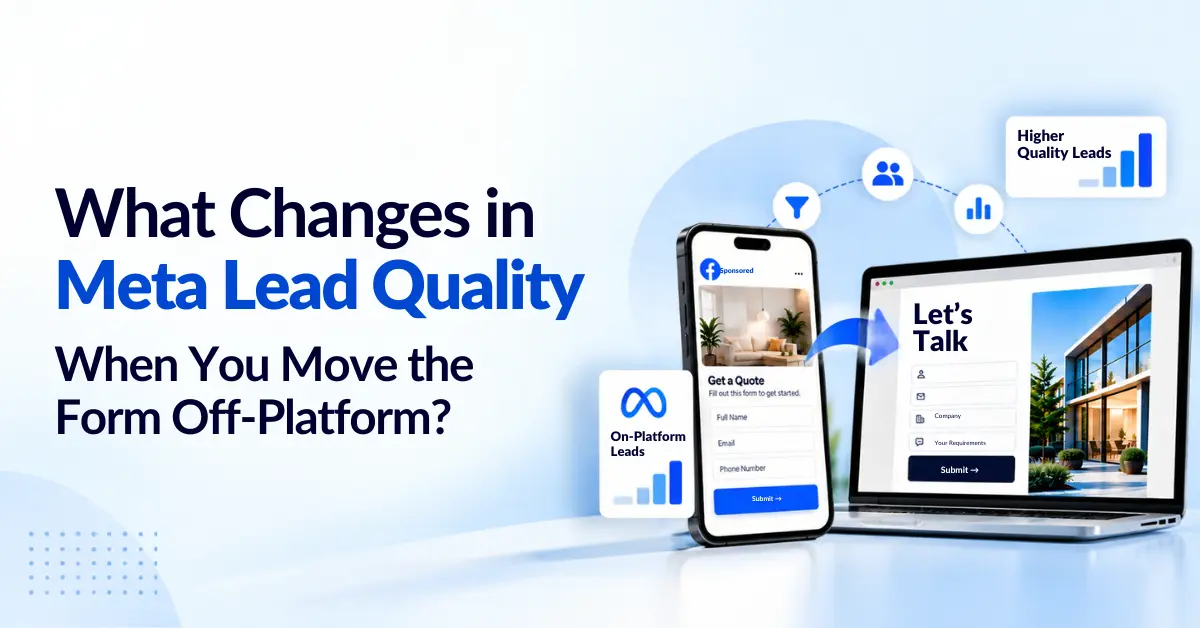
The Meta lead form vs landing page decision shapes who lands in your CRM. Instant Forms tend to bring leads in 30 to 50 percent cheaper, though they close at about half the rate. Landing pages cost more and bring fewer leads, but the people who get through usually want what you sell.
Every few months a client spots two numbers next to each other and gets very excited. Instant Form CPL looks gorgeous. Landing page CPL is nearly double. Then comes the question we could set our watch by, which is why on earth are we paying more for the same lead?
We’re not, though. It’s a different lead.
With the form sitting inside Facebook or Instagram, Meta fills in the person’s name, email and phone number for them. Two taps and they’re through, and some of them didn’t totally mean to be. Put the form on your website instead and suddenly they have to leave the app, sit through a page load, read whatever’s on it and type their own details out. That’s effort. And effort weeds people out, because the ones still standing at the end were usually properly interested before they started.
Moving the form off-platform changes your cost, sure. Mostly it changes who you’re paying for.
What Actually Happens to Lead Quality in Meta Lead Form vs Landing Page Campaigns?
One audit of over 1,200 advertisers keeps getting quoted for a reason. Lead form CPL came in 30 to 50 percent lower than landing page CPL, and those leads closed at roughly half the rate. Some 2026 data puts the gap a little narrower, with Instant Form leads converting to sales 20 to 30 percent worse than landing page ones. Different sizes, same direction.
Run the numbers and the cheap lead stops looking cheap. Pay half as much for someone who closes half as often and you’ve spent about the same per customer, except your sales team made twice the calls to find them. Picture a lot of “sorry, who’s calling?” on speakerphone.
None of this is mysterious. Instant Forms are designed to have zero friction, which does wonders for volume and not much for intent. People fill them in mid-scroll, half curious, now and then by accident. Can’t blame them really. Your sales team still has to ring every one of them, though.
Why Does a Landing Page Filter Out the Wrong People?
It makes them do a bit of work. Casual browsers mostly won’t bother.
Leaving the app is hurdle one. The page load is hurdle two, and people underestimate it, since every second past the three-second mark can knock conversion down by around 7 percent. After that the person actually reads something about your business, and by the time they’ve typed their details in they’ve had several chances to wander off. Whoever’s left is generally more serious.
You also get space to explain yourself. If you sell an expensive service or a fiddly B2B offer, or anything where people need to trust you before handing over a phone number, that context does real work. An in-app form can’t tell your story in any meaningful way. A page can.
The downside’s obvious enough. Fewer leads, each one pricier, and if your page is slow or cluttered you’ll lose good people along with the tyre-kickers, which is about the worst result you can get.
Can You Make Meta Lead Forms Bring in Better Leads?
You can. Plenty of accounts we look at are skipping easy wins here.
Meta lets you add SMS phone verification now, ask for a work email, and use conditional logic so the questions change depending on what someone answers. Throw in even one or two qualifying questions and the form gets a touch slower, which is exactly what you want, because you’re adding back a little of the friction that kept the time-wasters out.
The bigger lever is sending your CRM data back to Meta through the Conversions API. Once Meta can see which leads became qualified opportunities, it goes hunting for more people like them, instead of more people who just enjoy filling in forms. Meta says campaigns that hooked their CRM up this way and optimised for conversion leads saw cost per quality lead drop by 15 percent on average. Skip that step and you’re optimising for volume and crossing your fingers on quality. Rarely works out.
In 2026 any half-decent social media marketing services setup should see this as basic plumbing. It shouldn’t be an upsell.
Clients usually ask us why the landing page leads cost more. The better question is why the form leads cost less. Most of the time it’s because a chunk of them were never going to buy anything. Once you price in the sales team’s time, the gap between the two gets a lot smaller than the dashboard makes it look.
— Vishal Singh, Performance Marketing Specialist
Do You Have to Pick One or Can You Run Both?
Running both is fine. For a lot of brands it’s the smart move.
According to Meta, advertisers who ran Instant Form and website form campaigns side by side saw an average 60 percent lower cost per lead and 125 percent more lead volume than with website forms alone. It’s Meta marking its own homework, so a pinch of salt is fair, but the thinking behind it holds.
We tend to split by how warm the audience is. People who already know you (retargeting lists, past engagers, video viewers) get the Instant Form, since they’ve done some of the thinking already and the missing friction doesn’t really hurt. Lead quality from retargeting usually ends up much nearer landing page quality for that exact reason. Cold audiences meeting you for the first time go to the landing page, where it can do a bit of convincing and a bit of filtering at once.
Shopping around for agencies that say they offer the best social media marketing services? Ask them how they’d split this. If you hear “we just go with whichever has the lower CPL,” keep looking.
Instant Form or Landing Page, Which One Should You Use?
Go with the Instant Form if you’re after volume and the offer is simple or low commitment, think a guide, a webinar or a free download, or if you’re retargeting warm people. It only really works when your sales team can reach leads within minutes, because that interest fades fast.
Landing pages earn their extra cost on expensive or complicated offers, on cold traffic, and anywhere trust has to be built before someone will fill anything in. They also make sense when each lead eats up real time from your sales team, since a bad one costs you more than the CPL suggests.
Easy-yes offer plus fast follow-up points to the form. If the offer needs explaining and junk leads hurt, build the page.
Questions We Get Asked About Meta Lead Forms and Landing Pages
Q1. Why are my Meta Instant Form leads so hard to reach?
Ans. The form pre-fills from people’s profiles, and some of that info is years out of date. Others hit submit without thinking much. SMS verification and a qualifying question or two cut down the dead numbers, and calling in the first few minutes helps loads.
Q2. Is a lower CPL always better on Meta?
Ans. Nope. CPL is just the price of getting a name into your system. Cost per qualified lead, or per customer, is what you actually care about, and a lead that’s half the price but closes half as often hasn’t saved you a thing.
Q3. Should small businesses use landing pages if they don't have a great website?
Ans. A slow, confusing page does more damage than good. If you can’t build a quick, focused one yet, an Instant Form set up properly with qualifying questions is usually the better bet for now. Build the page when you’re able to and then test it against the form properly.
Written by Vishal Singh, Performance Marketing Specialist
I run Meta lead generation for brands in all sorts of industries, and the form versus landing page argument turns up in nearly every account. The answer’s almost never “always use one.” It comes down to who you’re talking to and how ready they are.
If you’d like help setting up Meta lead campaigns that bring in leads your sales team actually wants, have a look at our social media marketing services.