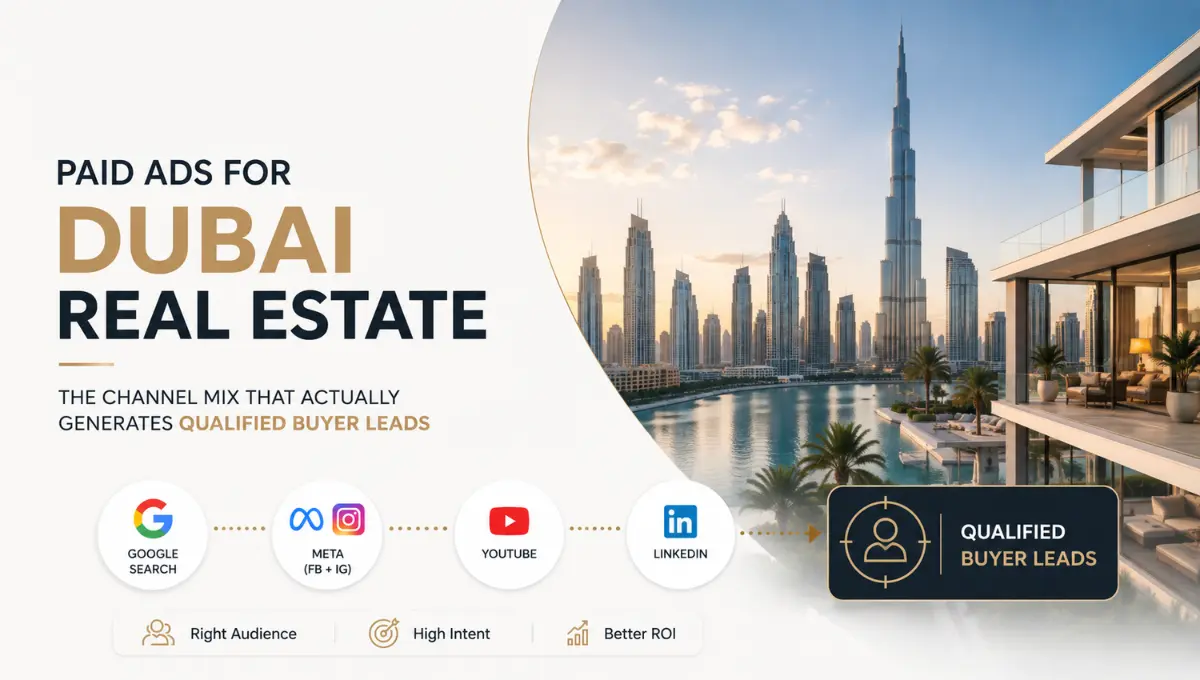
Dubai real estate paid ads lead generation in 2026 is not a one-platform game. Google captures buyers who already know what they want. Meta builds demand from international audiences who have not heard of your project yet. LinkedIn goes after the investor segment that neither handles well. Getting the mix right is about sequence — and most campaigns get it wrong before the first ad even goes live.
Here is the pattern we see constantly in Dubai real estate. Leads are coming in. Sometimes a lot of them. The sales team is working through the list, making calls, following up on WhatsApp, and the conversion rate is making everyone quietly uncomfortable. The response is almost always the same, increase the budget, try a new creative, maybe switch agencies.
What nobody looks at is the fact that the campaign is talking to two completely different types of buyers as if they are the same person.
An end-user looking for a home has already done the thinking. They know which community they want, they know the configuration, sometimes they even have a building in mind. They just need a reason to choose your project over the one they saw on Bayut yesterday. An investor making a capital allocation decision needs something entirely different, like a payment plan breakdown, expected rental yield, developer track record, and enough trust signals to justify committing serious money to a project that does not exist yet.
Same ad, same landing page, same CTA for both of these people is why high lead volume and poor qualification almost always show up together in Dubai property campaigns.
Why the Highest-Intent Dubai Buyer Is Already on Google Waiting to Be Found
When someone types “off-plan 2BHK Dubai Marina 2026” into Google, they are not browsing. They have done the research, they have a preference, and they are now looking for the specific product that matches it. That is a completely different person from someone scrolling Instagram who sees a property video and thinks “that looks nice.”
The keyword strategy that burns the most budget in Dubai real estate is broad match on generic terms. “Apartments Dubai” is pulling in researchers who are six months away from making a decision, if they make one at all. Exact and phrase match on area, unit type, and price range puts the ad in front of the buyer at the decision stage. There is a meaningful difference between “Dubai apartments” and “1BHK JVC under AED 700K” and every dirham spent on the first while the account is running the second targeting is wasted money.
Google Ads CPL for high-intent real estate keywords in Dubai runs AED 450 to 900. It sounds steep compared to what Meta shows in the dashboard. It does not sound steep when you track it against how many of those leads actually show up for a site visit.
What Meta Is Good For in Dubai Property and What It Is Not
Meta’s job in Dubai real estate is not to close buyers. It is to find them before they start searching, and bring them back once they have.
The platform does awareness and retargeting exceptionally well. Source market campaigns targeting Indian nationals, UK residents, and Pakistani audiences using video walkthroughs of Palm Jumeirah or Downtown projects generate strong inquiry volume at AED 30 to 300 CPL. These leads need nurturing. They are not ready to sign anything today, and treating them like they are will frustrate the sales team and produce a qualification rate that nobody is happy with.
Where Meta genuinely earns its place in the mix is retargeting. Website visitors, video viewers, people who interacted with a previous campaign and did not convert. These audiences come back with higher intent and lower CPL than cold acquisition, and concentrating the Meta budget here rather than on cold bottom-funnel campaigns is the change that moves the numbers fastest in most Dubai property accounts.
Why LinkedIn Is the Underused Channel for the Investor Buyer Segment
Nobody runs LinkedIn for residential real estate until they have been burned enough times trying to reach investors on Meta.
For C-suite executives in London, Mumbai, or Singapore looking at UAE investment options, LinkedIn offers targeting precision that Meta simply cannot match. Job title, seniority, industry, geography. The investor making a multi-million dirham capital allocation decision is on LinkedIn during the working day making professional decisions. That is where the message lands differently.
LinkedIn CPL in Dubai runs AED 200 to 600. For an audience where the average deal is in the millions and the sales cycle runs 60 to 90 days, that is not the number to stress about. The number that matters is qualified lead to transaction, and for the investor segment, LinkedIn consistently performs on that metric in a way that lower-CPL channels do not.
“Dubai real estate paid media has two distinct buyer profiles that most campaigns treat as one: the end-user buyer searching for a home and the investor looking for yield. The ad copy, the platform, the creative format, and the landing page are different for each. Running the same campaign to both audiences produces mediocre results for both — which is why most Dubai real estate campaigns show high lead volume with poor qualification rates.”
— Vishal Singh, Performance Marketing Specialist
Portals vs Paid Channels — They Are Not Competing, They Are Sequential
Bayut and Property Finder show listings to buyers who are still in the comparison stage. They are in the market, but they have not decided on a developer, a community, or a price point yet. Portal leads in Dubai run AED 50 to 200 CPL. They are explorers.
Google Search captures the same person three weeks later, after they have explored, narrowed it down, and are now looking for the specific thing they want. The search query “off-plan 2BHK Marina from AED 1.2M” is not an explorer. It is someone who has arrived at a decision and is looking for a reason to act.
These are not competing channels. They are different moments in the same buyer journey, and the budget allocation should reflect which moment you are trying to show up in.
The Budget Split That Makes Sense for Most Dubai Residential Developers
For most developers running both channels, the split that produces the best blended CPL is 60 to 70 percent on Google Search and Performance Max, with the rest of the Meta budget concentrated on retargeting and international source market awareness rather than cold acquisition. LinkedIn runs as a separate investor budget, not out of the same pool as the consumer campaign spend.
The international source market campaigns on Meta targeting India and the UK run differently in terms of creative and CTA than local UAE buyer campaigns on Google Ads Meta Ads Dubai property buyer leads. Combining them into one budget creates a reporting mess and a targeting mess at the same time.
Why the Landing Page Decides Whether the AED 80 CPC Was Worth It
At average CPCs of AED 80 and above in Dubai real estate, a landing page that is not doing its job is expensive in a very direct way.
One dedicated page per campaign area and property type is not overcomplicating things. It is the minimum architecture that makes sense when a buyer searching for a specific community lands somewhere and needs to feel in the first five seconds that they are in the right place. A buyer searching “1BHK JVC under AED 700K” who lands on a page that says “Premium Properties Across Dubai” has lost the thread and they are gone. No navigation, no distractions, one CTA, and a headline that matches what brought them there.
Questions That Come Up Every Time a Dubai Campaign Underperforms on Lead Quality
Q1. Why does Meta show a low CPL but the sales team says the leads are no good?
Ans. Because Meta CPL measures form submissions, not buyer intent. Someone who fills a form after seeing a property video on Instagram is at a completely different stage than someone who searched for a specific unit type in a specific community. The CPL looks efficient because the volume is high and the cost is low. The qualification rate tells the real story.
Q2. Should the same creative run on Google and Meta?
Ans. No. Google Search ads match a query. Meta ads interrupt a scroll. The creative, the message, and the CTA need to match the intent level of the platform they are running on. Repurposing the same assets across both is how you end up with creative that is slightly wrong for both platforms instead of properly right for either.
Q3. How fast does a Dubai real estate lead need a response?
Ans. Very fast. The consideration cycle for Dubai property runs 60 to 90 days, but the first response window is minutes, not hours. Leads not contacted within the first hour convert at significantly lower rates. WhatsApp integration for immediate acknowledgment is standard in every high-performing Dubai real estate account for this exact reason.
Written by Vishal Singh, Performance Marketing Specialist
I manage paid media for real estate clients in the UAE and across international source markets. The channel mix and benchmarks in this article come from campaigns we are running now, not industry reports written about the market from the outside.
For more on how we build performance marketing programmes across real estate and professional services, visit our digital marketing services.