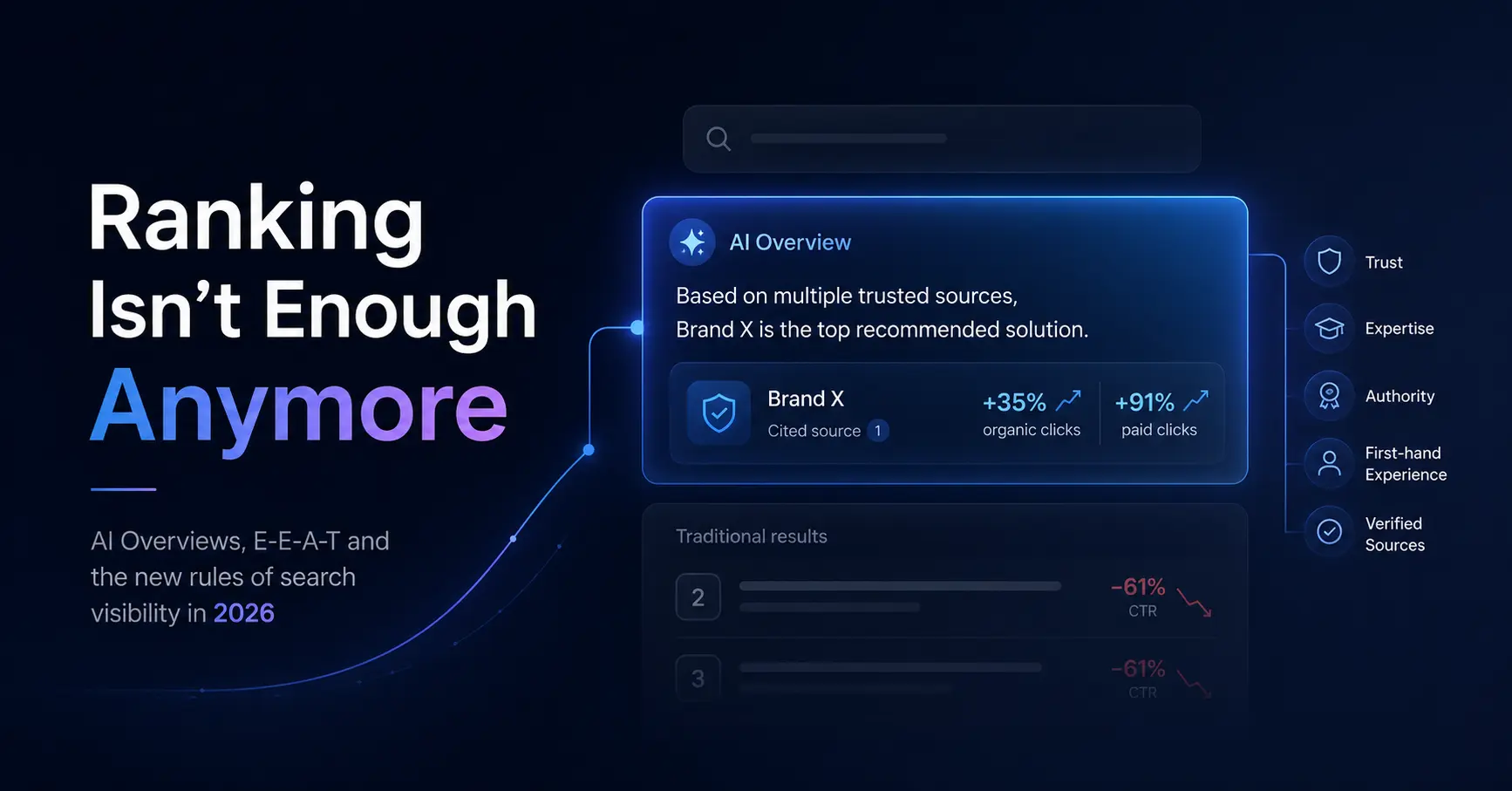
So, AI Overviews are now popping up on almost half of all Google searches. Fun, right? Except not so much if you care about clicks, because organic CTR can nosedive by 61% when they show up. But here’s the kicker, if your brand actually gets a mention inside those overviews, you’re suddenly getting 35% more organic clicks and a wild 91% more paid clicks than those who just rank but don’t get cited. Basically, Google has turned search into a two-player game, and most brands are still stuck playing the old one.
Last year, we started noticing something sneaky across client accounts. Rankings were holding steady, sometimes even inching up. But traffic? It was quietly slipping away, not in a way that would make anyone panic, just a slow, silent leak that the weekly reports politely swept under the rug until someone finally bothered to dig in.
When we dug in, the answer was not a penalty or a competitor that had suddenly gotten better overnight. AI Overviews had started appearing on the exact queries those pages ranked for, and the click was no longer guaranteed just because the position was. As of early 2026, AI Overviews appear on nearly half of all Google searches. On those queries, organic CTR drops by up to 61% for brands that rank but are not cited inside the overview itself.
Here’s where rankings stop telling the full story. If you have been running an SEO strategy built entirely around rankings, is that the brands being cited inside those overviews are not necessarily the ones ranked highest. They are the ones whose content Google decided to trust enough to quote. That is a different game, with different rules, and most content strategies have not caught up to it yet.
What Happens to Your Result When Google Puts an AI Answer Above It
The traditional organic links do not disappear when an AI Overview appears. They just end up below a response that, for a large share of users, already answered the question. There is no reason to scroll down when the answer is sitting right there at the top.
In AI Mode, which is Google’s more conversational search experience, this effect gets sharper. Roughly 93% of searches end without a click when AI Mode is active. The brands that appear inside the AI response exist for that user in that moment. Everyone else is competing for attention below something that already did the job.
This is what we mean when we say ranking and visibility are now two separate things. Visibility used to follow ranking almost automatically. That is not how it works anymore, and any Google AI overviews SEO agency 2026 conversation that ignores this is still solving last year’s problem.
Why the Same Query Is Sending Some Brands More Traffic and Others Almost None
Seer Interactive studied over 25 million organic impressions across more than 40 organisations to understand what AI Overviews are actually doing to traffic, and the findings split cleanly into two realities depending on where you land relative to the citation.
If your brand is not cited inside the overview on a query where one appears, organic CTR drops 61% compared to the same query without an overview. That is not a rounding error. That is most of your traffic gone from that keyword while your ranking sits exactly where it was.
If your brand is cited, branded queries see an 18% CTR increase over the baseline. The same feature that is hurting uncited brands is actively sending more traffic to the ones that earned a mention inside the response.
We watched this split happen in real time on a client running informational content in a competitive B2B category. Pages that got picked up as citations held their traffic during a period when every other page was declining. The ones that ranked well but did not get cited dropped, quietly and consistently, with no change in position to explain it.
What the 35% and 91% Numbers Are Really Telling You
Brands cited in AI Overviews earn 35% more organic clicks than brands that rank on the same page without a citation. That part is intuitive enough, since being inside the response means you are visible where the attention is.
The paid number is the one that makes people stop mid-conversation. Cited brands earn 91% more paid clicks than uncited competitors appearing on the same results page. Not because their ads are better. Because users who see a brand inside the AI summary and then see that brand’s ad are clicking at nearly double the rate of users who only see the ad on its own.
Being cited is functioning as editorial trust that carries across the entire page. Google’s AI picked this brand as a source worth quoting, and that signal follows the brand into every other placement on the same SERP. For a team running paid alongside organic, that lift is not coming from the media budget. It is coming from the content infrastructure underneath it.
“For performance marketing agencies, paid campaigns now perform better when organic content is being cited on the same queries. A brand with zero citation authority is paying a premium CPC to appear next to a competitor that Google’s AI has already editorially validated. That’s not a paid media problem. It’s a content infrastructure problem that bleeds into your ad costs.”
~ Vishal Singh, Performance Marketing Specialist
Why Being Number One Without a Citation Is Now a Stranger Position Than It Looks
A page at position 1 in a query with an active AI Overview has roughly a 33% chance of being cited within that overview. A page at position ten has about a 13% chance. The gap matters, but the number that reframes things is this: an uncited brand at position one receives around 9,400 clicks per million impressions on an AIO-heavy query. A cited brand at a lower position receives around 20,700.
More traffic. Lower ranking. Because citation is now the variable that actually controls what happens to the click.
The hierarchy that search has been built around for years has a new layer sitting above it, and most content strategies are still optimising for the layer underneath.
Content That Gets Cited vs Content That Just Ranks
The obvious question is what actually separates one from the other, and the answer is more pinpointing than writing better content.
Content that earns citations tends to open with a direct answer rather than three paragraphs of context-setting that makes the reader work for the point. It uses structured sections that give Google something clean to extract. It carries verifiable claims with real sources attached. And it is written with first-person specificity, meaning it reads like someone who has actually done the thing is explaining it, not like a page that assembled information about the thing from other pages.
Content that ranks but does not get cited is usually technically fine. Topically relevant, properly optimised, decent domain authority. The information is there. Google just cannot pull a clean answer from it because it was structured for human reading rather than AI extraction.
Domain authority remains the strongest predictor of AI citation probability, and pages that have not been updated in more than three months are three times more likely to lose citation status than pages that are actively maintained. Google is treating content freshness as a trust signal, not just a ranking factor.
Choose citation-focused content if you want to hold visibility on AI Overview-heavy queries going forward. Choose traditional ranking-only content if you are confident those queries will stay AIO-free, which, given that AIO presence grew 58% year over year in 2026, is an increasingly difficult bet to make.
Whether an Organic Citation Actually Outperforms a Paid Placement in the Same Response
When a brand appears cited inside an AI Overview and also runs a paid ad on the same query, the organic citation does something the ad cannot. It tells the user that Google’s own system decided this brand was worth quoting. The paid placement tells the user the brand paid to be there. Users in AI-first search environments are increasingly good at reading that difference, and the click behaviour reflects it.
If you’re building for any Google AI Overviews SEO agency 2026 strategy, the worth building is not to choose between paid and organic but to reach a point where the organic citation is doing trust work that makes the paid placement perform better on the same query. That combination is where the compounding advantage actually sits, and it starts with the content, not the ad.
What People Ask Us Every Time This Comes Up
Q1. Does ranking still matter if AI Overviews are taking the clicks?
Ans. Yes, because citation probability is still tied closely to organic position. Pages outside the top ten are roughly four times less likely to be cited inside an overview. Ranking is still the prerequisite. It just stopped being enough on its own.
Q2. How do you actually check if your content is being cited?
Ans. Google Search Console does not separate AIO citation data from standard organic impressions yet. The practical way to check is manual searches on your target queries combined with tools like SEMRush or Ahrefs that track AIO presence and citation status across a keyword set over time.
Q3. Is E-E-A-T in 2026 actually different from what it was before?
Ans. The principles are the same, but what they require in practice has shifted. AI Overviews E-E-A-T 2026 rewards first-person specificity and verifiable claims in a way that generic authority signals do not cover anymore. Content that reads like it was written by someone with direct experience gets cited. Content that signals expertise without demonstrating it does not.
Q4. Can a smaller brand realistically compete with large domains for citations?
Ans. On the right queries, yes. Domain authority matters broadly, but on certain informational or niche queries, a well-structured piece with real first-hand detail from a smaller domain regularly outperforms larger sites with thinner coverage of the same topic. The playing field is more level on specificity than it is on scale.
Written by Vishal Singh, Performance Marketing Specialist
I work across paid and organic search strategy for agencies and direct clients, and the way AI Overviews are redistributing traffic is something we track in live accounts, not just something we read about. The observations in this article come from that work.
For more on how we build content and SEO strategies that earn visibility in AI-driven search, visit our search engine optimization services.