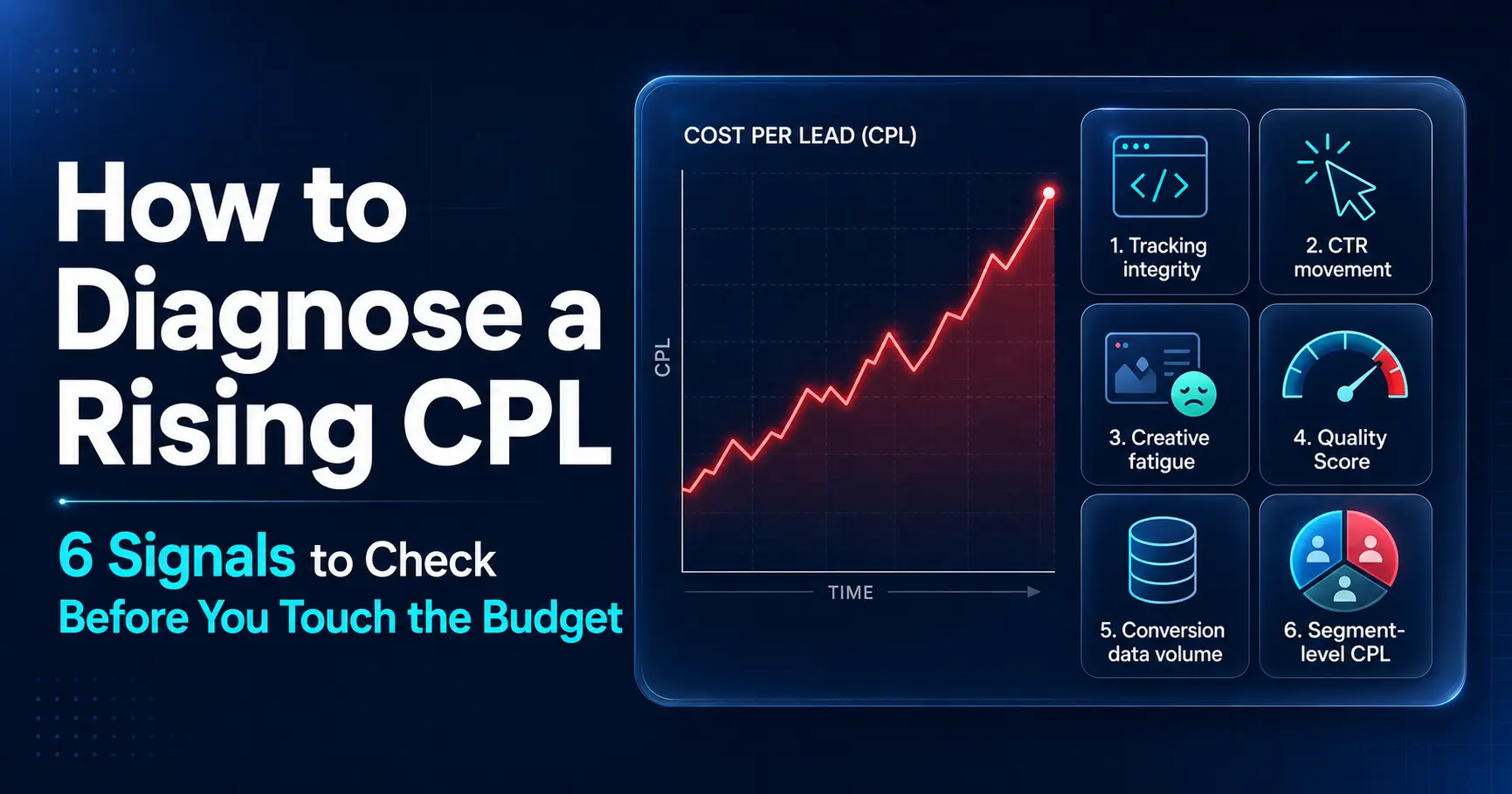
A rising CPL does not always mean the campaign is broken. Before adjusting any budget or bid strategy, use six diagnostic signals tracking integrity, CTR movement, creative fatigue, Quality Score, conversion data volume, and segment-level CPL to identify where the problem actually lies in a paid media account.
When cost per lead starts climbing, the first instinct is usually to increase the budget or tweak the targeting. But surprisingly, most of the time, that isn’t where the problem starts. A rising CPL usually leaves clues elsewhere in the account first. These are the six signals we check before making any changes to spend or campaign settings.
The budget is rarely the first thing that needs changing. It gets the most attention because it’s the easiest setting to adjust, but a rising CPL is usually a symptom of something else like tracking issues, creative fatigue, or a disconnect between the keyword, ad, and landing page. Changing the budget before checking those areas often means treating the symptom instead of the cause.
One pattern we’ve seen repeatedly in 2026 is advertisers responding to a rising CPL by increasing spend. The accounts that performed better were usually the ones that diagnosed the underlying issue before changing the budget.
Before You Read Any Other Number, Check If the Number Is Even Real
This is Signal 1, and it goes first because everything else in the diagnosis depends on it.
Pixel drift, GTM trigger misfires, thank-you page URL changes, and consent mode updates that quietly stopped firing on a subset of users any of these can make CPL look like it is climbing when what actually happened is that the measurement broke. Accounts without Enhanced Conversions or Conversion APIs in place report 30 to 50% higher CPAs than accounts with complete tracking, not because performance is worse, but because the data coming in is incomplete.
The first checkpoint should be to review whether the conversion being counted today is the same one counted 30 days ago. Pull the conversion action report, verify tag coverage, and confirm the thank-you page URL has not been quietly changed in a recent site update. If any changes have occurred, the CPL number cannot be relied upon for accurate diagnosis.
Your CTR Has Not Moved, But Then Why Is CPL Going Up?
Signal 2 is where the diagnosis splits, and this one shows the ad isn’t the issue.
If click-through rate is holding steady while CPL continues to climb, the ad is probably doing its job. The problem is more likely to be what happens after the click. We’ve seen plenty of accounts where CTR stays healthy while conversion rate gradually drops because the landing page no longer delivers on what the ad promised.
Check load speed, check form field count, and check whether the message on the page actually matches what the ad promised. If those three things are misaligned, no bid adjustment will fix what happens after the click.
Your CTR Is Falling Too, and That Is a Completely Different Problem
Signal 3 is not the same diagnosis, and it needs a different fix.
When CPL and CTR are both moving in the wrong direction together, the audience has seen the creative enough times that it has stopped working. Creative fatigue and audience exhaustion show up here before they show up anywhere else in the account, and they look almost identical in the numbers until you pull frequency.
High frequency with falling CTR on Meta points to creative fatigue. Stable impression share with falling CTR on Google usually means a shift in search intent that the creative has not caught up with. Either way, this is a creative and audience diagnosis, the budget had nothing to do with it.
What a Slipping Quality Score Is Quietly Doing to Your CPL
Then comes Signal 4 that runs up the bill before anyone connects it to rising CPL.
A quality score measures how well your keyword, ad, and landing page are aligned with what the user was actually looking for. When it drops, Ad Rank drops with it, and you pay more for the same position or lose it entirely. The average quality score across over 15,000 Google Ads accounts sits at 5 to 6 out of 10. Moving from a 5 to an 8 cuts CPC by roughly 30%, which flows directly into CPL without touching the budget at all.
Landing page experience accounts for roughly 39% of Quality Score. If Quality Score has dropped while CPL keeps rising, start there. In many cases, the issue isn’t the keyword or the bid, but it’s that the landing page no longer matches the intent behind the search or the promise made in the ad.
“The first thing we check before any account-level diagnosis is whether the conversion being counted today is the same one counted 30 days ago. Tracking drift, pixel misfiring, GTM trigger breaking, and thank-you page URL changing also account for at least 30% of the ‘rising CPL’ calls we get from new clients. The CPL didn’t rise. The measurement broke.”
— Vishal Singh, Performance Marketing Specialist
Is the Algorithm Underperforming or Just Underinformed?
A data problem that may look like a campaign problem is actually Signal 5.
Smart Bidding needs a minimum of around 100 conversions per month to function with reasonable stability. Below that threshold, expect 20 to 30% CPA volatility that has nothing to do with how well the campaign is built. The algorithm isn’t necessarily underperforming, but it simply doesn’t have enough conversion data to make confident decisions. Making structural changes to fix that volatility almost always resets the learning phase and extends the problem rather than ending it.
When cost per lead is increasing on Google Ads and Meta at the same time, the first question is whether both platforms have enough conversion data to work with cleanly. If they do not, the rising CPL is a volume problem. The fix is not a new campaign structure. It is patience and more conversions going into the system.
Campaign Level CPL Is the Last Number to Read, Not the First
Signal 6 is about where in the account you are reading the number, because the campaign average is almost always hiding something underneath it.
A campaign-level CPL can look stable or slightly elevated while one device, one placement, or one audience segment runs at three times the efficient cost and quietly subsidises the rest. Before making any account-level changes, break CPL down by device, placement, and audience. That’s often where the real issue shows up instead of being hidden inside the campaign average.
Check device split first if you have not done it in the last 30 days. Mobile CPL runs higher than desktop in almost every lead generation account because of form friction alone. If the device numbers are wildly different, that is the fix. The campaign-level number is where you end up, not where you start.
The Questions We Get Asked Every Time a Client’s CPL Starts Climbing
Q1. Should the budget be the first thing adjusted when CPL rises?
Ans. Most of the time, no. Budget changes without a prior diagnosis usually amplify whatever is already broken. Run the six signals first, find which layer the problem is sitting in, and adjust the relevant variable. Budget is a volume dial, not a performance fix.
Q2. How do you know if a rising CPL is a tracking issue or a real performance drop?
Ans. Check the conversion action report and verify tag coverage before reading any other metric. If the pixel fired fewer times in the last 30 days without a corresponding drop in actual leads received, the measurement broke. If leads genuinely dropped, the performance issue is real.
Q3. Does Smart Bidding cause CPL to spike during optimization?
Ans. Yes, temporarily. Smart Bidding needs a learning period after any significant change, and CPL can swing 20 to 30% during that window on accounts running below 100 conversions per month. Making structural changes during the learning phase resets the clock and extends the volatility rather than fixing it.
Q4. What is the fastest signal to check when cost per lead is increasing on Google Ads and Meta at the same time?
Ans. Tracking integrity first, always. When CPL rises across platforms simultaneously, the most common explanation is a shared tracking issue upstream, a form break, a thank-you page change, or a consent mode update that hit both at once. Platform-level issues almost never cause CPL to rise in parallel across channels at the same time.
Written by Vishal Singh, Performance Marketing Specialist
I have diagnosed paid media performance across Google Ads and Meta accounts in lead generation, B2B, and e-commerce, working across agency and direct-client structures. The six-signal framework in this article comes from real accounts with a real rising CPL diagnosis, not a checklist built in a vacuum.
For more on how we structure and manage paid search performance, visit our search engine marketing services.