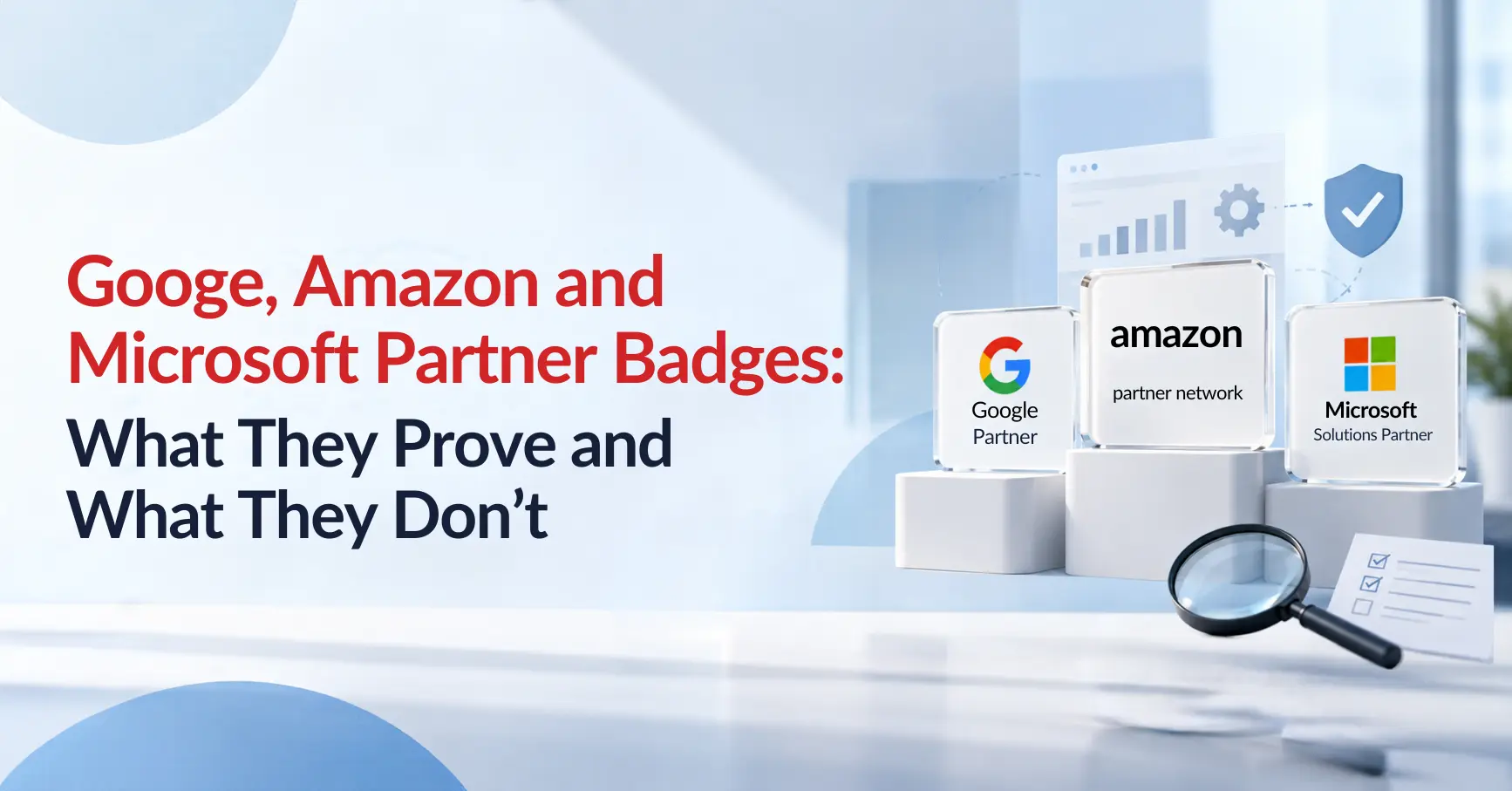
A certified digital marketing agency usually holds partner status with platforms like Google, Amazon or Microsoft. Those badges prove an agency meets each platform’s rules on spend, certifications and account setup. They don’t prove the agency will be good for your business, so treat them as a starting filter, not a verdict.
A while back we were helping a client shortlist agencies, and one of them had six partner badges lined up across the footer of its website. Very impressive. Very shiny.
One of those badges was a Google Partner logo in a design Google had retired years earlier. Another linked to a directory profile that no longer existed.
The agency wasn’t a scam, as it turned out. They’d just stopped updating the footer. But it made the point nicely. Badges look like proof, and most people treat them that way without ever clicking through to see what’s behind them.
So here’s what the big three partner programs require, what each badge tells you, and the rather long list of things they don’t. Anyone hunting for the best digital marketing agency ends up staring at these logos sooner or later, so it helps to know how to read them.
What Does “Certified Digital Marketing Agency” Mean, Anyway?
Less than you’d hope. There’s no single body that certifies agencies. When an agency calls itself certified, it usually means one of two things.
Either individual people on the team have passed platform exams, like Google Ads or Amazon Ads certifications. Or the agency as a company has earned partner status with a platform, which is a different and generally stricter bar.
Both are real. Neither is a licence, and there’s no regulator checking the claim on the website. That part is on you.
What Does a Google Partner Badge Prove?
Google’s program is the best known, and its rules are fairly public. To earn the Partner badge, an agency has to meet requirements in three areas, performance, spend and certifications, and Google checks them every day.
In plain terms, that means an optimization score of at least 70 percent, $10,000 in combined spend across managed accounts over 90 days, and certifications for at least half of the agency’s account strategists. Premier Partner goes to the top 3 percent of Partners in each country, decided once a year.
So the badge proves the agency is active on Google Ads, handles real money and has certified people on staff. Useful.
Now the wrinkle. That optimization score is about how an agency handles Google’s recommendations, and dismissing a recommendation counts just as much as applying it. Which is fine, since plenty of Google’s suggestions deserve ignoring. But it means the score reflects housekeeping more than results. And $10,000 over 90 days is a very low bar for a US agency. It tells you they’re not tiny. It doesn’t tell you they’re good.
What Does an Amazon Ads Badge Tell You?
Amazon has two tiers of status, Verified and Advanced. Verified mainly confirms an agency has completed Amazon’s setup requirements, like registering, linking advertisers, creating a directory listing and keeping its account in good standing. It isn’t a measure of campaign performance.
Advanced asks for more, including product adoption, certifications and managed investment thresholds. That’s the one with some weight behind it.
Two things trip people up. Status and certifications are separate, so an Advanced partner might have deep Sponsored Ads skills and very little DSP experience. And individual certifications expire two years after they’re earned, so a strong team in 2024 isn’t automatically a certified team today.
A badge tells you an agency passed the platform’s test. It says nothing about whether they’ll pass yours. Those are two different exams, and only one of them is about your business.
— Vishal Singh, Performance Marketing Specialist
And Microsoft Advertising?
Microsoft uses three tiers, Partner, Select and Elite, and they’re based largely on how much an agency invests in Microsoft Advertising, along with other requirements. Select and Elite partners can only enroll during an annual window from January to March.
In practice, an Elite badge mostly tells you the agency spends a lot on Microsoft. That often comes with dedicated support from Microsoft’s side, which can help your account. It signals scale and access more than skill.
What Don’t Any of These Badges Prove?
Quite a lot, as it happens.
They don’t tell you who’ll run your account. The certified strategist on the sales call and the junior buyer doing the daily work can be very different people.
They don’t tell you whether the agency understands your industry. Running Google Ads for a dentist in Ohio and for a software company selling six-figure contracts are completely different jobs.
They say nothing about measurement, creative, landing pages or strategy, which is where most campaigns are won or lost. And spend thresholds reward size. A big agency with average results can hold every badge going, while a sharp twelve-person shop might skip Microsoft’s program entirely because its clients don’t advertise there.
None of this makes badges meaningless. It makes them the first filter, not the last. The top digital marketing agency for a given business is often not the one with the most logos.
How Do You Check a Badge is Real?
Don’t trust the logo on the website. Go to the source.
Google has a public Partners directory, and Amazon has its own Partner Directory, where the badge shown is the authoritative one. Search the agency by name, check the tier, and make sure the listing matches the company you’re talking to.
Then ask for specifics. Which certifications do your account managers hold, and when did they last renew them? Who on the team will work on our account? Can we see a case study from a business like ours? Agencies that are proud of their credentials tend to answer these quickly.
So Should Badges Matter When You Choose an Agency?
Yes, a bit. A badge rules out agencies that don’t meet a platform’s basic bar, which helps when you’re starting with a list of twenty.
After that, stop looking at logos and start looking at thinking. How does the agency talk about your goals? Do they ask good questions? Do they push back on anything?
If you’d like that kind of conversation about your own business, badges and all, talk to the team behind our digital marketing agency services.
Frequently Asked Questions
Q1. What is a certified digital marketing agency?
Ans. Usually one whose team holds platform certifications, like Google Ads or Amazon Ads, or that has earned company-level partner status with Google, Amazon or Microsoft. There’s no single official body that certifies agencies.
Q2. Does Google Premier Partner mean an agency is better?
Ans. It means they’re in the top 3 percent of Google Partners in their country, based on spend, performance and certifications. Good sign of scale and activity, but no guarantee of results for your business.
Q3. How can I verify an agency's partner badge?
Ans. Look the agency up in the platform’s own directory, like Google Partners or the Amazon Ads Partner Directory. Don’t rely on the logo on their website.
Q4. Do agency certifications expire?
Ans. Individual ones do. Amazon Ads certifications last two years, and Google Ads certifications need renewing too. Partner status can also be lost if an agency stops meeting the requirements.
About the Author
Vishal Singh, Performance Marketing Specialist, has clicked through more agency badges than most people ever will, mostly to see where they lead. See how the team approaches digital marketing.