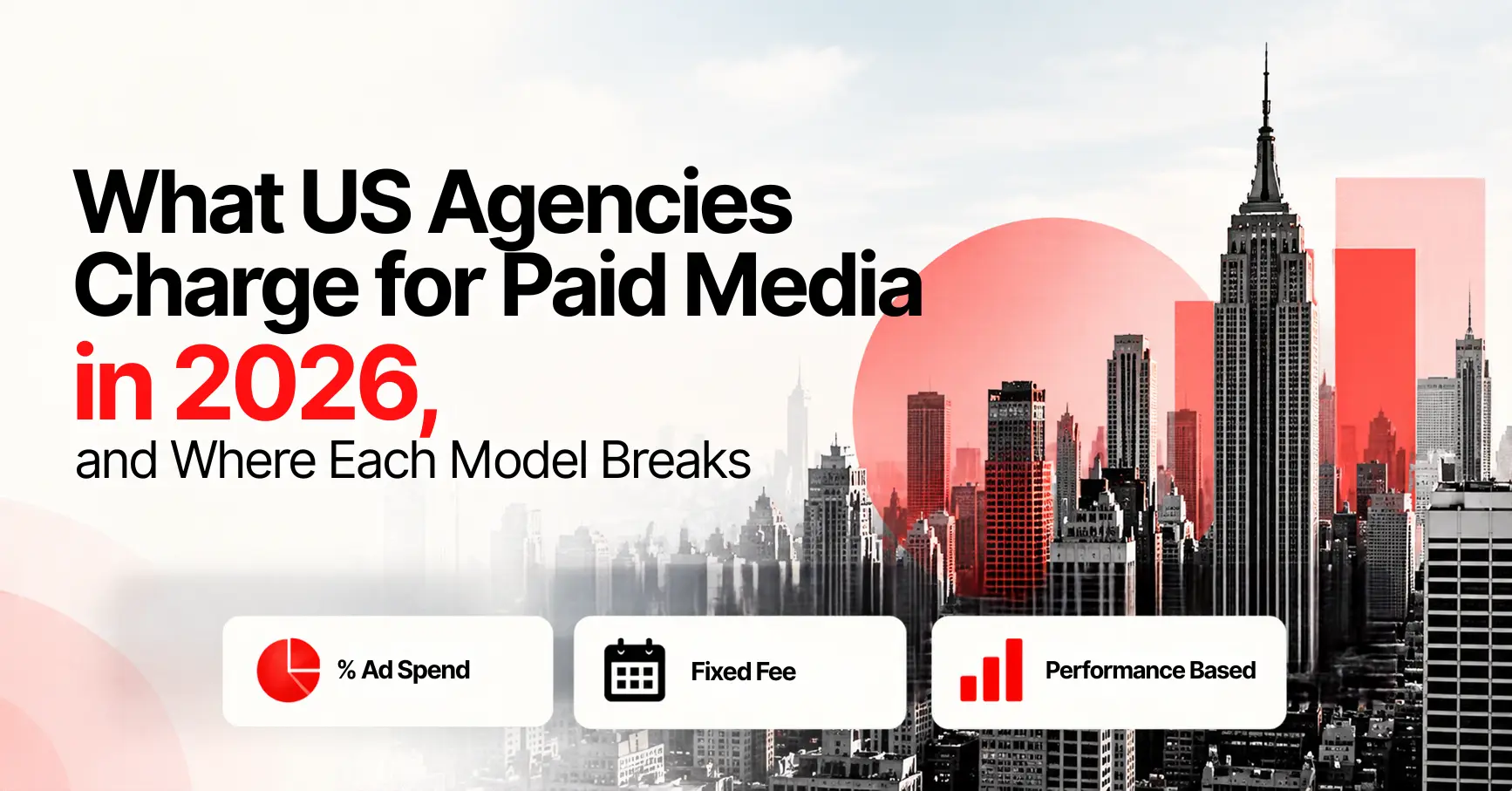
US agencies mostly bill paid media one of four ways. A cut of ad spend, usually 10 to 20 percent, a flat monthly retainer, an hourly rate, or a performance deal. No digital marketing agency pricing model is the “right” one. Each fails in its own particular way, and it pays to know how.
November, a couple of years back. A client forwards us their agency invoice with no message, just a question mark in the subject line.
The fee had doubled.
No new channels. No fresh strategy deck. They’d bumped up their Black Friday budget, and because the agency billed a percentage of spend, the fee climbed right alongside it. The work that month looked a lot like October’s. The invoice looked nothing like it.
Nothing shady happened there. That’s just how the model behaves when a budget moves, and budgets move all the time. People tend to forget that part when they’re comparing quotes.
So think of this as a field guide more than a price list. It covers what US agencies charge for paid media in 2026, and the exact point where each pricing model starts to wobble. If you’re weighing up digital marketing services right now, or quietly suspect you’ve been overpaying for a while, it should help.
So How Much Do Digital Marketing Agencies Charge in 2026?
Ballpark figures first, from current US benchmarks.
A percentage of ad spend usually sits somewhere between 10 and 20 percent, and tends to come down as budgets grow. Flat retainers for paid media run roughly $2,500 to $15,000 a month, with single-channel work at the cheap end. Clutch’s July 2026 guide puts hourly rates at $100 to $149 and retainers mostly between $2,500 and $12,000, with a median around $3,000. Below $10,000 a month in spend, flat fees are the more common arrangement.
Wide ranges, yes. A two-person shop tending one Google Ads account and a firm juggling Google, Meta, LinkedIn and TikTok for a national retailer aren’t really in the same business. Use the numbers to spot a quote that’s wildly off, not to haggle someone down to the bottom of the range.
When Does Percentage of Ad Spend Stop Making Sense?
Percentage billing has been around since the Mad Men days, and it’s still everywhere in paid media. The maths is easy too. $30,000 in spend at 15 percent means $4,500 in fees.
It gets awkward at both ends of the scale.
Small budget? The agency is barely breaking even. Fifteen percent of $4,000 is $600 a month, and $600 doesn’t buy you a senior strategist. It buys you whoever joined most recently, or a minimum fee buried on page six of the contract.
With a big budget, it flips. Running $200,000 a month takes more effort than running $20,000, but nowhere near ten times more. Then there’s the incentive problem nobody mentions in a pitch meeting. If the agency earns more when you spend more, asking them to switch off a campaign that’s burning money means asking them to take a pay cut. Plenty of agencies will do it without blinking. It’s still a strange arrangement once you stop and look at it.
Tiered rates that drop as spend climbs, or a hard cap on the fee, take most of the sting out. An agency that won’t discuss either is telling you something.
Is a Flat Retainer the Safer Bet?
Mostly, yes. You get the same bill every month, and the agency’s income has nothing to do with how much of your money goes out the door.
What kills retainers is scope creep. The fee gets priced against a workload someone guessed at during onboarding, and that guess ages badly. You launch a product. You expand into Texas. Somebody decides the ads need new creative every fortnight. By July, the retainer that felt roomy in March is stretched thin, and one of two things happens. The agency quietly starts doing less, or a change order lands in your inbox.
Then there’s seasonality. A flat fee can feel steep in slow months and like a steal at peak. A garden centre and a tax prep firm will feel very differently about the same retainer in January.
So write the scope down properly. It’s boring advice, but it saves a lot of arguments later.
Every pricing model is fair on the day you sign it. The real question is what happens to it when your budget doubles, your priorities shift or a campaign stops working. That’s the conversation to have before the contract, not after.
— Vishal Singh, Performance Marketing Specialist
What About Paying by the Hour?
It’s fine for audits, a one-off project or a few weeks of consulting. For ongoing campaign management, it goes sideways.
Running paid media means hundreds of tiny tweaks. A bid here, a budget there, pausing an ad set, checking again on Thursday. Bill each of those by the hour and clients start watching the timesheet instead of the results. Worse, it rewards slowness. The buyer who’s seen the problem fifty times and fixes it in twenty minutes bills less than the one who spends an afternoon figuring it out.
Save hourly billing for work with a clear start and finish.
Can Performance-based Pricing Actually Work?
On paper, it’s lovely. The agency gets paid when you make money. Some ecommerce deals set it up as a revenue share of around 3 to 10 percent of attributed sales.
Attributed. That’s the word that ruins it.
Which sales did the agency cause? Ask Meta, Google Analytics and your CRM and you’ll get three different answers, sometimes miles apart, so every invoice turns into a small courtroom drama. There’s a quieter problem too. Performance deals pull agencies toward the fastest conversions, which usually means retargeting people who’d already made up their minds. Prospecting, the work that fills next quarter’s pipeline, slowly gets starved.
We’ve seen it work, but only with solid tracking, one agreed source of truth in writing, and a base fee underneath so a slow month isn’t a crisis for anyone.
Which Digital Marketing Agency Pricing Model Should You Pick?
Increasingly, a bit of everything. Hybrid deals are common now, something like a $3,000 monthly base plus 10 percent of ad spend. The base pays for strategy and account management, the percentage flexes with workload, and occasionally there’s a performance bonus on top.
As a rough rule of thumb, smaller or steady budgets suit flat retainers. Bigger, growing budgets suit tiered percentages or hybrids. Performance deals suit companies whose tracking would survive a grilling from their CFO.
Don’t skip the contract terms, either. The 2026 norm is a 90-day initial commitment followed by 30-day cancellation, and twelve months with no performance clauses is a red flag. In our experience, the best digital marketing services rarely need to lock anyone in for a year. The results tend to handle that.
What Should You Ask Before Signing?
Four questions cover most of it.
What happens to our fee if spend doubles, or halves? What’s included, and what gets billed as extra? Who’s touching the account day to day, since it’s often not the person who pitched? And how do we walk away if it’s not working?
If you get clear answers and nobody squirms, you’re probably in good hands. And if you’d like to talk it through for your own budget, our Digital Marketing Services team is happy to walk you through how we price paid media and why.
Frequently Asked Questions
Q1. How much do digital marketing agencies charge?
Ans. For paid media in the US, expect somewhere between 10 and 20 percent of ad spend, or a flat retainer of roughly $2,500 to $15,000 a month. Hourly work tends to land around $100 to $150.
Q2. What is the most common digital marketing agency pricing model?
Ans. Percentage of ad spend is still everywhere in paid media. That said, flat retainers and hybrid setups, a base fee plus a percentage, have been catching up fast.
Q3. Is percentage of ad spend a fair way to pay an agency?
Ans. It can be. Just make sure the rate drops as your spend grows, or that there’s a cap, so the fee doesn’t balloon when your budget does.
Q4. How long should an agency contract be?
Ans. Most start with 90 days and switch to 30-day cancellation after that. If someone wants twelve months with no performance clauses, ask why.
About the Author
Vishal Singh, Performance Marketing Specialist, has read enough agency contracts to know the pricing model usually says more than the price. See how the team approaches digital marketing.