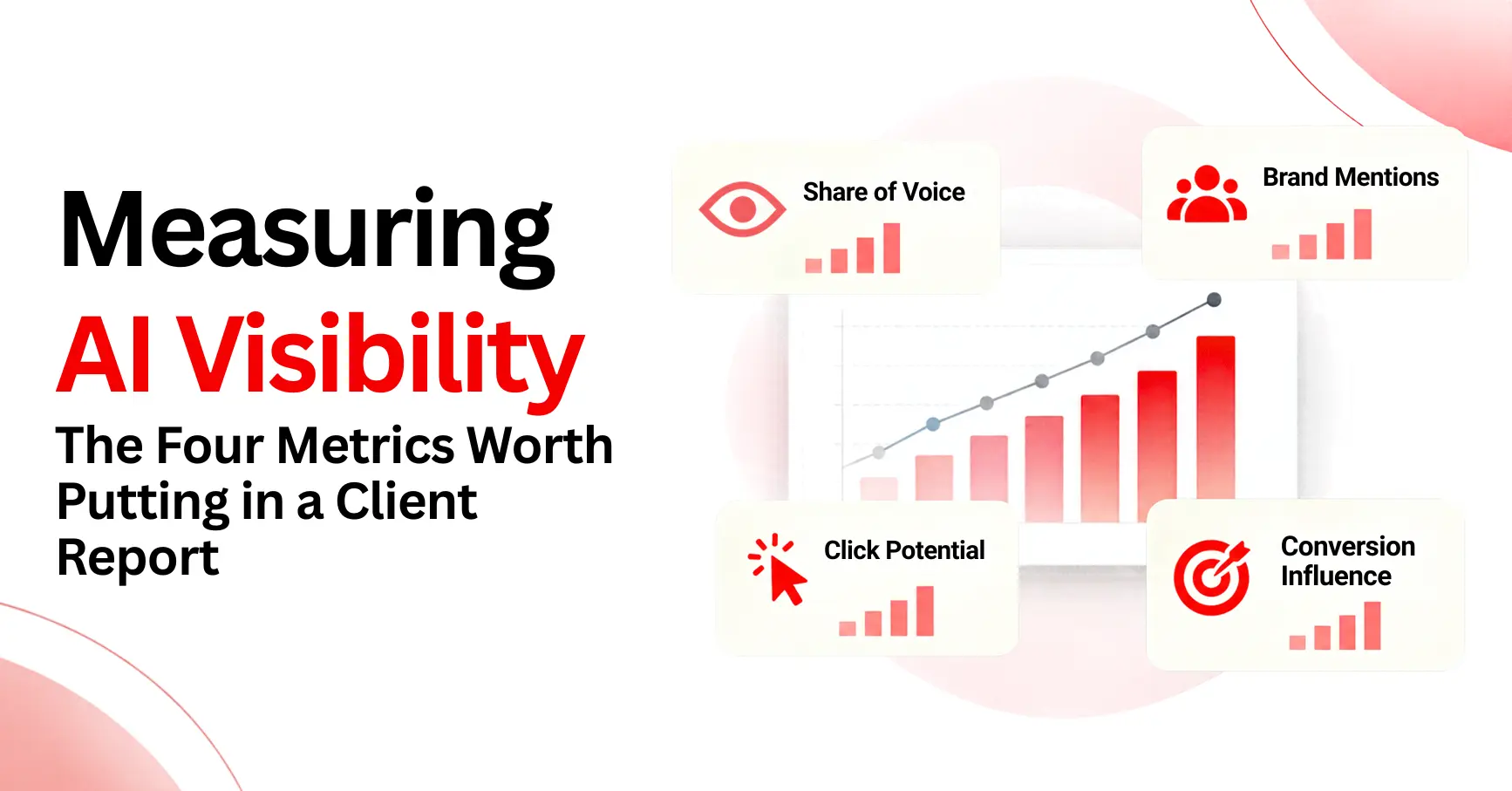
Four AI visibility metrics are worth a place in a client report. How often the brand shows up in AI answers, how much of that conversation it owns compared to competitors, whether its pages get cited, and whether the AI describes it correctly. Most of what else gets reported is noise.
Confession time. The first AI visibility report we ever sent a client was a mess.
It had eleven metrics on it. Eleven. There was a “visibility index,” a “prompt coverage score,” and a very colourful bar chart nobody had asked for. The client scrolled through it on a call, stopped at the top number, which had gone from 34 to 41, and asked the only question that mattered. “Okay, but is that good?”
We didn’t have a great answer.
That call changed how we report. These days we stick to four AI visibility metrics, and each one has to answer something a client would actually ask out loud. If you’re putting together reporting for search engine optimization services that now covers AI search, this is the version that survived.
Why Don’t Regular SEO Metrics Tell You Much About AI Visibility?
They were built for a different kind of search, basically.
Rankings and clicks assume a person looked at a list of links and chose one. AI answers don’t really work like that. You get a paragraph, a few brand names dropped into it, maybe a source link at the bottom, and a lot of people read it, nod, and close the tab without clicking anything.
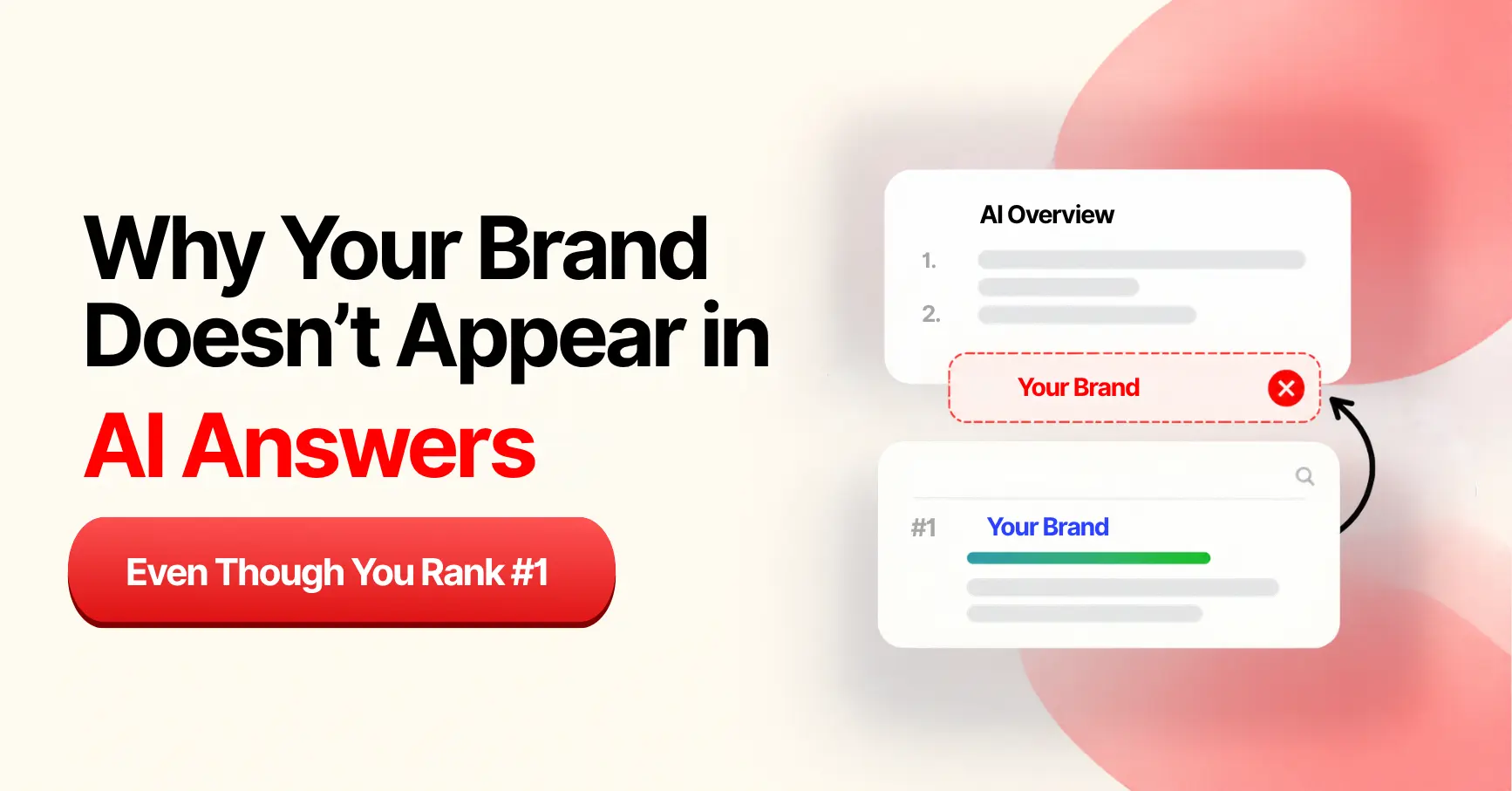
So a client can hold position one, see steady traffic, and still be completely missing from the answers their buyers are reading. The dashboard won’t flag it. It isn’t looking.
How Often Does the Brand Actually Show Up?
Start with mention rate. Of all the prompts you track, what percentage of answers include the brand at all?
If you’re tracking 40 prompts and the brand turns up in 14, that’s 35 percent. Nothing clever. That’s partly why clients like it.
A couple of caveats, learned the annoying way. Don’t fill the prompt list with huge category questions the brand was never going to win, or the number just makes everyone sad. And run each prompt a few times before you record anything. We once asked ChatGPT the same question three times in one afternoon and got three different sets of brands back. One run is a guess. Three runs and an average gives you something you can defend.
Are You Winning the Conversation or Just Showing Up to It?
Mention rate says you were in the answer. It doesn’t say who else was, or how often.
That’s what share of voice is for. Count every brand mentioned across the whole prompt set, competitors included, and work out the client’s slice. Competitors named 120 times, client named 30? The client has 20 percent of the conversation.
Of the four, this is the one that gets reactions. Clients tend to be fairly calm about their own numbers. Show them that one specific competitor appears in 70 percent of answers and the mood in the meeting shifts fast. People start asking what that competitor is doing differently, which is exactly the question you want them asking.
Answering it properly is where the best search engine optimization services prove their worth. Counting mentions is easy. Working out why a competitor keeps getting picked, and what to do about it, is the actual job.
Is the AI Sending People to Your Pages?
Mentions are nice. Citations are where it gets useful.
Citation rate tracks how often the client’s own pages are linked as sources in AI answers. Perplexity lists sources right there on the page, Google’s AI Overviews link out, and ChatGPT adds links when it searches the web. Note which URLs come up and how often.
You get two practical things out of this. You find out which pieces of content are quietly carrying the brand, which makes planning the next quarter a lot easier. And since cited pages can actually send visitors, you finally have a bridge between AI visibility and traffic, something clients already understand.
Keep an eye out for one pattern in particular. Lots of mentions, very few citations. That usually means the AI is getting its information about the brand from somewhere else, like review sites or directories. Not a crisis. But the client isn’t the one telling their own story, and that’s worth fixing.
Nobody hires an agency to be visible to an algorithm. They hire you because they want the right buyer to hear their name at the right moment. If a metric can’t tell them whether that’s happening, it doesn’t belong in the report.
— Vishal Singh, Performance Marketing Specialist
What is the AI Actually Saying About the Brand?
If a report only had room for one more thing, this is what we’d add. It’s also the one most reports leave out.
Mentions don’t mean much if the AI gets the details wrong. Calling a mid-range brand premium. Listing a service that was dropped two years ago. Putting the Abu Dhabi office in Sharjah. It happens all the time.
So whenever the brand appears, read the actual sentence. Is it accurate? Is the tone positive, neutral, or a bit off? A plain tally is enough. Say 14 mentions, 11 spot on, 2 neutral, 1 with the wrong pricing. That one wrong answer is now a task, usually tracking down an outdated page on the client’s site or a third-party listing the AI keeps reading.
We once spent the better part of a week wondering why a client kept being described with an old service line. It turned out to be a single directory profile nobody had touched since 2022.
How Do You Measure AI Visibility in a Way Clients Will Actually Read?
One page. That’s the rule we stick to now.
The four numbers go at the top, with last month’s beside them so the direction is obvious. Mention rate, share of voice, citation rate, and a short line on accuracy and tone. Below that, a few sentences in plain English about what moved, why we think it moved, and what we’re doing next month.
To keep the numbers comparable, leave the prompt set alone for at least a quarter and test on the same AI tools every time. If a platform rolls out a big change, write that down too. Sometimes the numbers swing and it has nothing to do with the client’s work, and you’ll want that context when someone asks.
AI referral traffic from GA4 can sit underneath as a supporting number if the client wants a link to revenue. Visits from ChatGPT or Perplexity are usually modest right now, but worth watching. We just wouldn’t open the report with them, since they only capture the people who clicked.
If building and running all this sounds like a lot to take on internally, our search engine optimization services handle the whole thing, from prompt set to monthly report.
Frequently Asked Questions
Q1. What are AI visibility metrics?
Ans. They’re the numbers that show how a brand performs inside AI-generated answers. The main ones are how often it’s mentioned, its share of mentions against competitors, how often its pages get cited, and whether it’s described accurately.
Q2. How do you measure AI visibility?
Ans. Pick a fixed list of realistic prompts, run each one a few times in tools like ChatGPT, Gemini and Perplexity, and log who gets mentioned, which pages get cited, and what the answers actually say about the brand.
Q3. How often should AI visibility be reported to clients?
Ans. Once a month suits most clients. You can run checks weekly behind the scenes, but monthly reporting evens out the day-to-day swings in AI answers.
About the Author
Vishal Singh, Performance Marketing Specialist, would rather send a client four numbers they understand than eleven they don’t. See how the team approaches search engine optimization.